


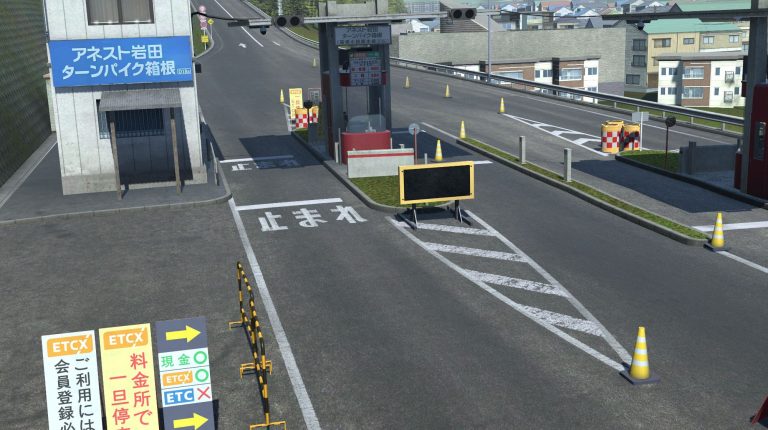
Simulation software specialist rFpro has launched an engineering-grade digital twin of Japan’s Hakone Turnpike. The 15km toll road, which climbs through the forested mountains of Kanagawa Prefecture, is widely used by Japanese vehicle manufacturers for vehicle dynamics development. The model is commercially available and has already been adopted by a major Japanese OEM.
“Vehicle manufacturers are being asked to bring new models to market faster, at lower cost and with more variants than ever, and the only way to do that is to move more of their development work into simulation,” said Catherine Wood, head of content at rFpro. “That only works if the digital environments, which engineers are relying on, are highly accurate and correlate to real development decisions. The Hakone model is proving popular with our customers as it’s a route their test drivers already know intimately.”
A route built at scale
The digital twin has been created using survey-grade lidar scan data to create a vehicle dynamics-grade road surface that is accurate to within 1mm in height across the entire 15km route. Every curb, drain, paint marking and barrier has been placed accurately to match its real-world counterpart. Where relevant, the paint markings are worn and cracked to increase realism and immersion for the driver.
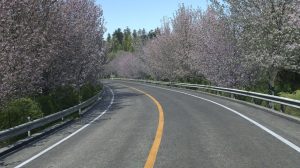
Building a route of this nature and scale requires a careful balance of visual detail. A driver-in-the-loop (DIL) simulator has to run in real time, so rFpro’s content team created engineering-grade fidelity where the driver and the vehicle model need it most. Detailed modeling extends approximately 25m either side of the road, where accuracy is critical for vehicle dynamics and where the driver’s eye is primarily focused. Beyond that, the surrounding landscape, which includes the distant hills and Mount Fuji, is represented by an optimized 3D model of the terrain, incorporating satellite imagery. This helps to balance run-time performance and driver immersion.
The Hakone Turnpike model includes 57,000 trees, 13km of Armco barriers, 460 drains and more than 45km of painted road markings. The tollgate and plazas at the entrance are fully modeled. The route also features 12m-high retaining walls that were particularly challenging to replicate. They sit directly in the driver’s field of view and any obvious repetition in their brickwork texture would be immediately noticeable, so the team used rFpro’s advanced material shaders and techniques to produce long, unique sections that look highly realistic even at close range.
Expanding Japanese portfolio
Hakone Turnpike joins rFpro’s growing library of Japanese content, which includes public road models of Tokyo’s C1 urban expressway, the Tomei expressway and numerous race and testing circuits, such as Suzuka, Fuji, Okayama, Motegi, Sugo and Autopolis.
rFpro has also completed high-fidelity lidar scans of public roads in Odawara, Yokkaichi and Kyoto, and is working with customers to develop these into future additions to its public road library.
“Hakone is one of the most demanding builds we have taken on,” added Wood. “The scale, the vegetation, the walls and the sheer quantity of surface detail all had to be handled without compromising simulator performance. The result is a route our customers can use with confidence for vehicle dynamics, and is incredibly immersive for drivers who already know it well.”
In related news, rapid adoption of automotive ethernet raises standardization and cost concerns