


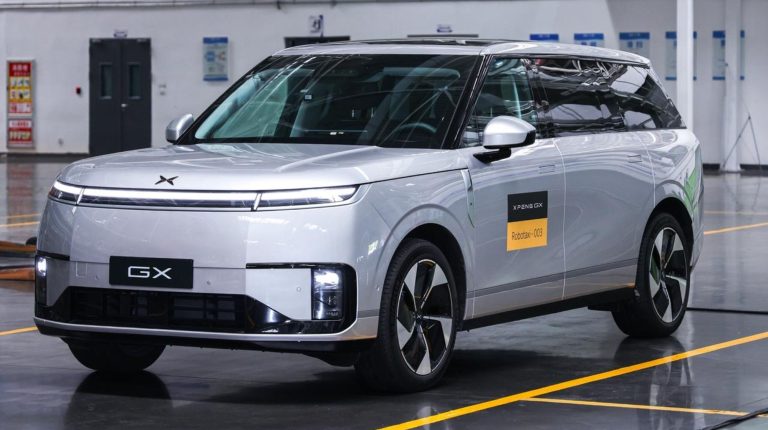
Xpeng has announced that its first mass-produced robotaxi has rolled off the production line in Guangzhou, China.
The robotaxi, built on the Xpeng GX platform, is China’s first production-ready, pre-assembled robotaxi model developed entirely with in-house technologies and engineered to L4 autonomous driving standards. Powered by four self-developed Turing AI chips, it reportedly delivers an industry-leading, effective onboard computing power of 3,000 TOPS.
In January 2026, Xpeng secured a road-testing permit for intelligent connected vehicles in Guangzhou, formally entering routine L4 public road testing. In March, the company established its robotaxi business unit to oversee product definition, R&D testing and operations.
Xpeng’s robotaxi operates without lidar or high-definition maps; instead, it adopts a pure vision solution, with decision-making driven by the VLA 2.0 end-to-end large model. The model eliminates the language-translation step inherent in traditional vision-language-action three-stage architectures, compressing system response latency to under 80ms. It also offers enhanced urban generalization capabilities, supporting cross-city and even cross-border deployment.
Designed to deliver a premium, safe, luxurious and intelligent travel experience, the mass-produced robotaxi is equipped with practical intelligent cabin configurations including privacy glass, comfort gravity seats and rear in-car entertainment screens. Passengers can enjoy multimedia entertainment and adjust in-car settings via built-in voice assistant during rides.
Xpeng plans to initiate pilot robotaxi operations in the second half of this year to validate technical viability, user acceptance and the complete business model. The company aims to achieve fully autonomous operations without an on-site safety officer by early 2027. On the ecosystem front, Xpeng will open its robotaxi SDK, with Amap becoming its first global ecosystem partner.