


Close Menu
ADAS & Autonomous Vehicle International
  • News
    • A-L
      • ADAS
      • AI & Sensor Fusion
      • Business
      • Connectivity
      • Cybersecurity
      • Expo
      • HMI
      • Last-mile delivery
      • Legislation & Standards
      • Localization/GNSS
    • M-Z
      • Mapping
      • Off-Highway
      • Robo-Taxis
      • Sensors
      • Shared Mobility
      • Safety
      • Simulation
      • Testing
      • Trucks
      • V2X
  • Features
  • Online Magazines
    • April 2026
    • January 2026
    • September 2025
    • April 2025
    • January 2025
    • September 2024
    • April 2024
    • January 2024
    • Subscribe
  • Opinion
  • Videos
  • Supplier Spotlight
  • Events
LinkedIn Facebook X (Twitter)
  • Automotive Interiors
  • Automotive Testing
  • Automotive Powertrain
  • Professional Motorsport
  • Tire Technology
  • Media Pack
LinkedIn Facebook
Subscribe
ADAS & Autonomous Vehicle International
  • News
      • ADAS
      • AI & Sensor Fusion
      • Business
      • Connectivity
      • Cybersecurity
      • Expo
      • HMI
      • Last-mile delivery
      • Legislation & Standards
      • Localization/GNSS
      • Mapping
      • Off-Highway
      • Robo-Taxis
      • Sensors
      • Shared Mobility
      • Safety
      • Simulation
      • Testing
      • Trucks
      • V2X
  • Features
  • Online Magazines
    1. April 2026
    2. January 2026
    3. September 2025
    4. April 2025
    5. January 2025
    6. September 2024
    7. April 2024
    8. January 2024
    9. Subscribe
    Featured
    April 28, 2026

    In this Issue – April 2026

    Online Magazines By Web Team
    Recent

    In this Issue – April 2026

    April 28, 2026

    In this Issue – January 2026

    November 27, 2025

    In this Issue – September 2025

    July 21, 2025
  • Opinion
  • Videos
  • Supplier Spotlight
  • Expo
  • Awards
    • About
    • 2026 winners
    • 2025 winners
    • Judges
  • Webinars
LinkedIn Facebook
Subscribe
ADAS & Autonomous Vehicle International
HMI

Small language models power offline vehicle intelligence in Microsoft-FEV collaboration

Zahra AwanBy Zahra AwanJuly 15, 20263 Mins Read
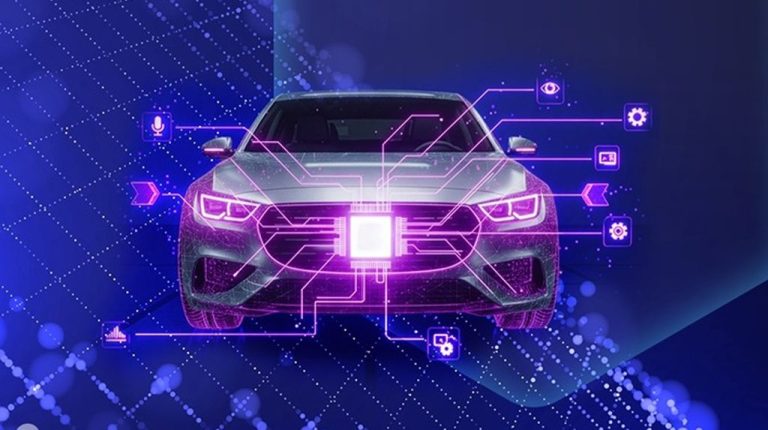
Small language models power offline vehicle intelligence in Microsoft-FEV collaboration.
Share
LinkedIn Twitter Facebook Email

FEV is collaborating with Microsoft to integrate in-vehicle generative AI capabilities built on Nvidia GPU-accelerated compute and AI model microservices. The cooperation aims to enable multimodal voice, text and gesture interactions directly in the vehicle – independent of a permanent internet connection.

The focus is on the use of small language models (SLM) such as Microsoft’s Phi-4-mini-instruct in Microsoft Foundry, which is powered by Nvidia Drive AGX accelerated compute. The solution allows vehicle functions such as the dashboard or individual vehicle profiles to be configured by voice command. At the same time, the system acts as robust local backup intelligence for cloud-based large language models (LLMs).

More intelligence, robustness and efficiency

Auto makers are increasingly deploying small language models (SLMs) directly on vehicle hardware rather than relying solely on cloud-based processing. Because inference happens locally, core functions can remain available with limited or no internet connectivity. This approach can also reduce reliance on cloud infrastructure and backend costs, since embedded SLMs can supplement or, in some cases, replace cloud-based large language models depending on the specific use case, potentially making it more cost-effective for auto makers to scale software-defined vehicle features.

“Our collaboration with Microsoft and Nvidia showcases how small, efficient language models can transform in-vehicle experiences, delivering powerful functionality without the overhead of larger systems,” said Thomas Hülshorst, group vice president of intelligent mobility and software at FEV.

“By combining advanced AI frameworks with domain- and task-specific optimizations, FEV and Microsoft are shaping the future of intelligent, voice-driven interfaces that meet the high standards of automotive deployment,” added Boris Scholl, vice president of engineering at Microsoft.

Central fields of application for embedded Gen AI

As part of its collaboration with Microsoft and Nvidia, FEV is exploring several application areas it sees as having strong commercial potential. These include automated and autonomous driving (SAE Levels 3-5), where multimodal generative AI models are intended to improve recognition of objects, traffic situations and driving paths, particularly in complex urban environments and edge cases. Another focus is driver and passenger monitoring, where embedded generative AI aims to improve detection of fatigue, distraction or unusual behavior, with local processing intended to serve as a backup to cloud-based systems for safety-relevant functions. A third area is personalized vehicle and HMI configuration, where voice commands would allow vehicle functions and interfaces to be adapted for different driver profiles or use cases without relying on external cloud infrastructure.

Multimodal system architecture on Nvidia platforms

The underlying architecture is designed as a multimodal system and processes speech, text and visual information. To achieve high performance in the constrained environment of an embedded in-vehicle environment, FEV has used synthetically generated data curated with Nvidia NeMo in the fine-tuning process to optimize the Phi-4-mini-instruct model. This is followed by integration and deployment of the resulting model running on Nvidia Drive AGX, enabling further improvement in model performance. The AI functions are operated as modular software services inside the vehicle.

Personalized vehicle and HMI configuration

Building on these technologies, FEV has developed a dashboard configurator showcase that highlights the potential of intelligent in-vehicle interfaces. Using natural voice commands, a locally deployed small language model dynamically updates the dashboard, reducing reliance on continuous cloud connectivity while enabling fast, responsive performance.

The showcase demonstrates strong real-time performance. In the future, FEV plans to gradually supplement or replace cloud-based AI functions via models that run locally in the vehicle.

In related news, hands-free driving and smarter navigation added to Lucid Gravity

Share. Twitter LinkedIn Facebook Email
Previous ArticleRheinmetall and MIRA launch teleoperated shuttle pilot at Düsseldorf Airport

Related Posts

ADAS

Hands-free driving and smarter navigation added to Lucid Gravity

June 9, 20262 Mins Read
Car interiors

Mercedes‑Benz adds steer-by-wire to EQS

April 7, 20262 Mins Read
Connectivity

Harman launches Ready Ride connectivity platform for two-wheelers

March 6, 20262 Mins Read
Latest News

Small language models power offline vehicle intelligence in Microsoft-FEV collaboration

July 15, 2026

Rheinmetall and MIRA launch teleoperated shuttle pilot at Düsseldorf Airport

July 15, 2026

Beamr partners with Intempora to bring ML-safe video data to RTMaps

July 15, 2026
FREE WEEKLY E-NEWSLETTER

Receive breaking stories and features in your inbox each week, for free


Enter your email address:


Our Social Channels
  • Facebook
  • LinkedIn
Getting in Touch
  • Free Weekly E-Newsletters
  • Meet the Editors
  • Contact Us
  • Media Pack
RELATED UKI TOPICS
  • Automotive Interiors
  • Automotive Testing
  • Automotive Powertrain
  • Professional Motorsport
  • Tire Technology
  • Media Pack
© 2026 UKi Media & Events a division of UKIP Media & Events Ltd
  • Terms and Conditions
  • Privacy Policy
  • Cookie Policy
  • Notice & Takedown Policy
  • Site FAQs

Type above and press Enter to search. Press Esc to cancel.

We use cookies on our website to give you the most relevant experience by remembering your preferences and repeat visits. By clicking “Accept”, you consent to the use of ALL the cookies.
Cookie settingsACCEPT
Manage consent

Privacy Overview

This website uses cookies to improve your experience while you navigate through the website. Out of these, the cookies that are categorized as necessary are stored on your browser as they are essential for the working of basic functionalities of the website. We also use third-party cookies that help us analyze and understand how you use this website. These cookies will be stored in your browser only with your consent. You also have the option to opt-out of these cookies. But opting out of some of these cookies may affect your browsing experience.
Necessary
Always Enabled
Necessary cookies are absolutely essential for the website to function properly. These cookies ensure basic functionalities and security features of the website, anonymously.
CookieDurationDescription
cookielawinfo-checbox-analytics11 monthsThis cookie is set by GDPR Cookie Consent plugin. The cookie is used to store the user consent for the cookies in the category "Analytics".
cookielawinfo-checbox-functional11 monthsThe cookie is set by GDPR cookie consent to record the user consent for the cookies in the category "Functional".
cookielawinfo-checbox-others11 monthsThis cookie is set by GDPR Cookie Consent plugin. The cookie is used to store the user consent for the cookies in the category "Other.
cookielawinfo-checkbox-necessary11 monthsThis cookie is set by GDPR Cookie Consent plugin. The cookies is used to store the user consent for the cookies in the category "Necessary".
cookielawinfo-checkbox-performance11 monthsThis cookie is set by GDPR Cookie Consent plugin. The cookie is used to store the user consent for the cookies in the category "Performance".
viewed_cookie_policy11 monthsThe cookie is set by the GDPR Cookie Consent plugin and is used to store whether or not user has consented to the use of cookies. It does not store any personal data.
SAVE & ACCEPT