


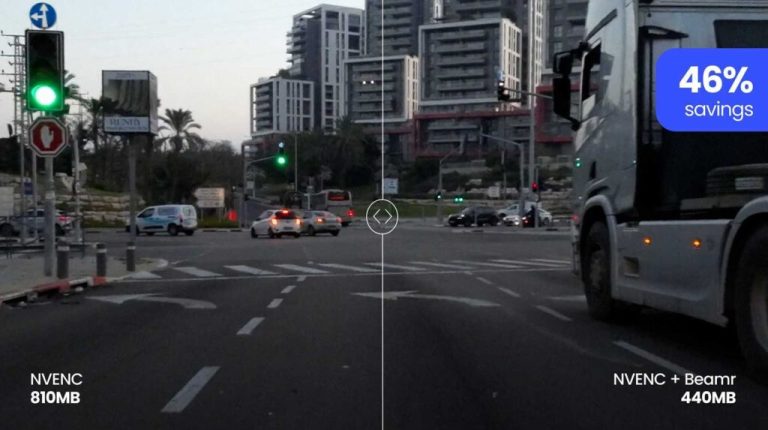
AV programs generate video data in tens to hundreds of petabytes, driving up storage and networking costs and slowing development.
Beamr Imaging and Intempora, a dSPACE company, have announced that Beamr’s ML-safe video data technology is now available on the RTMaps AI Store, ready to use across the AV stack. The collaboration lets AV teams reduce their data volumes while preserving ML accuracy, without changing the stack they already rely on.
Real-Time Multisensor Applications (RTMaps) is a modular development and execution middleware, designed to acquire, synchronize, process, record and replay heterogeneous data streams in real time. Beamr’s ML-safe compression can be deployed at the stages where video data accumulates: at logging, where compression lets constrained storage hold more recorded footage; in the cloud and data center, where it cuts existing petabyte-scale storage and transfer costs; and in simulation and training, where it reduces the real-world and synthetic datasets feeding hardware-in-the-loop (HIL) testing.
At each stage, Beamr’s content-adaptive bitrate technology (CABR) reduces file sizes by up to 50% while the object boundaries, edges and scene detail that perception and detection models rely on are preserved. CABR reduces file sizes beyond standard encoding alone, and runs GPU-accelerated for high-throughput processing.
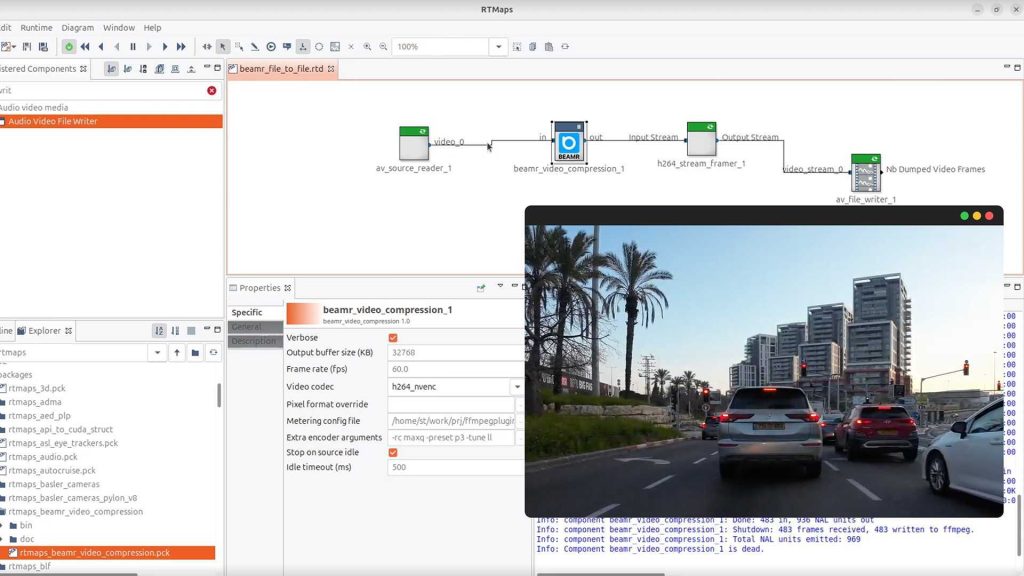
“The RTMaps AI Store gives AV teams ready-to-use software components they can easily drop straight into their development pipelines, and compression is a capability our users have been asking for,” said Nicolas Du Lac, CEO of Intempora. “Beamr is the first compression technology in the store. It lets teams significantly cut the size of their video data without compromising the models that data feeds, inside the framework they already work in.”
“Managing the volume of data AV programs generate is a constant challenge for the teams we work with, and video is the largest part of it,” said Jacob Perrin, ADAS/AD engineering manager, dSPACE. “In our testing, Beamr reduced that video data while preserving the detections perception models depend on – which is what makes it the right fit for the petabyte-scale workflows across our ecosystem.”
“AV programs run many video pipelines, real-world capture, simulation, synthetic data – each feeding different models – and all need to meet their accuracy targets,” said Sharon Carmel, Beamr CEO. “Our content-adaptive compression achieves improved results over existing workflows, so the same technology reduces data volumes through the AV lifecycle. On the RTMaps AI Store, Beamr’s technology fits into existing pipelines without changing how downstream models behave. AV teams want certainty before making changes, and our Beamr Blueprint methodology provides them an end-to-end assessment of their own video workflows.”
In recent news, Yanfeng reveals XiM27 smart cabin concept with reconfigurable layout and AI-adaptive seating