


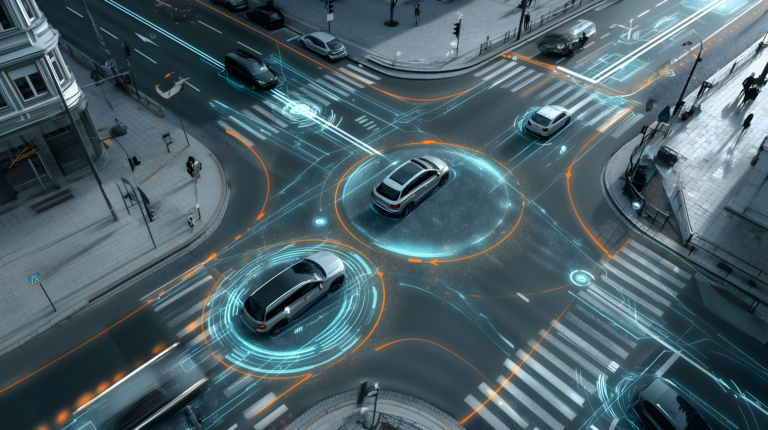
From K.I.T.T. to the Batmobile and Herbie, driverless cars have long captured our imagination, but reality may soon catch up. By spring 2026, automated vehicles (AVs) could be operating on UK roads. However, meeting the rigorous safety standards needed for deployment is a major challenge. Ross Turnbull, director of business development at application-specific integrated circuit (ASIC) manufacturer Swindon Silicon Systems, explains how ASICs can make AVs safe and road-ready
The UK’s AV Act, passed in May 2024, sets out a landmark framework for the introduction of autonomous vehicles to UK roads. The act establishes a clear safety benchmark, requiring all self-driving cars to achieve a level of safety at least equivalent to that of a competent and careful human driver.
However, achieving this standard is no easy feat. Unlike a human driver, who instinctively adapts to unexpected or hazardous situations, AVs rely entirely on onboard systems to interpret their environment and respond to danger while coordinating acceleration, braking and navigation safely alongside other road users.
Electronic senses
In place of a human’s five senses, AVs rely on an ecosystem of electronic sensors to avoid hazards and respond to changing road conditions.

Lidar systems use laser pulses to create a highly precise 3D map of the vehicle’s surroundings. However, they can struggle to operate in heavy rain or snow. In contrast, radar sensors excel in poor visibility and can detect objects at a distance, making them important for collision avoidance.
While radar sensors work at a distance, cameras capture detailed visual information, which is crucial for recognizing traffic signs and lane markings. Ultrasonic sensors excel at close-range detection, such as when parking or navigating tight spaces.
To create a dependable perception of the surroundings, AVs fuse these sensor inputs in real time. However, processing these large, varied datasets with minimal delay can overwhelm conventional processors, potentially leading to slower reaction times or reduced accuracy in detecting hazards. This is where ASICs come into play.
Enabling safer systems
Unlike a general-purpose processor, an ASIC is a custom-designed semiconductor chip created to perform a specific task with maximum efficiency and precision.
For AVs, ASICs can be designed to handle the high throughput demands of real-time sensor data. Each chip can be architected to run multiple parallel processing pipelines, analyzing thousands of data points per millisecond. Inputs can then be synchronized and weighted according to reliability, environmental conditions and context, producing a unified, highly accurate model of the vehicle’s surroundings to support instant decision-making.
ASICs also optimize energy efficiency by reducing power draw and limiting heat generation. This is a critical consideration for tightly packaged automotive electronics. Furthermore, an ASIC’s robust design ensures consistent performance across wide temperature ranges, mechanical vibration and electromagnetic interference.
By maintaining reliable operation, ASICs prevent system failures that could compromise sensor accuracy or delay hazard detection, boosting AV safety. Moreover, they help AVs meet real-time operational demands and the rigorous safety benchmarks established under UK law.
The road ahead
While the AV Act provides the legal framework for deployment, the finer requirements, including how compliance with the safety benchmark will be validated in practice, are still being developed. A public consultation, which closed in September 2025, aims to help shape these rules.
For AVs to gain approval and operate safely on UK roads, every part of the sensing and decision-making chain must perform flawlessly. Advanced sensor systems provide essential awareness, while ASICs ensure that the vast flow of data they produce is processed quickly, efficiently and reliably, helping AVs meet safety standards and demonstrate compliance.
With the right integration of sensors and ASICs, driverless vehicles could soon shift from the realms of fiction to everyday reality.
Explore: Transportation in 2026: from experimentation to acceleration