


ADAS & Autonomous Vehicle International
  • News
    • A-L
      • ADAS
      • AI & Sensor Fusion
      • Business
      • Connectivity
      • Cybersecurity
      • Expo
      • HMI
      • Last-mile delivery
      • Legislation & Standards
      • Localization/GNSS
    • M-Z
      • Mapping
      • Off-Highway
      • Robo-Taxis
      • Sensors
      • Shared Mobility
      • Safety
      • Simulation
      • Testing
      • Trucks
      • V2X
  • Features
  • Online Magazines
    • January 2026
    • September 2025
    • April 2025
    • January 2025
    • September 2024
    • April 2024
    • January 2024
    • Subscribe
  • Opinion
  • Videos
  • Supplier Spotlight
  • Events
LinkedIn Facebook Twitter
  • Automotive Interiors
  • Automotive Testing
  • Automotive Powertrain
  • Professional Motorsport
  • Tire Technology
  • Media Pack
LinkedIn Facebook
Subscribe
ADAS & Autonomous Vehicle International
  • News
      • ADAS
      • AI & Sensor Fusion
      • Business
      • Connectivity
      • Cybersecurity
      • Expo
      • HMI
      • Last-mile delivery
      • Legislation & Standards
      • Localization/GNSS
      • Mapping
      • Off-Highway
      • Robo-Taxis
      • Sensors
      • Shared Mobility
      • Safety
      • Simulation
      • Testing
      • Trucks
      • V2X
  • Features
  • Online Magazines
    1. January 2026
    2. September 2025
    3. April 2025
    4. January 2025
    5. September 2024
    6. April 2024
    7. January 2024
    8. Subscribe
    Featured
    November 27, 2025

    In this Issue – January 2026

    Online Magazines By Hazel King
    Recent

    In this Issue – January 2026

    November 27, 2025

    In this Issue – September 2025

    July 21, 2025

    In this Issue – April 2025

    April 15, 2025
  • Opinion
  • Videos
  • Supplier Spotlight
  • Expo
  • Awards
    • About
    • 2025 winners
    • Judges
  • Webinars
LinkedIn Facebook
Subscribe
ADAS & Autonomous Vehicle International
Features

Staged rollouts become safety evidence

Nitish Sanghi, senior software engineer in autonomy perception, CyngnBy Nitish Sanghi, senior software engineer in autonomy perception, CyngnMarch 12, 20265 Mins Read
Nitish Sanghi.
Share
LinkedIn Twitter Facebook Email

Vehicle software used to feel like a finish line: verify, sign off, ship. In modern fleets, that mindset breaks down. Deployment is where risk shows up, even after pre-release validation.

Hardware variants, uneven connectivity, partial installs and real-world edge cases turn rollout strategy into a safety variable. For advanced driver assistance system (ADAS) features, how a release is executed can matter as much as what is released. The point of staged rollout is simple: expansion decisions are based on measurable gates, not optimism.

The direction set by emerging standards

UN Regulation No. 156 requires manufacturers to operate a software update management system (SUMS). ISO 24089 adds guidance for software update engineering and governance. Neither mandates a single rollout pattern, but a staged rollout makes “controlled deployment + corrective action” legible to an auditor.
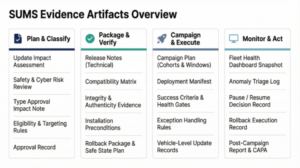
SUMS evidence artifacts overview: core evidence artifacts used to demonstrate controlled software updating across planning, deployment, monitoring and rollback

Why big-bang releases hurt

A big-bang release pushes an update to the whole fleet at once. It saves coordination work up front but maximizes blast radius when uncertainty is highest. When something regresses, the signal gets mixed with vehicle diversity, and the first week becomes a debate about whether the problem is ‘real’ or just noise. In practice, many issues are configuration dependent: uneven connectivity, partial installs, multi-ECU dependencies and hardware or compute variance can turn one defect into a dozen different symptoms. With dense sensor pipelines, small implementation changes can create performance cliffs that only appear on certain configurations, and exposure expands before a clean signal is earned.

One pattern commonly seen in practice is that a change can be ‘functionally correct’ yet quietly erode real-time margin. A perception path that used to have comfortable headroom starts running hot on a subset configuration, then intermittent dropouts or restarts appear that look random at fleet scale. With staged rollout, the canary cohort makes the issue obvious early, while it is still cheap to pause, fix and continue.
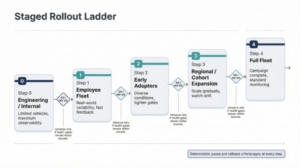
Rollout ladder: progressive exposure through cohorts, expanding only when predefined health gates remain within bounds

Earning the right to scale

Progressive exposure only works if programs can target and trace precisely. That starts with configuration awareness and compatibility constraints across interconnected control units, plus disciplined release identity so programs can answer: who was eligible, who actually installed and what happened afterward. This is where an eligibility manifest and a clean campaign ID stop being ‘process’ and start being survival.

Governance turns technical risk into operational rules: who can start a campaign, what evidence is required and what conditions force a pause, rollback, or escalation. If authority is not defined up front, it gets defined in the middle of an incident.

Health gates turn monitoring into permission. A gate is a defined set of signals, thresholds and observation windows that must stay within bounds before expanding to the next cohort. Gates blend update integrity signals (completion rate, retry rate, recovery success) with vehicle behavior signals (fault rates, feature availability, performance margin). One concrete example is keeping P95 cycle time within budget and restart rate at baseline during the cohort window; otherwise, the campaign pauses.
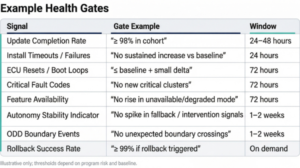
Example health gate KPIs and thresholds: illustrative cohort health gates used to decide whether to expand, pause, or roll back an update campaign.

Two patterns from the field show up again and again. Performance regressions are the quiet killers, because features often fail politely by timing out rather than failing loudly. If teams do not gate on real-time health (latency, headroom, restarts), a software update problem can surface as a safety availability problem. A gate is not just a dashboard; it is a permission slip. When thresholds are pre-agreed, debate shrinks and teams execute the playbook.

Recovery is where auditors push

Staged rollouts can feel slower. It’s extra work, and nobody loves it – until the first time it prevents a fleet-wide fire drill. Not every update needs the full ladder. Teams can reserve the heaviest gating for safety-impacting changes (ADAS behavior, fault handling, real-time scheduling), while low-risk updates use a shorter canary window.

Recovery is where credibility is won or lost. Programs need predictable recovery from failed or interrupted updates, and safe behavior when an update cannot complete. For post-deployment regressions, some issues are best handled by rolling forward with a corrective update, while others warrant reverting to a known-good software set. Triggers and execution paths should be defined in advance, including how recovery works across multiple control units and migrations. A rollback runbook that’s been exercised beats a ‘we can figure it out’ promise every time.

If a program cannot explain, in plain language, how a campaign pauses and safely recovers at scale, it does not have controlled deployment.

Make evidence fall out of operations

Staged rollout can produce audit-ready evidence as a natural by-product of good operations. Before release, record an impact assessment. During rollout, capture go or no-go decisions with supporting metrics for each cohort in a campaign decision log. After rollout, publish a post-campaign report summarizing outcomes, anomalies, corrective actions and the changes that harden future gates.

As vehicles increasingly evolve through software, the safety lifecycle extends past validation and into the field. Programs that treat staged rollout, health gates and recovery design as first-class elements reduce real-world surprises while making decision-making easier to audit. In that environment, staged rollout becomes repeatable safety evidence.

Nitish Sanghi is a senior software engineer in autonomy perception at Cyngn, where he ships safety-critical perception and diagnostics for industrial autonomous vehicles. Previously, he integrated and tested autonomy software for Cruise’s Origin platform and worked on fail-safe autonomy systems at Argo AI. Earlier in his career, he built robotics and automation systems at Intuitive Surgical and Cogenra Solar. He holds an MSc in robotics from the University of Michigan.

Share. Twitter LinkedIn Facebook Email
Previous ArticleAurrigo International signs £6.28m deal to manufacture 25 AGVs for Ultra Global

Related Posts

Features

FEATURE*: Augustin Friedel on how OEMs can succeed in SDV/AV transformation

February 26, 20265 Mins Read
Features

INTERVIEW: Motive’s Nyanya Joof on driver monitoring and safety

February 23, 20266 Mins Read
Features

INTERVIEW: Qualcomm Europe’s Enrico Salvatori on the Snapdragon Ride Pilot AD system

January 26, 202611 Mins Read
Latest News

Staged rollouts become safety evidence

March 12, 2026

Aurrigo International signs £6.28m deal to manufacture 25 AGVs for Ultra Global

March 10, 2026

Qualcomm and Wayve collaborate on pre-integrated ADAS/AD system for auto makers

March 10, 2026
FREE WEEKLY E-NEWSLETTER

Receive breaking stories and features in your inbox each week, for free


Enter your email address:


Our Social Channels
  • Facebook
  • LinkedIn
Getting in Touch
  • Free Weekly E-Newsletters
  • Meet the Editors
  • Contact Us
  • Media Pack
RELATED UKI TOPICS
  • Automotive Interiors
  • Automotive Testing
  • Automotive Powertrain
  • Professional Motorsport
  • Tire Technology
  • Media Pack
© 2025 UKi Media & Events a division of UKIP Media & Events Ltd
  • Terms and Conditions
  • Privacy Policy
  • Cookie Policy
  • Notice & Takedown Policy
  • Site FAQs

Type above and press Enter to search. Press Esc to cancel.

We use cookies on our website to give you the most relevant experience by remembering your preferences and repeat visits. By clicking “Accept”, you consent to the use of ALL the cookies.
Cookie settingsACCEPT
Manage consent

Privacy Overview

This website uses cookies to improve your experience while you navigate through the website. Out of these, the cookies that are categorized as necessary are stored on your browser as they are essential for the working of basic functionalities of the website. We also use third-party cookies that help us analyze and understand how you use this website. These cookies will be stored in your browser only with your consent. You also have the option to opt-out of these cookies. But opting out of some of these cookies may affect your browsing experience.
Necessary
Always Enabled

Necessary cookies are absolutely essential for the website to function properly. These cookies ensure basic functionalities and security features of the website, anonymously.

CookieDurationDescription
cookielawinfo-checbox-analytics11 monthsThis cookie is set by GDPR Cookie Consent plugin. The cookie is used to store the user consent for the cookies in the category "Analytics".
cookielawinfo-checbox-functional11 monthsThe cookie is set by GDPR cookie consent to record the user consent for the cookies in the category "Functional".
cookielawinfo-checbox-others11 monthsThis cookie is set by GDPR Cookie Consent plugin. The cookie is used to store the user consent for the cookies in the category "Other.
cookielawinfo-checkbox-necessary11 monthsThis cookie is set by GDPR Cookie Consent plugin. The cookies is used to store the user consent for the cookies in the category "Necessary".
cookielawinfo-checkbox-performance11 monthsThis cookie is set by GDPR Cookie Consent plugin. The cookie is used to store the user consent for the cookies in the category "Performance".
viewed_cookie_policy11 monthsThe cookie is set by the GDPR Cookie Consent plugin and is used to store whether or not user has consented to the use of cookies. It does not store any personal data.

Functional

Functional cookies help to perform certain functionalities like sharing the content of the website on social media platforms, collect feedbacks, and other third-party features.

Performance

Performance cookies are used to understand and analyze the key performance indexes of the website which helps in delivering a better user experience for the visitors.

Analytics

Analytical cookies are used to understand how visitors interact with the website. These cookies help provide information on metrics the number of visitors, bounce rate, traffic source, etc.

Advertisement

Advertisement cookies are used to provide visitors with relevant ads and marketing campaigns. These cookies track visitors across websites and collect information to provide customized ads.

Others

Other uncategorized cookies are those that are being analyzed and have not been classified into a category as yet.

SAVE & ACCEPT