

Partha Goswami, principal at PG Mobility Analysis, shares his views ahead of Intelligent Vehicle Expo (October 27-29, 2026) in Novi, Michigan, where he will kick off the Intelligent vehicle: SDV and intelligent mobility session with a presentation discussing the foundations of the SDV and how the shift is orchestrating a new paradigm of collaboration and inspiring a new suite of services and ownership experiences. Register for your free pass here
 We have arrived at a new phase of autonomous technology. Robotaxi pilots are proliferating globally. Investors and technology players are looking forward to the possibility of an impending commercial deployment. In North America, Waymo is leading the charge, with a fleet close to 4,000 vehicles across 11 metropolitan areas. Zoox, its closest peer, just received an important approval from the National Highway Traffic Safety Administration (NHTSA) for up to 2,500 robotaxis, with an exemption to operate its unique bi-directional vehicles with no manual control. Several Chinese players (for example, Baidu Apollo Go, WeRide) are running similar pilots in multiple cities in China and other markets.
Road safety and autonomous deployment
Despite the spread of commercial pilots across the globe, the evolution of autonomous development has sometimes been overshadowed by a lack of matching regulation and appropriate metrics of safety.
In 2017, Rand Corporation, a non-partisan policy think-tank, published a report reminding us of the baseline average fatality rate in the US, i.e., 1.09 fatalities per 100,000,000 miles traveled, and that a 10% safety improvement over human drivers could justify earlier deployment, provided the systems continue to improve and are subject to adaptive regulation. Although the 2017 report is widely cited, there have not been any cohesive guidelines yet by NHTSA or anyone to dictate a national safety policy, at least in the US, despite the 2018 fatality caused by an Uber test vehicle and Cruise’s mishandling of internal data after one of its robotaxis dragged a pedestrian in 2023.
New US study – robotaxi crash record
A new study by the Insurance Institute of Highway Safety (IIHS) in the US published a crash assessment of the various robotaxi pilots. Even though the initial raw data set included incidents from multiple operators, Waymo was the only company used for the actual comparison, since it publicly shares mileage data.
The top-line assessment that Waymo’s crash rate was 68% lower than that of human drivers makes a positive case for robotaxis and is hard to argue with. However, there are caveats worth noting. Waymo’s routes are not yet generalizable to all driving conditions or speed ranges. The data from night driving scenarios remains ambiguous. It is important not to draw too many conclusions from this study at this stage, especially when the underlying sample is small, geographically limited and only verifiable for Waymo.
Traffic failures and road behavior – an unexplored area
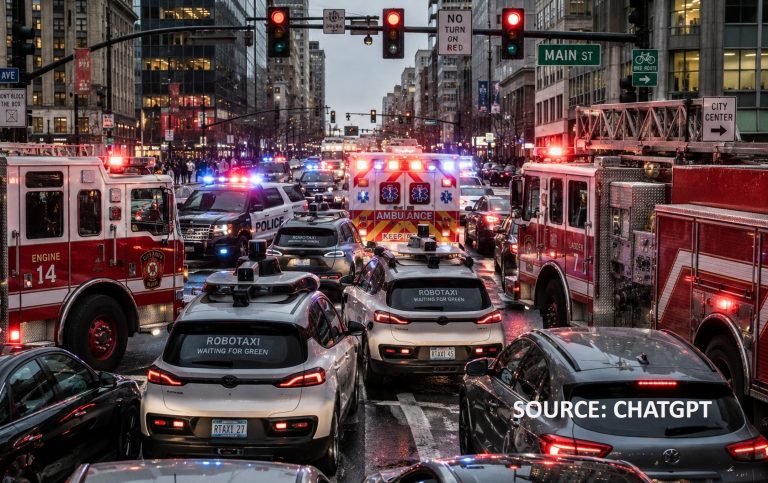
Road crashes are just one factor in a broader road safety landscape. The study focused only on crash events, and critical public safety failures were not considered; for example, where robotaxis frequently ignored incidents involving emergency responders or school buses. A series of recent episodes of robotaxis interfering with first responders and getting into road situations that they had no business getting into is shining a spotlight on a new aspect of robotaxi deployment that goes beyond obstacle sensing, path planning or crashes. As Junko Yoshida, a veteran technology analyst, recently observed, AV safety or road-worthiness may “no longer be about car crashes,”; it is equally about road behavior.
There is a new evidence base that is looking at the growing occurrence and cost to taxpayers of robotaxi misbehavior, false alarms and interference with first responders and street emergencies. There has been a series of incidents logged by the San Francisco Fire Department over the last year. The city of Austin, Texas, has kept a public AV incident database since July 2023, which shows that robotaxis either blocked traffic or ignored the directions of Austin police in 25% of reported incidents from July 2023 to June 2026.
False alarms and civic costs – new factors of robotaxi roadworthiness
These ‘road behavior’ challenges also include a brand-new sub-problem: robotaxis calling 911 about unresponsive passengers, who might be impaired, passed out or who simply fell asleep and did not exit the vehicle. There is a growing civic cost, since the city has to treat each as a potentially expensive cardiac arrest dispatch involving multiple ambulances, a fire truck and sometimes police, only to realize often that these were just cases of passed-out passengers.
Instead of just pondering how safe the robotaxis are, we also need to understand the holistic logistics and resource/liability issue of a large-scale robotaxi deployment at this time in history. The economics of the resource/liability issue may take some lessons from the home alarm system industry and how it passes on the cost of false alarms and law enforcement resources to the consumer.
In other words, we are increasingly understanding that the technology and traditional crash performance are only part of the equation. We must assess and mitigate the behavioral challenges and civic cost of the deployment before society is ready for at-scale deployment. Understanding road emergencies from visual cues, and the ability to stay away from first responders, should be part of the edge cases for robotaxis that typical human-driven taxis or private vehicles deal with daily, beyond the standard navigation, path planning and traffic maneuvering.
Regulatory role – global developments
NHTSA in the US is now attempting to address public safety involving robotaxi behavior in street emergencies with a formal call to action to all operators. It remains to be seen whether similar regulatory bodies elsewhere in the world begin to look into robotaxi behavior in various street emergencies, in addition to monitoring their traditional crash or similar records.
The new UN Global Technical Regulation on Automated Driving Systems (ADS GTR), currently in development in Europe, includes performance requirements for managing road emergencies and safe interaction with first responders.
China has recently drawn up new safety rules, taking effect July 1, 2027, that will require operators to ensure autonomous systems can match the safety of human drivers. We hope the requirements will encompass road behavior aspects as well.
The bottom line
Robotaxi pilots are proliferating globally, and investors are looking forward to the possibility of commercial deployment sooner rather than later. However, societies need to examine and push for a comprehensive regulatory, legal and civic framework to ensure that not only are the autonomous vehicles on the road safer than human operators across the board, but also that they behave appropriately with civic infrastructure without adding to the traffic congestion or costing and straining the limited resources of the first-responder and law-enforcement organizations.
Partha Goswami has over 30 years of experience in the automotive industry at multiple OEMs, working in R&D, planning and technology strategy, most recently at GM as a professional fellow of technology trends and strategy. Currently, Dr Goswami provides consulting and advisory services as principal at PG Mobility Analysis, focusing on emerging trends in CASE (Connectivity, Autonomous, Services, Electrification), software-defined vehicles (SDV) and technology-driven intelligent mobility. He serves as an industry mentor in the I-Corps program at Western Michigan University and as expert in residence (EIR) at the Centrepolis Accelerator. He is also an ambassador of the COVESA consortium.