


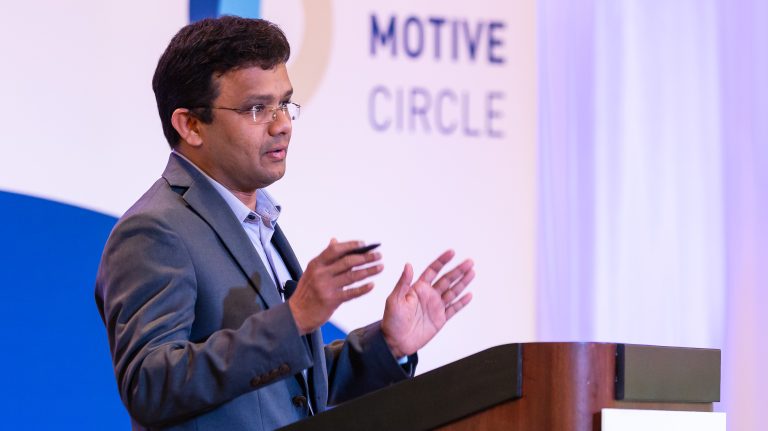
Ahead of his presentation – ‘AI-assisted in-cabin perception to software-defined cockpits’ – at the Automotive Design and In-Cabin Conference in Novi this October (27-29), Abdul Salam, lead ADAS platform system hardware engineer at Ford, speaks to AAVI about the opportunities and challenges surrounding intelligent cockpits
What’s one thing happening in the industry right now that people can’t afford to ignore?
The vehicle cockpit is quickly becoming a connected system rather than a collection of individual features. Driver monitoring, displays, lighting, cameras and other cabin functions increasingly share sensors, computing resources, software and vehicle networks.
From my experience across automotive electronics, ADAS, lighting and safety-critical systems, this integration creates great opportunities, but also new challenges. A problem in one area can affect several functions, so reliability and safety have to be considered at the complete system level.
What’s the biggest misconception in your field?
One misconception is that adding more intelligence or software automatically makes a vehicle system better.
A feature is valuable only when it works reliably under real driving conditions. We have to consider sensors, hardware, software, communication, power and environmental conditions, as well as what happens when something fails.
A good system should not only perform well when everything is working correctly; it should also recognize when something is wrong and respond safely.
What real-world problem is your presentation trying to solve?
The real-world problem is how we make intelligent cockpit systems dependable enough for everyday use.
An in-cabin perception system may depend on cameras, illumination, electronics, software and algorithms working together. If one part becomes degraded, the system needs to detect it and determine whether it can continue operating safely.
My presentation looks at how we detect faults, manage degraded conditions and maintain reliability in real-world vehicle operation.
Why is the shift from AI-assisted in-cabin perception to software-defined cockpit architectures becoming increasingly important for OEMs?
Customers experience the cockpit as one environment, not as separate electronic modules. Driver monitoring, HMI, displays, lighting and other cabin functions are becoming more connected, while more functionality is moving into software and centralized computing platforms.
For OEMs, this creates opportunities to introduce new features and improve vehicles over time. But it also means architecture decisions made today can affect many future functions. We are designing platforms, not simply individual features.
How can engineers balance the adaptability of AI with functional safety’s need for predictability?
I don’t see intelligence and functional safety as competing goals. They have to work together.
Intelligent functions can make complex decisions, but the surrounding system still needs clear boundaries. Engineers need to understand what inputs are valid, how the system monitors its health, what happens when information becomes unreliable and what the safe response should be.
The goal is to use intelligence where it adds value while supporting it with strong monitoring, diagnostics and clearly defined fallback behavior.
What’s one challenge in AI-enabled cockpit development that engineers underestimate today?
I think degradation is often underestimated. Real vehicles operate under changing conditions. Components age, temperatures change, cameras can become obstructed, communication can be interrupted and hardware performance can degrade.
The important question is not only, “Does the system work?” It is also, “Does the system know when it is no longer working as intended?” That becomes increasingly important as vehicles depend more on intelligent sensing.
How is collaboration between software, systems, UX and design disciplines changing?
Developing each area separately is becoming less effective. A design decision can affect sensor performance; a UX decision can affect system requirements; and software depends on the capabilities and limitations of the hardware.
In my experience, the best results come when these teams communicate early rather than trying to solve integration problems near the end of development.
Effective cockpit development requires understanding both the user experience and the engineering behind it.
What should engineers be doing differently today to prepare for the next generation of intelligent vehicle interiors?
Engineers need to think beyond their individual technical areas. Hardware engineers should understand software. Software engineers should understand sensors and hardware limitations. HMI and design teams should understand what happens when a function becomes unavailable or degraded.
My career has taken me through embedded systems, automotive electronics, lighting, ADAS, vehicle architectures and functional safety. One important lesson I have learned is that system-level thinking becomes more valuable as vehicles become more integrated.
What will attendees learn from your session that they won’t get anywhere else?
I want to bring a practical engineering perspective based on more than two decades of experience with automotive electronic systems.
Rather than focusing only on what future intelligent cockpits might look like, I will discuss what it takes to make them reliable: how systems interact, where failures can occur, how degradation can be detected and how functional safety fits into the architecture.
My industry experience, together with my technical involvement with IEEE and SAE, allows me to look at these challenges from practical engineering and broader industry perspectives.
Who should be in the room for this discussion?
System architects, hardware and software engineers, functional safety engineers, ADAS and in-cabin sensing teams, HMI and UX specialists, technical leaders and interior designers.
The future cockpit depends on all these areas working together, so this discussion is especially valuable for people who want to understand what is happening beyond their own technical discipline.
What are you hoping to explore at Automotive Design & In-Cabin Expo North America?
I am looking forward to hearing how designers, UX specialists, technology suppliers and other automotive engineers are approaching these challenges.
I am particularly interested in how intelligent sensing, HMI, lighting, materials and software-defined architectures will come together in future vehicle interiors. No single engineering discipline can define the future cabin by itself.
In one sentence, why should someone attend your session?
If you are working on the next generation of intelligent vehicle interiors, my session will show why making the cockpit smarter is only half the challenge – the other half is making sure it remains safe, reliable and dependable in the real world.
Automotive Design & In-Cabin Expo is part of Vehicle Tech Week North America, which will take place in Novi, Michigan, October 27-29, 2026. Visit the website for more information and to register for your free expo pass: https://www.designandcabinexpo-usa.com/