
 Deontic will present ‘Simulation-First Validation: Turning Autonomy Requirements into Regulator-Ready Scenarios at Scale’ at the free-to-attend conference taking place at this year’s Intelligent Vehicle Expo North America (October 27-29, 2026), in Novi, Michigan. The Intelligent Vehicle Conference will discuss the technical solutions needed to secure public purchasing, ensure passenger safety and drive continuous lifecycle value. AAVI recently caught up with Deontic’s co-founder and CEO, Stephen Lernout, to find out more.
How can your company help with ADAS and autonomous driving development?
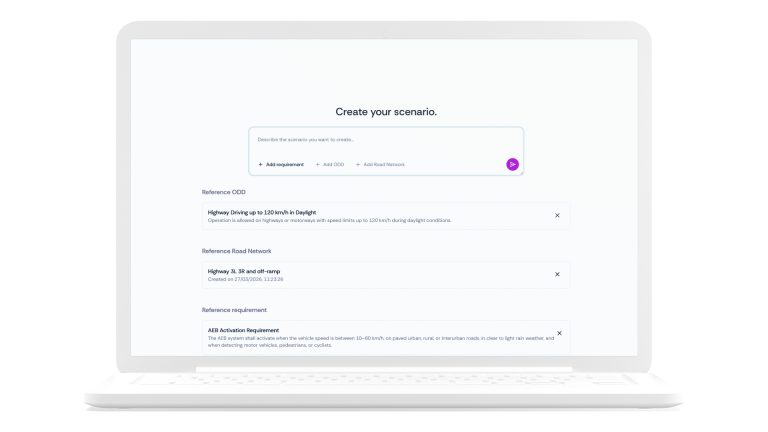
Deontic is a Belgian AI company building a validation intelligence layer for ADAS and autonomous driving development. Our agent transforms natural language requirements, regulations and operational design domain definitions into executable, standards based OpenScenario and OpenDrive assets. It can generate base scenarios; expand them across parameters such as weather, traffic, road geometry and actor behavior; and maintain traceability from the original requirement through simulation and test evidence.
Deontic integrates with existing requirements management, engineering, simulation and CI/CD environments rather than replacing them. This allows validation teams to automate scenario engineering, measure ODD coverage, maintain reusable scenario libraries and support continuous homologation as vehicle software, regulations or operating domains change. In practical terms, we help engineering teams move from manually creating individual test cases to producing and maintaining large, auditable validation campaigns at industrial scale, while keeping engineers in control of the underlying assumptions, parameters and acceptance criteria.
Can you describe what you will present at this year’s Intelligent Vehicle Expo Conference in Novi?
As ADAS and autonomous driving programs scale, validation is shifting from road-heavy testing to simulation-first evidence generation. Deontic will show how natural-language requirements, ODD definitions, and regulatory constraints can be transformed into executable OpenScenario/OpenDrive scenarios, parameter sweeps, coverage metrics and traceable test evidence.
The session explains why scenario explosion, expanding ODDs, and continuous homologation create a new bottleneck, and how agentic AI can act as a validation intelligence layer inside existing engineering toolchains. Attendees will see how simulation-first workflows help teams close coverage gaps, prioritize regression and produce regulator-ready evidence for safer, faster autonomy deployment.
Can you share some specific examples from previous customer case studies of how simulation-first validation has helped them?
A recurring customer challenge is that creating one simulation-ready base scenario manually can require approximately four hours. Engineers must interpret the requirement and ODD; define the test intent and KPIs; configure the road, actors, behaviors and triggers; author the OpenX files; debug the simulation; and document the resulting traceability.
In customer evaluations, Deontic has demonstrated how this workflow can be reduced to minutes by automatically converting requirements and ODD constraints into structured scenarios and then generating large parameter sweeps. A single cut-in, emergency braking or pedestrian scenario can consequently be expanded across speeds, distances, road types, weather conditions and traffic configurations without rebuilding each test manually.
This simulation-first approach is particularly valuable when a customer introduces a new vehicle release, feature update or geographical ODD. Instead of restarting validation, teams can identify the affected scenario set, regenerate the relevant variations and prioritize regression testing, significantly improving coverage, repeatability and engineering throughput.
How is agentic AI helping to rewrite simulation, and where does it offer the greatest opportunity?
Agentic AI moves simulation from a collection of specialist tools and manual handovers toward an orchestrated, continuously evolving validation workflow. Rather than only generating text or code, an agent can interpret a requirement, retrieve the applicable ODD and regulatory constraints, plan the necessary tests, call scenario generation and simulation tools, analyze results and preserve the context and traceability behind each decision.
The greatest opportunity is not simply faster scenario creation. It is closing the loop between changing requirements, regulations, operating domains and regression testing. An agent can monitor a change, assess which vehicle feature, ODD segment and scenario set are affected, and then regenerate or prioritize the necessary validation campaign. This creates the foundation for continuous homologation.
Over time, agentic AI can become the connective layer between requirements systems, simulation platforms, physical AI models and compliance processes, turning simulation from a periodic engineering activity into a scalable, auditable and continuously updated evidence pipeline.
Click here to see the full conference program.
Intelligent Vehicle Expo is part of Vehicle Tech Week North America.