


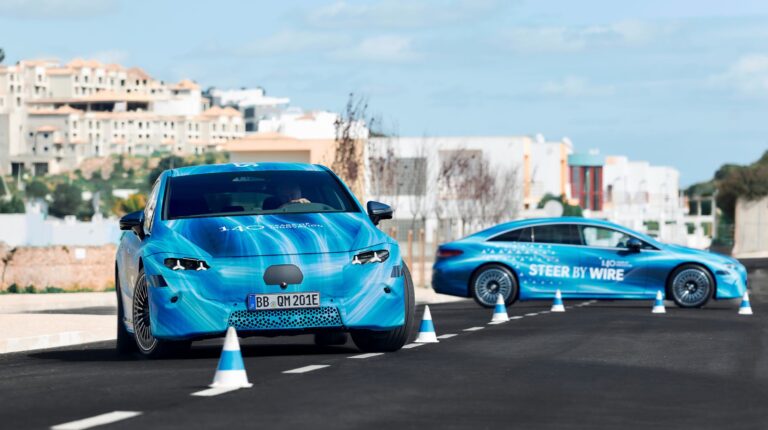
The new EQS features steer-by-wire technology that transforms the interaction between the driver and vehicle with “precise, intuitive and effortless steering”, Mercedes‑Benz said, and which will support automated steering and future autonomous functions. It is the first production vehicle from a German auto maker with this technology.
The new steering feel benefits driving dynamics, maneuvering and parking. With steer-by-wire, the steering effort required from the driver can be further reduced and the driver no longer needs to adjust their grip on the steering wheel when turning. Vibrations caused by uneven road surfaces, which were previously transmitted to the driver via the steering wheel, can now be eliminated.
Steer-by-wire also reshapes the interior. A flatter steering wheel rim opens up space for the driver, improving their view of the driver display and making it easier to get in, or out.
Suspension specialists have tuned the steering ratio for different driving conditions, which works in conjunction with standard rear-axle steering – at higher speeds, the rear wheels steer in the same direction as the front wheels to improve stability.
The steer-by-wire system has completed over 1,000,000km of testing (over 621,000 test miles) on test benches, test tracks and in overall vehicle validation in road traffic. To ensure it meets the brand’s strict safety standards, the design uses a redundant system architecture in addition to high-precision sensors and powerful control units. These two signal paths ensure steering capability is always guaranteed. Lateral control is also possible through rear-axle steering and targeted wheel-specific braking interventions via the ESP.
In addition to the optional steer-by-wire system, the Mercedes‑Benz EQS continues to be equipped with electromechanical steering as standard.
Airbag structure and safety standards
In the EQS, Mercedes‑Benz uses the steer-by-wire technology for a flattened, more compact steering wheel and combines it with a newly developed airbag structure. Since the airbag can no longer support itself on a closed steering wheel rim, an internal support and folding architecture takes over the controlled shaping during deployment.
The airbag’s routing, folding pattern and mounting points are designed to ensure stable and consistent deployment, even without the upper steering wheel rim. The system remains integrated into the steering wheel hub and meets the brand’s safety requirements despite the revised design.
Related news, Single camera from e-con Systems enables day-to-night vision