


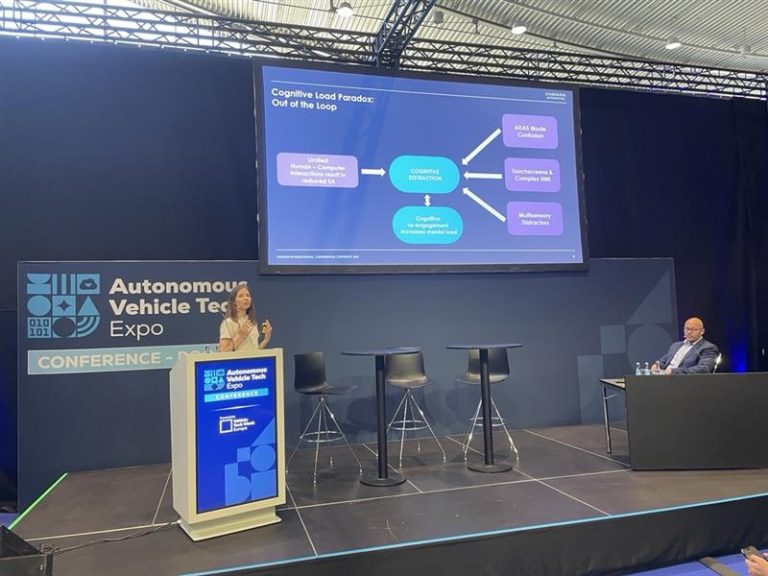
The second day of the conference at Autonomous Vehicle Tech Expo saw a fascinating presentation from Dr Marta Glinka, a psychophysiologist working for Harman International, which recently acquired the ADAS business of ZF Group. During her speech, titled ‘Driver distraction and readiness across levels of automation’, Glinka examined driver cognitive performance across over- and under-stimulation scenarios relevant to different levels of automation.
“While automation improves safety, sustaining driver alertness remains a challenge, as drivers remain vulnerable to both external distractions and internal cues,” she said.
Glinka showed how for ADAS (L1-L2), vehicle control taxes limited cognitive resources, and secondary tasks increase the risks of overload, stress and fatigue. At higher automation (L2+-L4), reduced control demands free cognitive capacity but introduces underload effects such as mind wandering and drowsiness. She also shared some practical methods for detecting visual, manual and cognitive distraction, as well as drowsiness and stress.
“I’m here to present how driver readiness and distraction evolves through different levels of automation,” Glinka told AAVI after her presentation. “We examined the driver’s responsibilities, as well as the risks and threats during different levels of automation, and how cognitive load is evolving – with drivers zoning out during higher levels of automation and the impact of that. It was important for me to emphasize how much human factors remain a critical concept, no matter how high the level of automation. Overall it’s a fantastic event, where I can listen with curiosity to many presentations and enjoy many interesting conversations.”
Keep checking the AAVI website for highlights from the event, which runs until Thursday, June 25.
Register for your free pass to Vehicle Tech Week Europe 2026 here.