


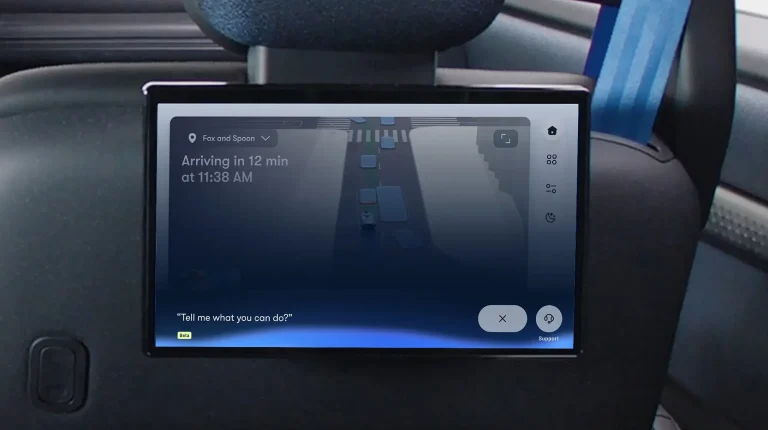
Waymo has integrated Google’s Gemini AI assistant into the cabin of its Ojai robotaxi, alongside a redesigned three-screen interface. The system enables riders to use voice commands for cabin controls and journey information, while the autonomous driving system operates independently.
Designed specifically for ride-hailing, the Ojai features a cabin focused on passenger comfort and flexibility, with Waymo announcing the introduction of new in-car features, including the Gemini AI assistant and a redesigned user interface, aimed at enhancing the rider experience.
While the Waymo Driver manages the vehicle’s autonomous driving functions, Google’s Gemini AI assistant provides in-cabin support for passengers. Riders can use Gemini to access cabin controls, journey information, details about Waymo’s services and general information through a voice interface.
Passengers can access Gemini through the in-car interface to control cabin functions, such as adjusting the climate, or ask location-based and general knowledge questions during their journey. The feature is intended to provide a more interactive and personalized in-cabin experience “like a helpful passenger” Waymo said.
Gemini is optional and remains inactive unless a passenger chooses to use it. The feature is currently available in beta, with Waymo saying additional voice assistant capabilities will be introduced through future updates.
Waymo has also introduced a redesigned three-screen in-car interface featuring dynamic ride information, simplified media controls and an updated system menu for cabin settings. The interface adapts to occupied seats, displaying relevant controls and journey information for each passenger. It also introduces features such as Calm Mode, which dims the display and presents minimal trip information for a less distracting in-cabin experience, according to the company.
Recent news, BMW selects Qualcomm for next-generation vehicle compute platform