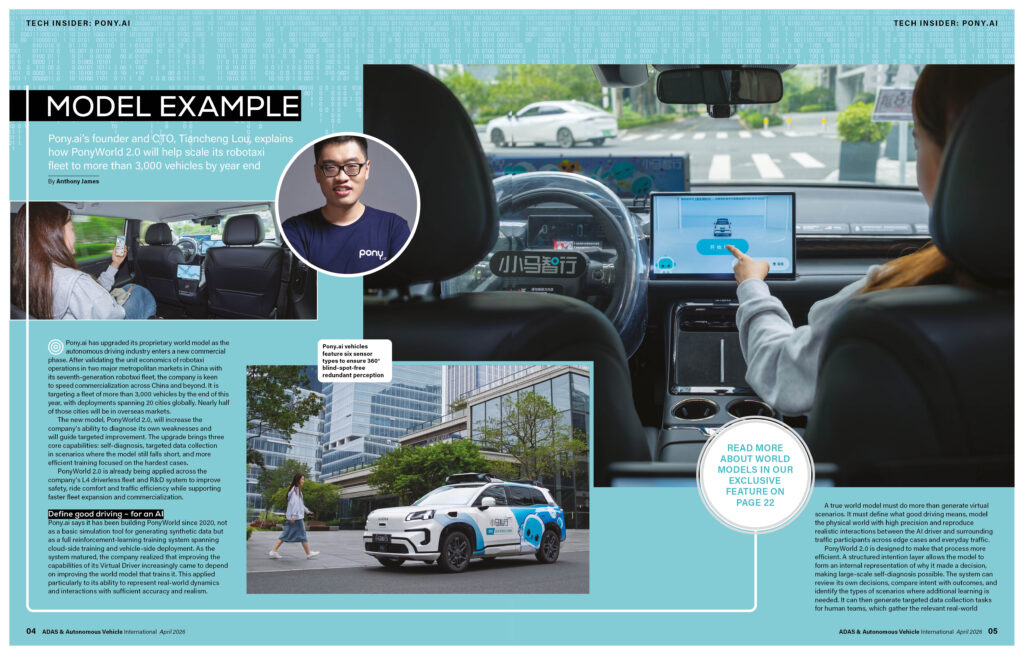


 AAVI catches up with Pony.ai’s founder and CTO, Tiancheng Lou, following the company’s recent launch of PonyWorld 2.0, the latest upgrade to its proprietary world model and a major advance in the core training system behind its autonomous driving stack.
After validating the unit economics of robotaxi operations in two major metropolitan markets in China with its seventh-generation robotaxi fleet, Pony.ai is keen to speed commercialization across China and beyond. It is targeting a fleet of more than 3,000 vehicles by the end of this year, with deployments spanning 20 cities globally. Nearly half of those cities will be in overseas markets.
The new model, PonyWorld 2.0, will increase the company’s ability to diagnose its own weaknesses and will guide targeted improvement. The upgrade brings three core capabilities: self-diagnosis, targeted data collection in scenarios where the model still falls short, and more efficient training focused on the hardest cases.
PonyWorld 2.0 is already being applied across the company’s L4 driverless fleet and R&D system to improve safety, ride comfort and traffic efficiency while supporting faster fleet expansion and commercialization.
Pony.ai says it has been building PonyWorld since 2020, not as a basic simulation tool for generating synthetic data but as a full reinforcement-learning training system spanning cloud-side training and vehicle-side deployment. As the system matured, the company realized that improving the capabilities of its Virtual Driver increasingly came to depend on improving the world model that trains it. This applied particularly to its ability to represent real-world dynamics and interactions with sufficient accuracy and realism.
A true world model must do more than generate virtual scenarios. It must define what good driving means, model the physical world with high precision and reproduce realistic interactions between the AI driver and surrounding traffic participants across edge cases and everyday traffic.
PonyWorld 2.0 is designed to make that process more efficient. A structured intention layer allows the model to form an internal representation of why it made a decision, making large-scale self-diagnosis possible. The system can review its own decisions, compare intent with outcomes, and identify the types of scenarios where additional learning is needed. It can then generate targeted data collection tasks for human teams, which gather the relevant real-world samples, feed them back into the cloud and help recalibrate the world model for more precise training.
In Pony.ai’s view, that changes the development process itself. In the early stages of autonomous driving, progress depended heavily on human engineers to design rules, label data and decide what to train next. However, as AI systems become more capable, they can take over more of their own improvement cycle, while human engineers increasingly serve as operators of a directed data collection loop shaped by the system’s own learning needs.
AAVI recently caught up with Tiancheng Lou, the founder and CTO of Pony.ai, to discover more.
Isn’t the new world model just another simulation tool?
I would make a clear distinction between a simulator and a world model. A simulator can generate virtual scenes, but that alone does not solve autonomous driving. To train a real L4 system, you need three things at once: a reliable way to define and evaluate what ‘good driving’ means, a sufficiently accurate model of the physical world and a way to reproduce the interactive behavior of other traffic participants in response to the AI vehicle. A world model is not just a place where the AI driver practices; it is also the framework that evaluates whether the AI driver is actually driving well – whether it is making safe, smooth and efficient decisions in realistic, interactive traffic conditions.
That matters because driving is not just perception plus rules. It is a dynamic, multi-agent problem where other cars, cyclists and pedestrians are constantly reacting to one another. So if you want to improve an AI driver through reinforcement learning, you need more than a scene generator. You need a full training-and-evaluation system that can measure the quality of the AI’s decisions and feed that back into improvement. That is what PonyWorld was built to do. It is not just a visual simulation layer or a synthetic-data engine; it is the environment in which the AI driver is trained, tested and evaluated.
What makes PonyWorld 2.0 especially important is that it builds on that foundation with a new capability: self-diagnosis and directed evolution. In the earlier phase, engineers still had to do much of the work of identifying failure modes and deciding what data to collect next. In 2.0, the system can identify where its own precision is insufficient, determine which scenarios deserve attention and feed those priorities back into training and data collection. That is a meaningful step forward in development methodology. It moves the system from broad iteration to targeted iteration, which is exactly what you need when you are trying to improve safety, comfort and traffic efficiency at commercial scale.
How does it differ from a simulator? And why no VLA model?
The core difference is that PonyWorld 2.0 is not simply generating more synthetic scenarios. It is becoming a more intelligent engine for improving the driving system itself. It is also worth separating two different layers here: the world model is the complete system used to train and improve the onboard driving model, while VLA refers to one possible architecture for the onboard model itself. The key innovation in 2.0 is that the system can look back at driving outcomes and separate different kinds of problems: whether the issue came from execution, from decision-making or from limitations in the world model’s understanding of the real interaction. That is a very different capability from a conventional simulator. A conventional simulator can give you practice. PonyWorld 2.0 can increasingly tell you why the model still struggles and where the next round of improvement should go.
A key part of that is the intention layer. The vehicle-side model does not just output steering, braking or acceleration; it also learns a structured representation of why it chose those actions. That gives us a much stronger basis for auditability, debugging and iteration. We can distinguish whether the system recognized the situation correctly, whether its intended response was right, and whether the final behavior matched that intent. That becomes the basis for self-diagnosis in PonyWorld 2.0. In other words, the system is no longer only learning how to drive better; it is also becoming better at understanding how it needs to improve.
As for VLA, driving is fundamentally a real-time physical intelligence problem. And in our case, the onboard model itself is not VLA-based: instead of inserting language into the middle of the driving stack, we use Intention as the structured intermediate representation. In highly dynamic road environments, what matters most is precise spatial understanding, interaction prediction and fast control. If you insert a language model between perception and action, you are compressing a rich, fast-changing physical process into language before converting it back into control. We think that can introduce unnecessary abstraction, latency and information loss. So our approach is a more direct sensor-to-action architecture, while still retaining structured semantics through the intention layer. Put simply, we are not against interpretability; we just believe it should be native to the driving system, not mediated through a language bottleneck.
Why is AI driving data better than human driving data?
Human driving data is very useful, especially in the early stages, but it has a ceiling. If the goal is simply to drive like a human, then human driving data is the natural reference. But if the goal is to drive well – and ultimately to drive better than a human – then human data alone is no longer enough. Human data tells you how people drive around other people. The challenge is that once an AI driver starts behaving differently from a human driver – even if it is behaving more safely or more consistently – the surrounding traffic may respond differently as well. Other drivers may yield differently, negotiate differently or interact differently with an autonomous vehicle than they would with a human. If your goal is to improve a world model that will train an AI driver, that difference becomes extremely important.
That is why real-world AI driving data becomes so valuable. It captures interaction patterns that simply do not exist in ordinary human driving datasets. From a technical perspective, those are exactly the signals you need to improve the fidelity of the world model. So the point is not just that AI driving data is proprietary or unique. It is that it contains a different class of information: it tells you how the real world reacts to an AI driver. At a certain stage of maturity, that becomes more informative for continued progress than simply collecting more human driving data.
You can think of it this way: once the system reaches a high enough level, continuing to rely only on ordinary human driving data is like asking an advanced player to improve by repeatedly studying beginner games. It may still have some value, but it no longer gives you the signals you need for the next level of progress. To keep improving, the model needs exposure to the harder and more distinctive interaction patterns that emerge in real driverless operations.
How is this helping you scale?
It helps us scale in two very practical ways. First, it improves engineering efficiency. Once you are operating at scale, the challenge is no longer collecting more data for its own sake. The challenge is identifying which data will actually improve the system. PonyWorld 2.0 can identify weak points in the world model, highlight which scenarios matter most and generate more directed data collection priorities around those weaknesses. That means the organization can move from broad, manual iteration to a much more focused improvement loop. Instead of asking engineers to search through enormous datasets and guess what to work on next, the system can increasingly guide attention to the highest-value problems.
Second, it improves training efficiency. Not every scenario is equally useful once the system reaches a certain level of maturity. PonyWorld 2.0 allows us to focus more of the training effort on the hard cases the model still struggles with, rather than spending the same amount of compute on situations it already handles well. In simple terms, it helps us spend less time on the easy points and more time on the edge cases that actually matter. In physical AI, that is essential, because both data and compute are expensive, and scale without efficiency is not sustainable.
At the fleet level, PonyWorld 2.0 strengthens a very important flywheel. Larger-scale L4 driverless operations generate high-value real-world AI driving data. That data improves the precision of the world model. A more precise world model improves the onboard driving model. And a better onboard model supports broader deployment, which then generates even more valuable data. That is how a world model becomes more than a research tool. It becomes part of the scaling engine for the business. From a CTO’s perspective, that is really the significance of PonyWorld 2.0: it improves not only the quality of the model but also the efficiency, directionality and repeatability of the entire development loop.
This article was first published in the April 2026 edition of ADAS & Autonomous Vehicle International magazine. You can read it in its original format, here. Subscribe here.