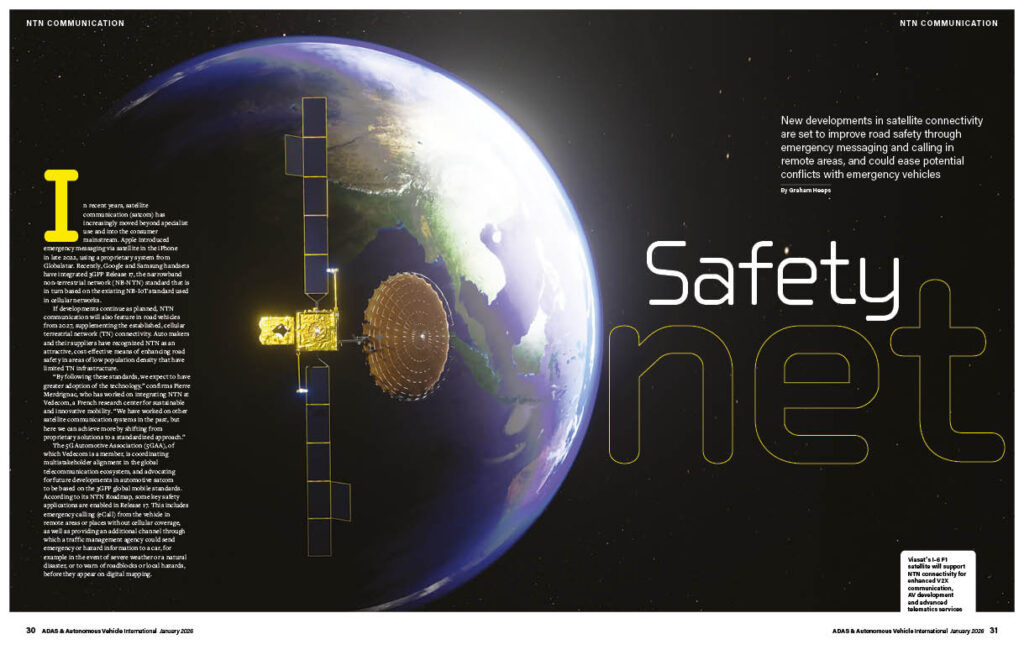


 Damian Lewis, market development manager at Viasat Enterprise, explains the company’s role in the vehicle-narrowband NTN communication ecosystem, and how it collaborates with the automotive industry to integrate its satellite capabilities for critical safety applications. This topic was recently highlighted in an exclusive feature in the January 2026 issue of ADAS & Autonomous Vehicle International
What did you learn from last year’s 5GAA technology demonstration in Paris?
The 5GAA demo in Paris was a landmark event that demonstrated for the first time that the technology for satellite-to-vehicle connectivity is now available. We learned that seamless in-vehicle integration and the ability to switch effortlessly between non-terrestrial and terrestrial networks for emergency messaging and voice communication is not just a concept but a tangible reality. It brought to life the vision of satellite connectivity complementing 4G and 5G terrestrial networks, proving that the future of automotive connectivity is closer than many might think.
From a technical perspective, have you had to develop anything new for vehicle-narrowband NTN communication versus other uses of your network?
The interoperability opportunity between terrestrial and non-terrestrial networks, catalyzed by 3GPP Release 17, presents an opportunity across a range of industries and consumer use cases. It’s very positive that much of the technical development from a satellite constellation and network operator perspective applies across all of these.
There are a few key things we’re doing to ensure we deliver the best service for the automotive sector specifically though, including working with the entire connectivity value chain to ensure an aligned roadmap to deliver an evolving level of service, and working closely with automotive OEMs to balance elements like antenna efficiency while limiting the amount of hardware changes/adaptions needed. This is with the aim to jointly deliver the required customer experience while we also limit the cost to integrate.
Are current satellite networks ready to handle the narrowband NTN vehicle emergency messaging/alert applications? What will have to change for them to be ready for wideband applications in the future?
Yes, our satellite networks are available to provide NTN vehicle emergency messaging and alert applications, building on our extensive experience in supporting highly reliable safety systems.
For more data-intensive use cases, such as video streaming, internet access, or high-definition voice and video calls, this longer-term evolution will involve the deployment of new radio non-terrestrial networks (NR-NTN) following future 3GPP release iterations. This would likely require next-generation satellite infrastructure but would ultimately mean that anything a consumer does over a cellular connection would be possible over satellite, unlocking a broader range of advanced infotainment and connectivity services in the future.
What have been the biggest technical challenges so far in sending and receiving emergency alerts to/from vehicles via satellite, and what challenges to adoption remain to be solved?
In fact, following 3GPP Release 17 standards, the technical challenge has been limited. Our satellite network is available today, and with ecosystem partners we have successfully showcased how new terminals can be integrated into vehicle software to allow vehicles to roam between satellite and terrestrial networks. We continue to develop new technical demonstrations with those partners to continue to showcase new use cases.
That said, looking ahead, the biggest challenges to mainstream adoption are largely commercial and ecosystem related. This requires long-term, deep collaboration across the vast auto connectivity ecosystem – from chipset manufacturers and car makers to mobile network operators – to establish commercial and roaming agreements and ensure interoperability between various systems. New vehicles that have 3GPP Release 17 compliant chipsets and software also need to enter the market, which will take time. Once these foundational elements are in place, connected cars will follow.
What key benefits of using NTN communication for emergency messaging have you observed so far?
Through our work with ecosystem partners, we have already enabled millions of consumer mobiles to access satellite connectivity. Consumers in the USA now have access to emergency messaging and location sharing, even when a terrestrial cellular network is not available. That provides adventurers and those living in underserved areas with access to services needed to protect them from harm.
Similarly, for the auto sector NTN connectivity could have a direct impact on road safety. In our demonstrations so far, we’ve observed its ability to provide ‘always-on’ connectivity, extending coverage to remote areas where cellular networks are patchy or unavailable. Once in service, this could ensure that passengers can make emergency calls, vehicles can send automated alerts with location data after a collision, and critical communications remain connected, even during natural disasters when terrestrial networks fail. Ultimately, NTN will help improve access to emergency services with the power to save lives.
More broadly, what do you think the next five years will look like for satellite-vehicle communications?
We anticipate satellite connectivity will become far more integrated into the automotive sector in the next five years, with a primary focus on enhancing road safety. We expect to see the initial market deployment of satellite connectivity in vehicles by 2027 (according to 5GAA 2030 Roadmap), enabling essential applications like emergency messaging, bidirectional voice calls, and breakdown assistance. Beyond this, we foresee a gradual evolution toward more data-intensive applications such as advanced infotainment systems. Ultimately, satellite connectivity will be a non-negotiable component of future V2X systems and autonomous driving, providing resilient, always-on communication essential for safety and efficiency, especially in areas without robust cellular coverage.
Interested in reading more about NTN communication? Check out our exclusive feature first published in the January 2026 issue of ADAS & Autonomous Vehicle International