


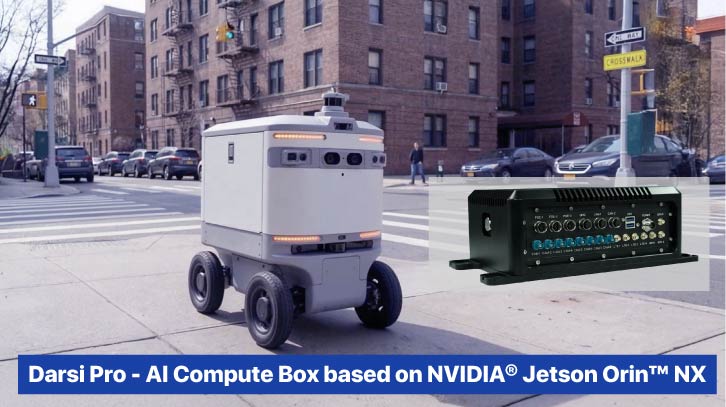
Next-generation autonomous mobility is moving toward systems that handle more complex tasks with far less external guidance. The focus is shifting from basic automation to continuous interpretation of space, activity and intent. The goal is to enable smoother movement through warehouses, factory floors, outdoor paths and mixed environments where tasks change quickly and perception needs to stay continuous.
This new wave of mobility emphasizes awareness, adaptability and faster decision cycles supported by dense visual inputs.
This direction is shaping how product teams think about perception itself. Vision is becoming the anchor for navigation, interaction and decision-making, guiding how machines respond. These days (and in the near future), the expectation is straightforward: autonomous machines should be more aware, adapt more smoothly to real-time changes, and maintain accurate perception in challenging environments.
Why this move toward unified AI vision boxes?
Those looking for camera solutions to power autonomous mobility systems often describe a familiar pattern. Systems perform adequately at lower camera counts or in controlled settings, yet once workloads scale, fragmentation becomes a limiting factor.
Each interface introduces uncertainty, and real-time perception begins to suffer when multiple streams are handled across separate processing layers. Unaligned inputs affect the stability of 3D mapping, while latency shifts can reduce the consistency of motion planning in dynamic environments.
Hence, a unified AI vision box is the need of the hour.
With camera inputs, compute and sensor pathways routed through a unified solution, perception becomes a coordinated flow rather than a distributed chain. This model empowers autonomous machines, AMRs, delivery robots and other mobility systems to handle real-world scenes that change rapidly.
Darsi Pro: e-con Systems’ AI vision box
Darsi Pro is e-con Systems’ latest AI vision box powered by Nvidia Jetson Orin NX. It is a unified AI solution capable of handling multiple camera streams and workloads that depend on continuous visual interpretation. With multi-sensor fusion capabilities, it ensures that radar, lidar, cameras, IMUs and other sensors are synchronized through PTP support.
This helps perception models receive inputs that correspond reliably in time, further strengthening the consistency of scene understanding during sudden exposure shifts or rapid motion.
Darsi Pro supports up to eight GMSL2 cameras through FAKRA connectors, offering the freedom to position sensors. It works with a wide portfolio of e-con Systems’ cameras, which cover HDR, RGB-IR, global shutter, wide-FOV, and other imaging features that are critical for mobility systems. Since the camera portfolio has been tested on the box, developers can avoid lengthy integration cycles that were common in earlier multi-vendor architectures.
Darsi Pro also delivers strong edge-side inferencing through the Nvidia Ampere GPU architecture with CUDA cores, supporting demanding detection and tracking workloads. With support for Nvidia JetPack 6.0 and higher, Darsi Pro delivers low-latency performance for advanced perception stacks. Its MCU layer manages power sequencing and peripheral activity, providing consistent control during startup, shutdown and extended low-power operations.
Unified AI vision box for practical mobility conditions
Mobility systems operate in environments that rarely remain stable. Floors may generate dust, outdoor paths introduce water contact, and exposure varies sharply between indoor and outdoor transitions. Unified AI vision boxes like Darsi Pro come with a fanless build and a rugged IP67 enclosure, enabling consistent operation in these conditions. It also helps maintain continuous processing during long-duty workloads that depend on uninterrupted perception.
The AI vision box’s interface flexibility can significantly impact the deployment outcomes, as well. That’s why Darsi Pro includes dual GbE with PoE, USB 3.2 Gen 1, CAN, RS485, HDMI, GPIO and wireless modules. These options make it easy to position sensing equipment and supporting hardware without requiring additional interface layers.
Remote maintenance also becomes part of the workflow, as Darsi Pro can be integrated with CloVis Central, e-con Systems’ cloud-based device management platform. That way, teams can monitor deployed units, review configuration details, check system health and perform OTA updates when field conditions require adjustments.
The future of autonomous mobility is now
With autonomous mobility moving quickly from controlled pilots into live environments, perception systems carry greater responsibility. Machines need to interpret scenes continuously, manage sensor alignment over long duty cycles, and respond to change as it happens.
They must react immediately, not after the fact. That places growing weight on architectures that reduce latency, simplify system design and keep visual intelligence tightly coupled to decision logic.
Unified AI vision boxes answer that direction directly. They bring cameras, compute, synchronization and interfaces into a unified platform so that mobility teams have a seamless path from development to deployment. As fleets expand and environments grow more unpredictable, AI vision boxes like e-con Systems’ Darsi Pro will set the pace for mobility systems to scale with confidence and be ready for the next generation of autonomous applications.
*This article was written by Prabu Kumar, chief technology officer and head of camera products at e-con Systems.