


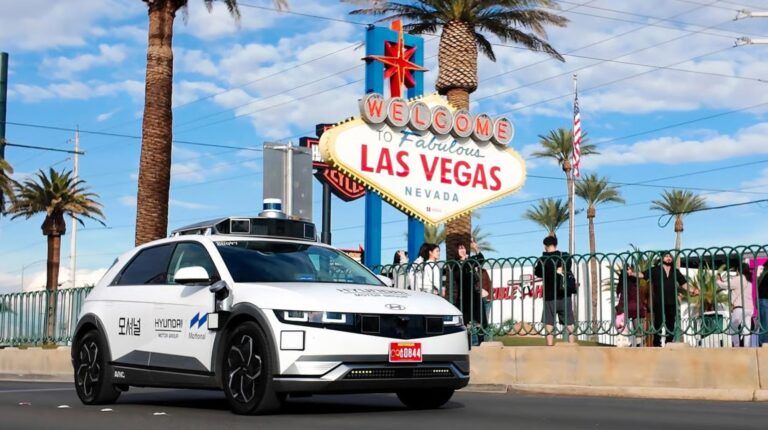
Hyundai Motor Group’s autonomous driving joint venture, Motional, plans to launch a fully driverless Level 4 robotaxi service in Las Vegas by the end of 2026, emphasizing safety and using end-to-end (E2E) artificial intelligence (AI) motion planning.
The Hyundai Ioniq 5 robotaxi that Motional uses – and its systems – are developed to US Federal Motor Vehicle Safety Standards (FMVSS), complemented by rigorous assessments from independent organizations such as TÜV Süd.
The technology will enter service through a phased validation program, gradually increasing in intensity to ensure robust performance. This includes large-scale scenario simulations, repeated closed-environment testing and careful expansion onto public roads.
“Motional does not place safety behind technological progress,” said Laura Major, Motional CEO. “We remain focused on accelerating our ability to scale the technology and operations in a sustainable way, from development through the commercialization stage,” she added, underscoring the company’s development principles.
From modules to integrated intelligence
Motional’s service expansion is guided by a roadmap for developing an E2E autonomous driving system powered by AI and machine learning.
Whereas traditional autonomous stacks separate perception, decision-making and control into multiple modules, Motional’s system is transitioning toward machine learning-based E2E motion planning that integrates these steps into a single learned decision process.
This E2E setup enables the system to learn and output driving behaviors holistically, moving beyond stitched module outputs to more natural, adaptable driving. The goal of this roadmap is to transition toward large driving models (LDM) trained on large driving datasets to further refine performance across a range of varied and unpredictable traffic conditions.
Simplifying the software architecture further enhances autonomous driving performance, enabling faster updates and greater scalability – key for reliable city-wide operation.
Major continued, “As E2E-based development advances, the importance of driving validation and safety assurance increases, so we are developing more granular internal performance evaluation criteria and test scenarios.”
Data-driven acceleration
Software and data are critical, but their effectiveness depends on using the best platform for Motional’s autonomous driving services: the Hyundai Ioniq 5 robotaxi.
Produced at Hyundai Motor Group Innovation Center Singapore (HMGICS) – the Group’s manufacturing R&D test bed and a highly automated and innovative facility – the Ioniq 5 robotaxi platform is facilitating the data-driven acceleration of Motional’s service toward commercialization at the end of 2026.
As these operations continue to grow in scale, so does test mileage and the volume of data collected. This serves to strengthen the model’s foundation.
The Ioniq 5 robotaxi in pilot operations uses a machine learning-driven approach, creating a feedback loop where driving data informs performance and validation. Motional is also developing more detailed internal benchmarks and test scenarios to ensure safety evolves alongside its E2E system.
Driving data is as valuable as development funding. Motional continuously collects and transmits this data to servers for ongoing validation and reliability improvements, building the experience that makes autonomous driving a reality.
Collaborating to advance autonomy
Hyundai Motor Group is deepening collaboration among its Advanced Vehicle Platform division, Motional and 42dot, using insights from Ioniq 5 robotaxi operations in Las Vegas to guide future development. Motional’s real-world commercialization experience informs the SDV framework, while large-scale models and data infrastructure strengthen the Group’s autonomous technology foundation.
Partnering with a global ride hailing platform will improve customer convenience from day one, integrating robotaxi services into familiar mobility networks and supporting geographic expansion as Motional’s robotaxi program grows.
In related news, Hyundai Mobis develops 5G antenna-integrated telematics solution