


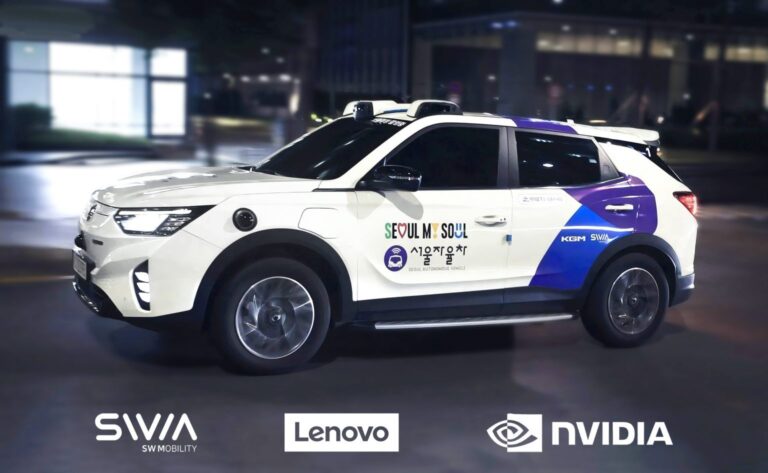
SWM, a South Korean autonomous mobility solutions company, is collaborating with Lenovo to co-develop a new-generation robotaxi. At the heart of the collaboration is SWM’s newly unveiled AP-700 autonomous driving platform, powered by Lenovo Vehicle Computing’s Level 4 autonomous driving domain controller, AD1.
Built on the Nvidia Drive AGX Thor platform, AD1 is engineered to meet the highest automotive standards. It features the Nvidia Blackwell architecture, delivering over 2,000 TFLOPS of AI computing power at FP8/INT8, and is designed for transformer and generative AI workloads.
This enables more accurate perception, faster decision-making and smoother vehicle control, supporting safe interaction with complex road users at the scale required for Level 4 robotaxi operations, according to the company.
“This collaboration marks another significant step from autonomous driving validation toward safe, reliable and scalable deployment,” said Peter Xu, VP and head of vehicle computing at Lenovo. “AD1, powered by Nvidia Drive AGX Thor, provides not just immense computing power but a vehicle-grade platform built for real-world safety and performance. Together with SWM and Nvidia, we are laying a trustworthy foundation for the next era of urban mobility.”
Ki Hyuk Kim, representative director of SWM, added, “Working with Lenovo and Nvidia represents a decisive leap forward in globalizing our autonomous taxi technology. Combining cutting-edge AI compute with our advanced driving software will elevate the robotaxi to world-class standards in safety and reliability. We plan to launch services initially in Japan, Southeast Asia and the Middle East, with a vision to expand globally.”
“The collaboration between SWM and Lenovo highlights how the Nvidia Drive Hyperion platform is enabling the next generation of scalable, safety-certified robotaxi systems,” noted Rishi Dhall, VP of automotive at Nvidia. “By combining advanced AI compute, functionally safe sensor architecture and a full autonomous driving software stack, this work demonstrates how developers can bring complex, real-world autonomous applications from development to deployment with confidence.”
Since it was founded in 2017, SWM has focused on autonomous technology development and commercialization. In September 2024, it claimed to have launched South Korea’s first fully driverless taxi service in Seoul’s Gangnam district, which it says has maintained a flawless safety record to date. SWM also collaborates on future mobility ecosystems with public-sector organizations including Seoul Metropolitan Government, Seoul Taxi Association, Gwangju Metropolitan City and Ministry of Trade Industry and Resources.
By building on the Thor-based platform, Lenovo Vehicle Computing extends Lenovo’s Hybrid AI vision into real-world applications, delivering scalable, production-ready solutions that support safe, efficient and intelligent urban transportation.