


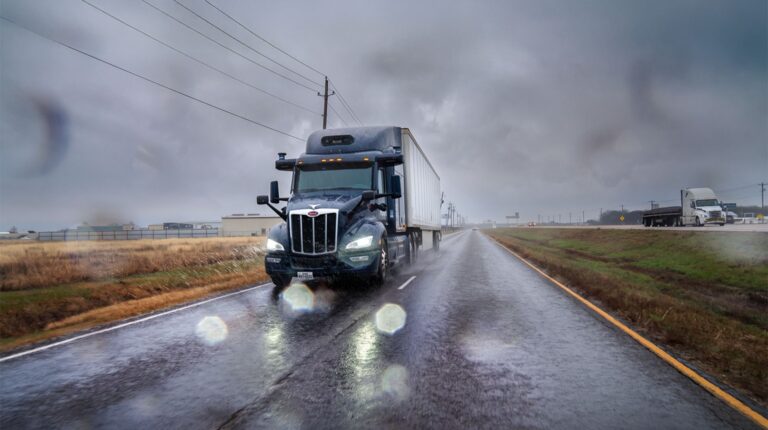
Aurora Innovation has announced that it is tripling the size of its driverless network with the launch of its latest software release, which will enable the Aurora Driver to begin expanding across the southern United States and serve customer endpoints in 2026.
“Expanding across the Sun Belt and introducing customer endpoints enables us to provide our customers with the capacity they need to move goods at a scale that wasn’t possible before,” said Chris Urmson, co-founder and CEO of Aurora. “Being a carrier is a game of margins, and if autonomy can work around the clock, it will be key to growing our customers’ businesses.”
The company’s latest software release is its fourth since deploying driverless trucks in April 2025. The first release validated initial driverless operations between Dallas and Houston, the second validated operations at night and the third validated El Paso.
Generalized AI
Before clearing the release, Aurora executed a rigorous validation process comprising over four million tests.
Driverless operations were validated on the approximately 1,600km lane between Fort Worth and Phoenix, a route that extends beyond hours of service (HOS) limitations.
According to the manufacturer, without mandatory rest breaks the Aurora Driver can cut transit times nearly in half and offer carriers a level of efficiency and “superhuman” asset use that is impossible for traditional single-driver fleets.
Direct-to-customer lanes
Aurora is leveraging Verifiable AI to build maps for new routes. After a single manual drive, cloud-based algorithms can generate semantic components that help build the maps with little to no human assistance, significantly reducing the time to map new routes.
Aurora has begun supervised autonomous freight deliveries serving multiple customer facilities, including Hirschbach Motor Lines between Dallas and Laredo for Driscoll’s; Detmar Logistics between Midland and Capital Sand’s mining site in Monahans, Texas; and a leading US carrier operating from a Phoenix facility.
Increasing performance
The Aurora Driver can now navigate highways and surface streets in various weather conditions, including rain, fog and heavy wind, without a human driver. Last year, weather of all types limited Aurora’s driverless operations in Texas roughly 40% of the time. The validation will increase potential uptime, enabling Aurora’s customers to increase their use of autonomous assets across the Sun Belt’s diverse climates.
Looking forward in 2026
As of January 2026, Aurora had completed over 402,000 driverless kilometers with no collisions attributed to the Aurora Driver. Global demand for the system has increased. In response, Aurora is laying the groundwork for scale, with all commercial truck capacity fully committed through the third quarter of 2026
With the capability to begin expansion across the Sun Belt, Aurora is preparing to launch its next-generation hardware kit on the International LT Series truck platform without a ride observer in Q2. The company expects to have more than 200 driverless trucks in operation by the end of the year.
“The era of superhuman logistics has arrived,” said Urmson.
In related news, AI research to support efficient management of autonomous baggage vehicles at airports