


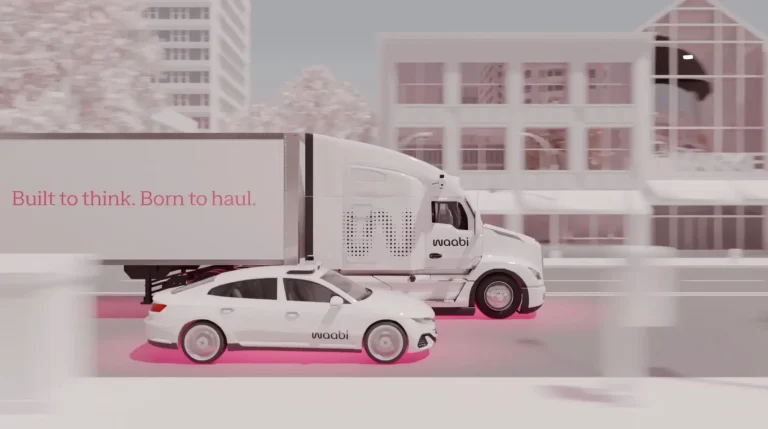
Waabi has secured US$750m in an oversubscribed series C round, co-led by Khosla Ventures and G2 Venture Partners, as well as a milestone-based investment from Uber to deploy Waabi Driver-powered robotaxis exclusively on the Uber platform. The funding will advance Waabi’s Physical AI Platform, accelerate autonomous trucking commercialization and support its expansion into robotaxis.
Waabi’s Physical AI Platform enables scalable autonomous driving across vehicle types, regions and environments. By combining a verifiable end-to-end AI model with an advanced neural simulator, a single AI model powers both autonomous trucks and robotaxis, enabling rapid expansion while improving the Waabi Driver’s overall performance.
“Waabi’s Physical AI Platform has enabled us to hit an industry-leading pace in the development and commercialization of autonomous trucks over the past few years,” said Raquel Urtasun, founder and CEO of Waabi. “Our current self-driving capabilities across highways and generalized surface streets have unlocked a new direct-to-customer model that for the first time solves the pain points of the industry, and provides an unprecedented opportunity to quickly and seamlessly enter the robotaxi market, delivering a truly scalable solution for both verticals.”
Series C funding
Waabi’s US$750m series C round includes participation from global leaders in AI, transportation and the Canadian ecosystem. In addition to the lead investors, Khosla Ventures and G2 Venture Partners, Waabi’s series C includes participation from strategic investors, such as Uber, NVentures (Nvidia’s venture capital arm), Volvo Group Venture Capital and Porsche Automobil Holding SE as well as various financial and Canadian investors.
“We invest in the companies that are leading the AI era. Waabi has developed a truly groundbreaking physical AI platform that represents a fundamental leap forward in how next generation driverless technology is being developed,” said Vinod Khosla, founder of Khosla Ventures. “Their remarkable progress in autonomous trucking and rapid expansion into robotaxis demonstrates how their technology unlocks for the first time true scale in the real world. This breakthrough will define AI for decades to come.”
“With a trillion miles driven globally each year, self-driving is one of the largest and most important AI opportunities of our time,” said Jensen Huang, founder and CEO of Nvidia. “Waabi represents a true breakthrough by treating autonomy as a scalable intelligence problem. Built on Nvidia compute, Waabi is unlocking real deployment – and we’re proud to support them as one of the future giants of AI.”
The Waabi–Uber partnership
Building on its autonomous trucking progress, Waabi is launching its second physical AI application: robotaxis. “We are thrilled to partner with the best-in-class ridesharing platform to bring about a safer, more efficient and sustainable future,” said Urtasun.
Waabi is partnering exclusively with Uber to deploy robotaxis powered by the Waabi Driver on the Uber platform. Uber will provide milestone-based investment to support the development and deployment of 25,000 or more Waabi Driver robotaxis, accelerating large-scale adoption.
“Waabi’s expanded focus on robotaxis marks an important milestone for their team and the AV industry more broadly. We’re very excited to deepen our partnership with Waabi as they significantly scale their Physical AI Platform and enter a new phase of an already remarkable journey,” said Dara Khosrowshahi, CEO of Uber.
Related news, Uber launches AV Labs to collect long-tail autonomous vehicle data