


Close Menu
ADAS & Autonomous Vehicle International
  • News
    • A-L
      • ADAS
      • AI & Sensor Fusion
      • Business
      • Connectivity
      • Cybersecurity
      • Expo
      • HMI
      • Last-mile delivery
      • Legislation & Standards
      • Localization/GNSS
    • M-Z
      • Mapping
      • Off-Highway
      • Robo-Taxis
      • Sensors
      • Shared Mobility
      • Safety
      • Simulation
      • Testing
      • Trucks
      • V2X
  • Features
  • Online Magazines
    • April 2026
    • January 2026
    • September 2025
    • April 2025
    • January 2025
    • September 2024
    • April 2024
    • January 2024
    • Subscribe
  • Opinion
  • Videos
  • Supplier Spotlight
  • Events
LinkedIn Facebook X (Twitter)
  • Automotive Interiors
  • Automotive Testing
  • Automotive Powertrain
  • Professional Motorsport
  • Tire Technology
  • Media Pack
LinkedIn Facebook
Subscribe
ADAS & Autonomous Vehicle International
  • News
      • ADAS
      • AI & Sensor Fusion
      • Business
      • Connectivity
      • Cybersecurity
      • Expo
      • HMI
      • Last-mile delivery
      • Legislation & Standards
      • Localization/GNSS
      • Mapping
      • Off-Highway
      • Robo-Taxis
      • Sensors
      • Shared Mobility
      • Safety
      • Simulation
      • Testing
      • Trucks
      • V2X
  • Features
  • Online Magazines
    1. April 2026
    2. January 2026
    3. September 2025
    4. April 2025
    5. January 2025
    6. September 2024
    7. April 2024
    8. January 2024
    9. Subscribe
    Featured
    April 28, 2026

    In this Issue – April 2026

    Online Magazines By Web Team
    Recent

    In this Issue – April 2026

    April 28, 2026

    In this Issue – January 2026

    November 27, 2025

    In this Issue – September 2025

    July 21, 2025
  • Opinion
  • Videos
  • Supplier Spotlight
  • Expo
  • Awards
    • About
    • 2025 winners
    • Judges
  • Webinars
LinkedIn Facebook
Subscribe
ADAS & Autonomous Vehicle International
Simulation

Next-generation Helm.ai models deliver full-HD 360° synthetic driving environments

Zahra AwanBy Zahra AwanMay 29, 20263 Mins Read
Helm.ai has launched next-generation foundation models.
Share
LinkedIn Twitter Facebook Email

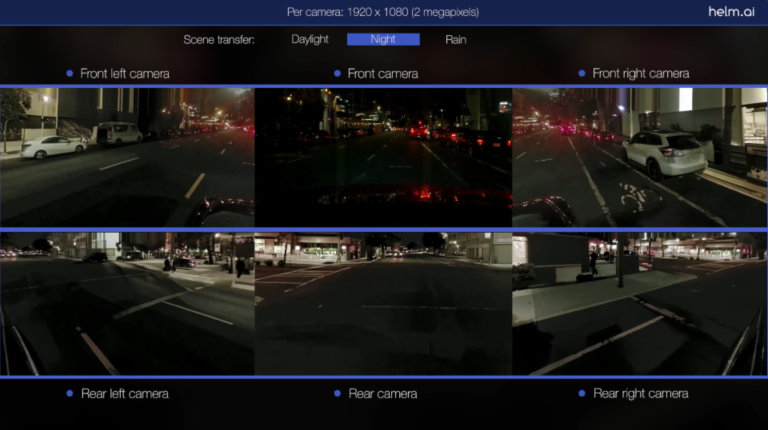
Helm.ai has launched next-generation foundation models, GenSim-3 and VidGen-3, which it says are the first to achieve native full-HD (1,920 x 1,080) resolution across a full six-camera, 360° surround-view suite. By rendering a 12MP fully synchronized synthetic canvas per timestep, Helm.ai reportedly delivers five times higher pixel density than current state-of-the-art benchmarks for generative world models.

The foundation models address what is often referred to as the industry’s data wall, where the cost and effort of collecting real-world edge-case data can slow development. Traditional generative world models typically produce video at sub-HD or VGA resolutions (around 0.4MP per camera). In contrast, Helm.ai generates full-HD (2MP) output that matches the resolution of modern production vehicle cameras, helping to reduce the sim-to-real gap in training for Level 2 and Level 4 autonomous driving systems.

Scene transfer versus fully synthetic generation

Helm.ai’s platform provides auto makers with a pipeline for data augmentation and creation.

GenSim-3 (high-fidelity scene transfer) enables development teams to restylize real-world video synchronously across six-camera, 360° surround-view setups. The model alters parameters such as weather, illumination and object appearance at full-HD (2MP) resolution. Additionally, the latest model introduces improvements in environmental texture, surface reflectivity and light behavior on complex materials.

VidGen-3 (fully synthetic generation) generates highly realistic driving sequences completely synthetically. By simulating complex environments, human-like agent behaviors and traffic logic from scratch, VidGen-3 bridges geographic and environmental data gaps at scale.

The 5X pixel density advantage

The technology’s key breakthrough is the fidelity of the multicamera generative simulation.

By producing full-HD (2MP) video, Helm.ai provides significantly more visual information than traditional generative datasets. Because modern production vehicles use high-resolution camera systems, training data is more effective when it matches that resolution. Lower-resolution synthetic data can create a domain gap when used to train full-HD perception systems. By generating data natively at 2MP per camera, Helm.ai aligns training inputs with real-world sensor output, supporting more consistent model performance in deployment.

To accommodate diverse sensor and training requirements, engineering teams can optimize for dynamic, high-speed validation with three-camera setups at 30fps, or maximize spatial context with a full six-camera, 12MP surround view at 5fps.

The virtual sensor twin

Unlike CGI-based video generation methods, Helm.ai’s models are designed to simulate hardware-like sensor output by incorporating certain physical characteristics of real camera systems. This includes reproducing effects such as sensor noise patterns, lens flares and exposure-related artifacts. This produces training data that more closely reflects real-world camera behavior, helping perception systems learn under conditions similar to those encountered in actual driving environments.

High fidelity on lower compute

While other generative world models rely on the massive computational scaling of thousands of GPUs to generate sub-HD video, the full-HD (2MP) resolution milestone was achieved using a highly optimized cluster of just a few hundred advanced GPUs.

“We are moving the industry from standard ‘AI video’ to authentic, hardware-accurate sensor emulation,” said Vladislav Voroninski, the CEO and founder of Helm.ai. “By leading with a full-HD (2MP) standard and a 12MP total aggregate capability per timestep, we have solved the resolution bottleneck that has historically limited the utility of generative AI in safety-critical systems. By optimizing our compute architecture, we are giving our partners a high-performance platform to validate their autonomous stacks using synthetic data that perfectly matches the fidelity of their actual production sensors.”

In recent news, WeRide and Renault once again offer autonomous bus service at Roland-Garros tournament

Share. Twitter LinkedIn Facebook Email
Previous ArticleNew companies join PAVE UK to promote self-driving education
Next Article Waymo starts public rides with new Ojai robotaxi in Los Angeles, San Francisco and Phoenix

Related Posts

Simulation

rFpro develops Japanese test route digital twin for virtual vehicle development

May 20, 20263 Mins Read
ADAS

Hyundai Mobis accelerates SDV and ADAS validation with large-scale data integration system

April 20, 20263 Mins Read
ADAS

First mass-production deployment of WeRide’s WRD 3.0 ADAS solution in co-developed GAC Aion N60

April 16, 20262 Mins Read
Latest News

Waymo starts public rides with new Ojai robotaxi in Los Angeles, San Francisco and Phoenix

May 29, 2026

Next-generation Helm.ai models deliver full-HD 360° synthetic driving environments

May 29, 2026

New companies join PAVE UK to promote self-driving education

May 29, 2026
FREE WEEKLY E-NEWSLETTER

Receive breaking stories and features in your inbox each week, for free


Enter your email address:


Our Social Channels
  • Facebook
  • LinkedIn
Getting in Touch
  • Free Weekly E-Newsletters
  • Meet the Editors
  • Contact Us
  • Media Pack
RELATED UKI TOPICS
  • Automotive Interiors
  • Automotive Testing
  • Automotive Powertrain
  • Professional Motorsport
  • Tire Technology
  • Media Pack
© 2026 UKi Media & Events a division of UKIP Media & Events Ltd
  • Terms and Conditions
  • Privacy Policy
  • Cookie Policy
  • Notice & Takedown Policy
  • Site FAQs

Type above and press Enter to search. Press Esc to cancel.

We use cookies on our website to give you the most relevant experience by remembering your preferences and repeat visits. By clicking “Accept”, you consent to the use of ALL the cookies.
Cookie settingsACCEPT
Manage consent

Privacy Overview

This website uses cookies to improve your experience while you navigate through the website. Out of these, the cookies that are categorized as necessary are stored on your browser as they are essential for the working of basic functionalities of the website. We also use third-party cookies that help us analyze and understand how you use this website. These cookies will be stored in your browser only with your consent. You also have the option to opt-out of these cookies. But opting out of some of these cookies may affect your browsing experience.
Necessary
Always Enabled
Necessary cookies are absolutely essential for the website to function properly. These cookies ensure basic functionalities and security features of the website, anonymously.
CookieDurationDescription
cookielawinfo-checbox-analytics11 monthsThis cookie is set by GDPR Cookie Consent plugin. The cookie is used to store the user consent for the cookies in the category "Analytics".
cookielawinfo-checbox-functional11 monthsThe cookie is set by GDPR cookie consent to record the user consent for the cookies in the category "Functional".
cookielawinfo-checbox-others11 monthsThis cookie is set by GDPR Cookie Consent plugin. The cookie is used to store the user consent for the cookies in the category "Other.
cookielawinfo-checkbox-necessary11 monthsThis cookie is set by GDPR Cookie Consent plugin. The cookies is used to store the user consent for the cookies in the category "Necessary".
cookielawinfo-checkbox-performance11 monthsThis cookie is set by GDPR Cookie Consent plugin. The cookie is used to store the user consent for the cookies in the category "Performance".
viewed_cookie_policy11 monthsThe cookie is set by the GDPR Cookie Consent plugin and is used to store whether or not user has consented to the use of cookies. It does not store any personal data.
SAVE & ACCEPT