
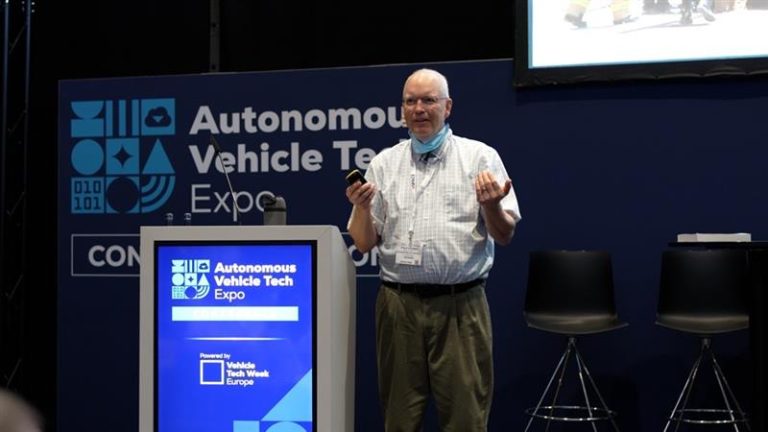
At the Autonomous Vehicle Tech Expo Conference this morning, Prof. Philip Koopman, faculty emeritus at Carnegie Mellon University, gave a thought-provoking presentation on the subject of embodied AI (eAI), also called physical AI, which uses artificial intelligence based on machine learning to interact with the physical world.
“We are already seeing eAI deployed in the real world in robotaxis, smart medical devices, household robots and other applications,” said Koopman. “However, everyone is struggling with the safety of these devices: how to design for safety, how to evaluate safety and how to think about whether any particular eAI system is acceptably safe.”
Koopman’s presentation provided an overview of his new book on this topic, with robotaxi safety as a concrete example. “Anyone working in this area needs a basic understanding of four core areas: safety engineering, cybersecurity engineering, machine learning technology and human/computer interaction,” he said.
The talk also discussed eAI safety issues in the wild, the complexities of establishing what risks might be acceptable and open challenges in eAI safety.
“I think this event is a great way to reach a broad audience in Europe,” Koopman told AAVI immediately after his presentation. “There’s lots of people here, it’s a busy place, lots of people asking good questions, so I’m happy to be here. My key message is that I’m looking forward to where autonomy is used on more than just self-driving cars, but humanoid robots – in fact anything with a computer that has AI in it that can affect the outside world – where safety clearly matters because it can affect the outside world.”
He continued: “In my talk, I was explaining that you need to understand functional safety, you need to understand cybersecurity, you need to understand machine learning and you need to understand computer/human interaction – and that liability matters. So, if you have never read anything on one of those topics, you should not be doing embodied AI or physical AI. You should at least be literate in all those areas to work on physical AI. Currently, there is a big misunderstanding that testing gets you safety, which isn’t true. There’s a thing called safety engineering, and many of the AI folks don’t understand what it means to do safety assurance.”
Keep checking the AAVI website for highlights from the event, which runs until Thursday, June 25. Click here to register for your free expo pass to Vehicle Tech Week Europe 2026