


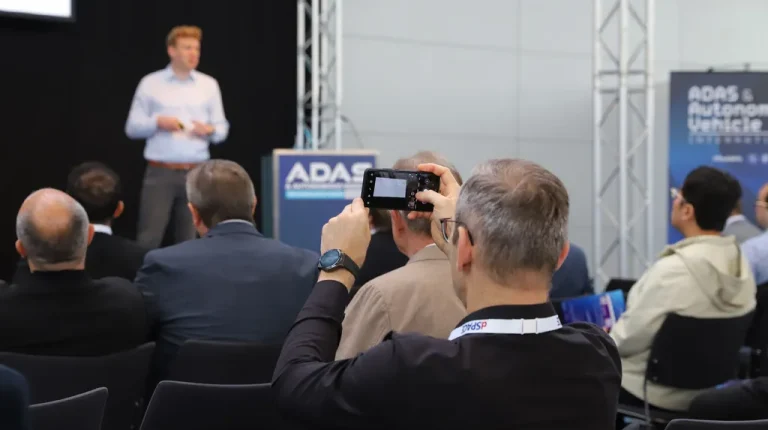
This year’s Autonomous Vehicle Tech Expo (June 23-25, 2026, Stuttgart, Germany) once again includes a three-day conference (rates apply), with over 80 expert speakers from the companies and organizations at the forefront of ADAS and automated driving development. AAVI has picked out some of the presentations it is most looking forward to in this year’s program (see the website for the latest details).
Enhancing the credibility of XIL approaches for automated driving systems using digital twins
 Physical testing efforts for automated driving systems are increasing due to higher automation levels and more rigorous approval requirements. Consequently, front-loading the development process through virtual testing has become an increasingly important task for engineers. To establish credibility and comparability, virtual tests are validated against real-world data. Therefore, digital twins of the test environment, such as proving grounds, vehicles and software, are employed. In a joint presentation, Nils Katzorke, manager of technical operations and development, Immendingen, and Niklas Pfahl, project coordinator – both of Mercedes-Benz – will share how researchers at the OEM, along with the company’s partners, have developed digital environment twins of the German proving ground in Immendingen, and Swedish proving grounds in Arjeplog and Arvidsjaur. These digital twins enable virtual test drives to evaluate driving dynamics, comfort and automated driving functions. To facilitate shift-left testing in the development process, it is essential to provide credible justification for the simulation results. The researchers aim to establish a method for the credibility assessment of virtual simulations, using a combination of local validation and structured credibility argumentation. You can read more about Mercedes-Benz’s Immendingen proving ground here
Beyond typical annotations: adapting data pipelines for VLM-driven cars
 Everyone in the autonomous vehicle industry is excited about vision-language models (VLMs) and vision-language-action (VLA). These models promise to help cars actually understand a scene, rather than just see it. But there is a catch, according to Rafael Oliveira, senior solutions architect at Uber. To teach a model to reason, you cannot just feed it traditional data. Oliveira will argue we are moving past simply drawing boxes around cars and pedestrians. In this talk, he will look at the practical side of how data pipelines must change to support VLM; and discuss how to add rich context and language to your data, ensuring your models get the exact information they need to make smart, human-like decisions on the road. Read more about the divergent paths big tech is taking to mass robotaxi deployment here
How customers ‘drive’ the change toward a new mobility era
 We are entering a new mobility era in which customer lifetime value, acceptance and trust are as critical as technological capability. As autonomous driving and new mobility services evolve, customer journeys are becoming more complex and increasingly shaped by ecosystems rather than single vehicles. During her presentation, Sophie Pohlmann, head of customer experience MaaS/TaaS at Volkswagen Commercial Vehicles, will explore how customer needs, perceptions and behaviors influence the validation and successful deployment of Level 2-4 autonomous technologies. In this context, ‘driving’ as we know it is gradually becoming a thing of the past. You can read more about Moia’s winter testing in Oslo here
From autonomous driving regulation to implementation: why the biggest challenge lies not in the system but in the organization
 Autonomous driving technology is advancing rapidly, while regulatory requirements are increasing and evolving across markets. At the same time, pressure is growing to bring innovation into real-world operation more quickly. Ann-Christin Schneider, head of governance, risk and compliance at Scania, will ask how this can best be achieved. Her presentation will explore a central idea: successful deployment depends not only on the technology itself but equally on the organizational clarity behind it. Drawing on practical experience, her talk will explain why clear ownership, transparent processes and fit-for-purpose operating models are becoming essential to manage complexity, reduce silos and accelerate scalable deployment. Read more on autonomous trucks here
Embodied AI safety
 Embodied AI (eAI), also called physical AI, uses artificial intelligence based on machine learning to interact with the physical world. In this presentation, Prof. Philip Koopman, faculty emeritus at Carnegie Mellon University, will explain how we are already seeing eAI deployed in the real world in robotaxis, smart medical devices, household robots and other applications. However, he will argue that everyone is struggling with the safety of these devices: how to design for safety, how to evaluate safety and how to think about whether any particular eAI system is acceptably safe. During his presentation, Prof. Koopman will provide an overview of his new book on this topic – with robotaxi safety as a concrete example. He will argue that anyone working in this area needs a basic understanding of four core subjects: safety engineering, cybersecurity engineering, machine learning technology and human/computer interaction. The talk will also tackle eAI safety issues in the wild, the complexities of establishing what risks might be acceptable, and open challenges in eAI safety. You can watch an interview with Prof. Koopman following his presentation at last year’s show here (and see below)
You can see the full list of speakers at this year’s Autonomous Vehicle Tech Expo conference here; and you can register for your conference pass (rates apply) here