

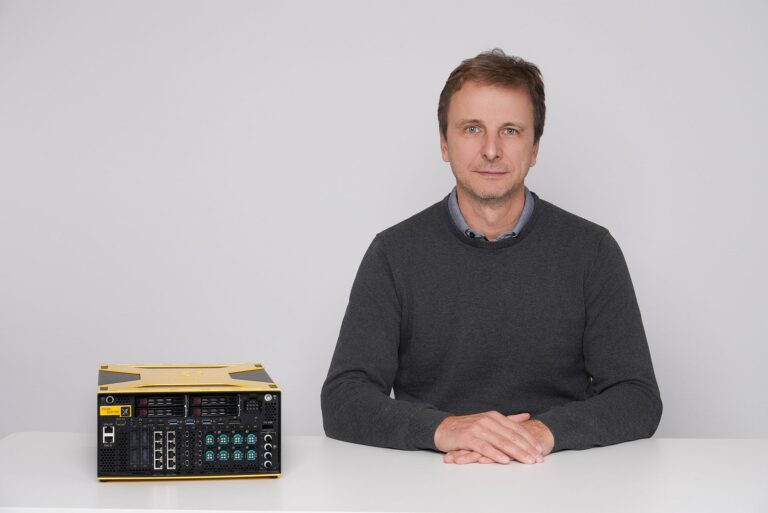
Xylon‘s CEO, Davor Kovačec, discusses the company’s flexible automotive datalogging solutions ahead of CES 2026 in Las Vegas, where visitors to its booth (LVCC West, 4067) can experience both a live HIL and a live computer vision demo.
Why is 2026 an important year for Xylon?
This year marks a milestone for Xylon, as we celebrate 30 years since the company’s founding. Today, Xylon operates globally and is capable of supporting large-scale projects in automotive datalogging as well as the deployment of HIL (hardware-in-the-loop) simulation systems.
Our datalogging and HIL devices are used by leading Tier 1 suppliers and OEMs, for example within the Qualcomm Snapdragon Ride platform ecosystem. Xylon also supplies dataloggers to ZF and works directly with other Tier 1s and OEMs. Our long-standing commitment to intellectual property development and design services in programmable FPGA/SoC technologies, which we have pursued for 30 years, has never wavered. Xylon is also recognized as a premier member of the AMD Embedded Partner Program.
What will you present at this year’s CES?
At the ADAS & Autonomous Vehicle Technology Expo and Automotive Testing Expo events in Europe, the US and Korea, our focus has traditionally been on promoting datalogging systems with HIL capabilities. We will continue this focus at the upcoming CES in Las Vegas (LVCC West, booth 4067), especially as we see growing customer interest in HIL systems capable of faithfully simulating the most advanced ADAS and autonomous driving functions.
We have already achieved significant success in this domain (HIL). Our dataloggers, logiRECORDER and Xylon Quattro, can accurately reproduce all recorded data with full timing fidelity from the original in-vehicle acquisition. Beyond raw data, synthetic data can also be injected into the hardware under test. Over the past few years, we have successfully collaborated with simulation software providers such as IPG, rFpro, Cognata, and others, enabling nearly any simulator to be directly connected to real hardware.
One of our core advantages lies in our programmable platform, which heavily relies on FPGA and programmable SoC chips. This allows us to manipulate synthetic data in ways that are not possible without specialized hardware. For example, we can inject programmed errors in real time or combine synthetic data with metadata from physical sensors. Within the HIL environment, we can emulate a camera, ensuring that simulations continue uninterrupted when the ECU under test expects specific camera responses.
The number of supported automotive interfaces, particularly on the newer Xylon Quattro platform, continues to grow. We support virtually all popular video interfaces and are finalizing or have completed the development of GVIF and MIPI A-PHY compatible modules. In parallel, we are working on implementing and hardware-accelerating widely used communication protocols such as SOME/IP.
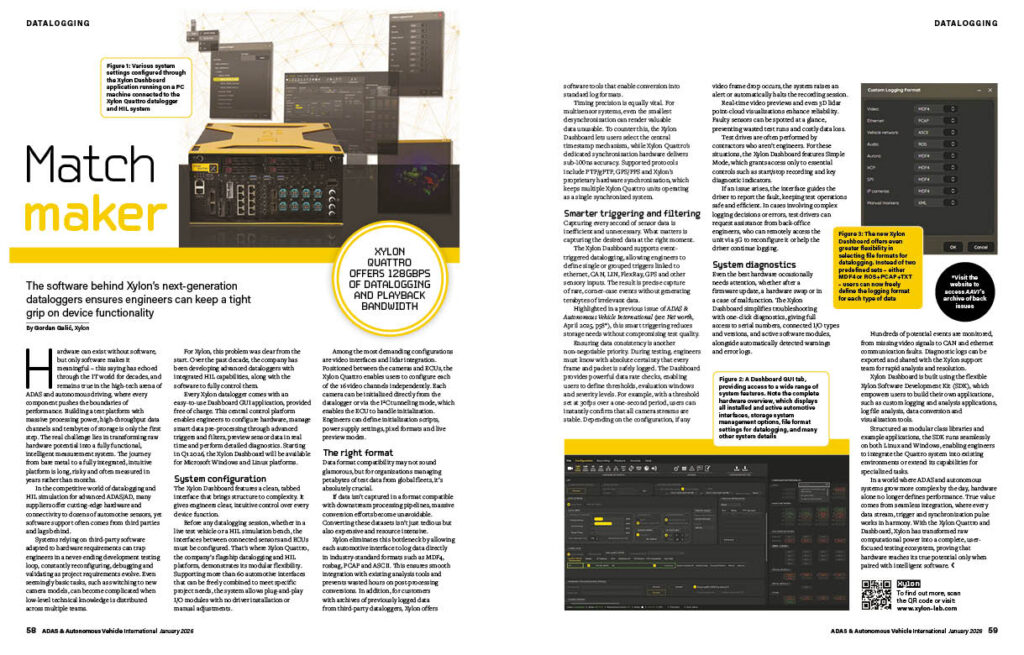
At CES, we plan to provide a comprehensive overview of our capabilities. We will feature a live HIL system demonstrating raw data injection into an AI-based ADAS unit, built using Xylon’s logicBRICKS IP core for AMD programmable devices. In addition to the HIL setup, the Xylon Quattro datalogger will showcase a high-end datalogging configuration with 15+ video cameras, multiple ethernet and CAN channels. Xylon has been developing image processing for RGB-IR sensors for years. This will be demonstrated through a live computer vision demo system using an RGB-IR camera, ensuring visibility under all environmental conditions.
Why should visitors stop by – how can you help them?
As I mentioned earlier, we come to the show with working demo systems configured in very current, relevant setups. From our experience, visitors really appreciate demo systems they can see, touch and interact with. It immediately proves that the capabilities we showcase are not just a vision of the future, but a reality today.
Our systems are highly modular and flexible, and we continuously add new features. Visitors to our booth can learn firsthand about the existing capabilities, discuss their technical challenges with us, and often, we can offer potential solutions right on the spot. I should emphasize that we design all our hardware and software in house, which allows us to meet very specific customer requirements quickly and in highly unique ways, not just at the module level, but even down to the chip level.
To give one example: one of our customers wanted to begin machine learning and AI development for an upcoming ECU. For this purpose, they needed to work with processed, color-corrected video input, as it would be the output of the ECU SoC chip’s image signal processing (ISP). Regular dataloggers capture raw images from the camera, but real-time processing is handled by the ECU, which presents a special challenge. To address this, we integrated our HDR ISP directly into an FPGA chip on the video input IO board and adapted its architecture and output to match the ISP of the selected SoC for the ECU. The result was video captured and processed closely to how it would appear in the future ECU, enabling the customer to start data collection early and accelerate their ML/AI development process.
By visiting our booth, customers can see these solutions in action, explore the flexibility of our systems, and discuss how we could address their unique technical challenges, sometimes even during the show itself.
What is your favourite memory from previous CES shows?
In the past, CES did not have such a strong or well-defined focus on ADAS and autonomous driving. Over the years, it has been exciting to watch that segment steadily grow in visibility and importance.
Through our long-term partnership – originally with Xilinx, and now with AMD, which Xilinx is part of today – Xylon has showcased a wide range of FPGA-based solutions for the automotive industry. Together with our partners, we often introduced early and forward-looking concepts that were not commonly shown elsewhere at the time.
From the perspective of our test and measurement business, CES has also been extremely valuable. Many of our customers exhibit in the LVCC main hall, and the concentration of high-profile prospects creates excellent opportunities for meaningful discussions. One of my fondest memories was meeting the head of test and measurement at one of the largest Tier-1 companies. That initial conversation led to numerous follow-up meetings and ultimately to a very successful business deal.
We’re looking forward to the next CES with great enthusiasm and hoping for more encounters and opportunities like those.
You can read more about Xylon’s datalogging solutions for ADAS and autonomous driving in the January 2026 issue of ADAS & Autonomous Vehicle International magazine