


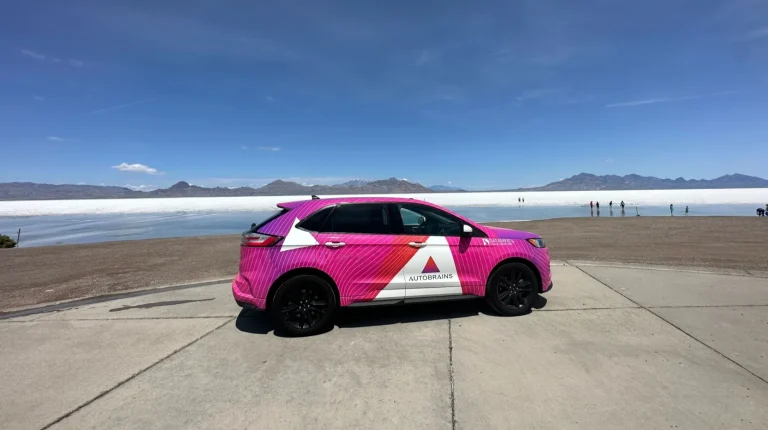
As advanced driver assistance systems (ADAS) and automated driving (AD) systems advance, they grow heavier and more expensive to scale – largely due to monolithic end-to-end architectures that rely on ever-larger models and expanding data requirements. In response, Autobrains has introduced agentic AI to power both ADAS and AD, enabled by its latest driving intelligence architecture.
Instead of relying on a single generalized driving model to handle every possible situation, Autobrains is built on agentic AI – an architecture that organizes driving intelligence into specialized, scenario-focused agents.
Autobrains is currently deploying its agentic AI technology with global automotive partners in programs designed for mass-market vehicles running on standard sensor configurations without reliance on costly high-end compute platforms.
Scaling autonomy without scaling hardware
Within this architecture, multiple driving agents operate in coordination, with only those relevant to the current situation activated at any given moment. According to Autobrains, this selective activation reduces compute load and preserves hardware efficiency, allowing the capability to expand within existing vehicle platforms. It means vehicles do more with less – running advanced driving intelligence on the hardware already inside mass-market cars, without the need for upgrades.
For OEMs, it removes the need to redesign vehicle platforms to unlock new safety features, which can instead be delivered through Autobrains’ agentic AI software.
“Autobrains’ agentic AI approach enables OEMs to evolve driving capability within existing vehicle platforms,” said Igal Raichelgauz, the CEO of Autobrains. “It gives OEMs architectural control over a system designed for continuous capability expansion rather than a fixed, monolithic software stack.”
By structuring intelligence around specialized agents rather than monolithic models, Autobrains enables scalable, cost-efficient autonomy designed to make advanced driving capability accessible to every vehicle.
“Agentic AI represents a structural shift for the industry,” added Raichelgauz. “Autonomy will not scale by adding more hardware. It will scale by organizing intelligence differently. Autobrains AI understands the road like humans do: learning from experience, recognizing patterns and using common sense in real time.”
Related news, AVL and Ansible advance vehicle validation with integrated simulation and driver-in-the-loop testing