

ADAS & Autonomous Vehicle International
  • News
    • A-L
      • ADAS
      • AI & Sensor Fusion
      • Business
      • Connectivity
      • Cybersecurity
      • Expo
      • HMI
      • Last-mile delivery
      • Legislation & Standards
      • Localization/GNSS
    • M-Z
      • Mapping
      • Off-Highway
      • Robo-Taxis
      • Sensors
      • Shared Mobility
      • Safety
      • Simulation
      • Testing
      • Trucks
      • V2X
  • Features
  • Online Magazines
    • January 2026
    • September 2025
    • April 2025
    • January 2025
    • September 2024
    • April 2024
    • January 2024
    • Subscribe
  • Opinion
  • Videos
  • Supplier Spotlight
  • Events
LinkedIn Facebook Twitter
  • Automotive Interiors
  • Automotive Testing
  • Automotive Powertrain
  • Professional Motorsport
  • Tire Technology
  • Media Pack
LinkedIn Facebook
Subscribe
ADAS & Autonomous Vehicle International
  • News
      • ADAS
      • AI & Sensor Fusion
      • Business
      • Connectivity
      • Cybersecurity
      • Expo
      • HMI
      • Last-mile delivery
      • Legislation & Standards
      • Localization/GNSS
      • Mapping
      • Off-Highway
      • Robo-Taxis
      • Sensors
      • Shared Mobility
      • Safety
      • Simulation
      • Testing
      • Trucks
      • V2X
  • Features
  • Online Magazines
    1. January 2026
    2. September 2025
    3. April 2025
    4. January 2025
    5. September 2024
    6. April 2024
    7. January 2024
    8. Subscribe
    Featured
    November 27, 2025

    In this Issue – January 2026

    Online Magazines By Hazel King
    Recent

    In this Issue – January 2026

    November 27, 2025

    In this Issue – September 2025

    July 21, 2025

    In this Issue – April 2025

    April 15, 2025
  • Opinion
  • Videos
  • Supplier Spotlight
  • Expo
  • Awards
    • About
    • 2025 winners
    • Judges
  • Webinars
LinkedIn Facebook
Subscribe
ADAS & Autonomous Vehicle International
Sensors

Roadside radar sensors could reduce blind spots in AV operations

Matt RossBy Matt RossMarch 3, 20264 Mins Read
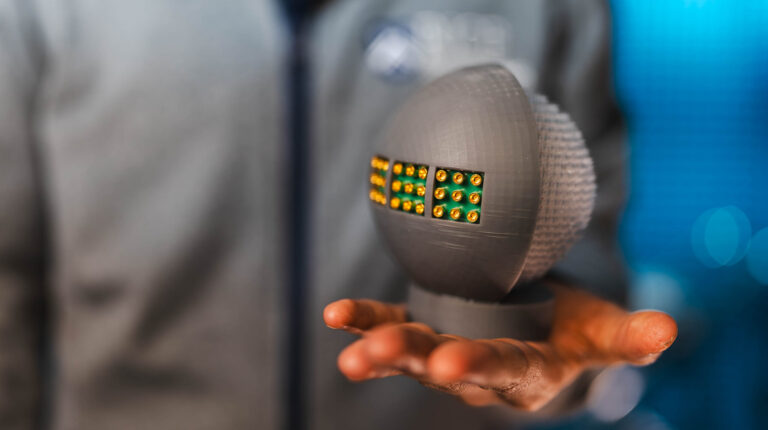
Eyedar.
Share
LinkedIn Twitter Facebook Email

With autonomous vehicles becoming increasingly common on the roads, making them as safe as possible may mean going beyond the specs of the vehicles themselves – and upgrading the roadway infrastructure.

Eyedar, a low-power millimeter-wave radar sensor roughly the size of an orange, could provide radar-equipped AVs with inputs about surrounding traffic, extending and enhancing the vehicles’ sensing accuracy.

Placed at key points such as streetlights and intersections, the sensors could reduce the chances of AVs failing to pick up on emergent obstacles, even when such hazards are not within range of the vehicles’ onboard sensors or when visibility is limited.

Kun Woo Cho, a postdoctoral researcher at Rice University, who leads the Eyedar research project, introduced the technology at HotMobile, The International Workshop on Mobile Computing Systems and Applications, which took place in Atlanta, Georgia, last week.

“Current automotive sensor systems like cameras and lidar struggle with poor visibility such as you would encounter due to rain or fog or in low-lighting conditions,” said Cho, who works in the lab of Ashutosh Sabharwal, Rice’s Ernest Dell Butcher Professor of Engineering and professor of electrical and computer engineering. “Radar, on the other hand, operates reliably in all weather and lighting conditions and can even see through obstacles.”

Radar systems transmit signals in a given direction, and when a signal encounters an obstacle in its path, part of it reflects back to the source, carrying information about the obstacle. However, only a small fraction of the radar signal emitted is reflected back, and most of it bounces away from the source device.

In the context of self-driving vehicles, this means that a large fraction of the emitted radar signal scatters away from the vehicle, leaving an incomplete view of its surroundings. Pedestrians emerging from behind large vehicles, cars creeping forward at intersections or cyclists approaching at odd angles can easily go unnoticed.

Thanks to its placement on roadside infrastructure such as traffic lights, stop signs or streetlights, Eyedar can capture radar reflections that would otherwise be lost. The device’s unique structure enables it to determine the direction of reflected signals and report that information back to self-driving vehicles.

“It is like adding another set of eyes for automotive radar systems,” said Cho, who specializes in metamaterial antenna design.
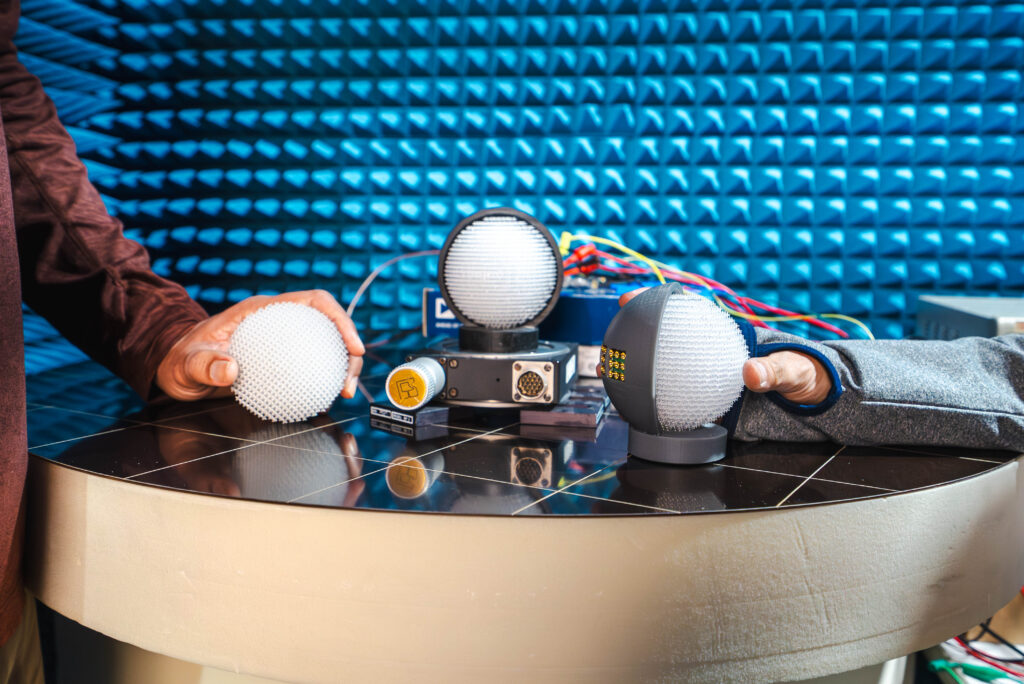
Eyedar.

The design of Eyedar is inspired by the human eye. The device consists of two main components: a 3D-printed Luneburg lens made from resin, focusing incoming signals from any direction onto a focal point on the opposite surface; and an antenna array surrounding the lens on the back end, which functions like a retina, detecting the signal and determining its direction.

Whereas conventional radar systems rely on large antenna arrays and complex algorithms to estimate angles, Eyedar’s physical design does most of the computation work typically required for direction finding ⎯ one of the most power- and data-intensive tasks in radar processing.

“Our lens consists of over 8,000 uniquely shaped, extremely small elements with a varying refractive index,” Cho said.

Through an intentional distribution of these elements, the lens structure interacts with incoming radar signals, routing them to the right spot on the antenna array. The approach has proved fruitful: in testing, Eyedar was able to resolve target directions more than 200 times faster than traditional radar designs.

Moreover, Eyedar communicates what it sees without transmitting new signals. Instead, the sensor alternates between absorbing incoming radar waves and reflecting them back to the source radar in a form it can interpret as a sequence of zeros and ones.

“Eyedar is a talking sensor,” Cho said, “It is a first instance of integrating radar sensing and communication functionality in a single design.”

This combination of sensing and communication in a compact, inexpensive, low-power architecture makes it feasible to deploy large numbers of sensors across roadways. In the case of self-driving cars, the system could be particularly suited to dense, high-traffic urban settings. However, the potential application space is much wider: Eyedar could be integrated into robots, drones and wearable platforms. Networks of these sensors could also share information with one another, allowing each device to see well beyond its own range of sight.

In related news, Forterra selects Aeva 4D lidar for autonomous vehicle system

Share. Twitter LinkedIn Facebook Email
Previous ArticleWaymo expands autonomous ride-hailing service to four US cities
Next Article XPeng to deploy second-generation AI-driven autonomous driving system by 2027

Related Posts

ADAS

Tensor and Arm collaborate on agentic robocar

February 27, 20262 Mins Read
Safety

bitsensing brings ADAS kit to the commercial vehicle sector

February 6, 20263 Mins Read
Sensors

Forterra selects Aeva 4D lidar for autonomous vehicle system

January 23, 20262 Mins Read
Latest News

XPeng to deploy second-generation AI-driven autonomous driving system by 2027

March 3, 2026

Roadside radar sensors could reduce blind spots in AV operations

March 3, 2026

Waymo expands autonomous ride-hailing service to four US cities

March 2, 2026
FREE WEEKLY E-NEWSLETTER

Receive breaking stories and features in your inbox each week, for free


Enter your email address:


Our Social Channels
  • Facebook
  • LinkedIn
Getting in Touch
  • Free Weekly E-Newsletters
  • Meet the Editors
  • Contact Us
  • Media Pack
RELATED UKI TOPICS
  • Automotive Interiors
  • Automotive Testing
  • Automotive Powertrain
  • Professional Motorsport
  • Tire Technology
  • Media Pack
© 2025 UKi Media & Events a division of UKIP Media & Events Ltd
  • Terms and Conditions
  • Privacy Policy
  • Cookie Policy
  • Notice & Takedown Policy
  • Site FAQs

Type above and press Enter to search. Press Esc to cancel.

We use cookies on our website to give you the most relevant experience by remembering your preferences and repeat visits. By clicking “Accept”, you consent to the use of ALL the cookies.
Cookie settingsACCEPT
Manage consent

Privacy Overview

This website uses cookies to improve your experience while you navigate through the website. Out of these, the cookies that are categorized as necessary are stored on your browser as they are essential for the working of basic functionalities of the website. We also use third-party cookies that help us analyze and understand how you use this website. These cookies will be stored in your browser only with your consent. You also have the option to opt-out of these cookies. But opting out of some of these cookies may affect your browsing experience.
Necessary
Always Enabled

Necessary cookies are absolutely essential for the website to function properly. These cookies ensure basic functionalities and security features of the website, anonymously.

CookieDurationDescription
cookielawinfo-checbox-analytics11 monthsThis cookie is set by GDPR Cookie Consent plugin. The cookie is used to store the user consent for the cookies in the category "Analytics".
cookielawinfo-checbox-functional11 monthsThe cookie is set by GDPR cookie consent to record the user consent for the cookies in the category "Functional".
cookielawinfo-checbox-others11 monthsThis cookie is set by GDPR Cookie Consent plugin. The cookie is used to store the user consent for the cookies in the category "Other.
cookielawinfo-checkbox-necessary11 monthsThis cookie is set by GDPR Cookie Consent plugin. The cookies is used to store the user consent for the cookies in the category "Necessary".
cookielawinfo-checkbox-performance11 monthsThis cookie is set by GDPR Cookie Consent plugin. The cookie is used to store the user consent for the cookies in the category "Performance".
viewed_cookie_policy11 monthsThe cookie is set by the GDPR Cookie Consent plugin and is used to store whether or not user has consented to the use of cookies. It does not store any personal data.

Functional

Functional cookies help to perform certain functionalities like sharing the content of the website on social media platforms, collect feedbacks, and other third-party features.

Performance

Performance cookies are used to understand and analyze the key performance indexes of the website which helps in delivering a better user experience for the visitors.

Analytics

Analytical cookies are used to understand how visitors interact with the website. These cookies help provide information on metrics the number of visitors, bounce rate, traffic source, etc.

Advertisement

Advertisement cookies are used to provide visitors with relevant ads and marketing campaigns. These cookies track visitors across websites and collect information to provide customized ads.

Others

Other uncategorized cookies are those that are being analyzed and have not been classified into a category as yet.

SAVE & ACCEPT