


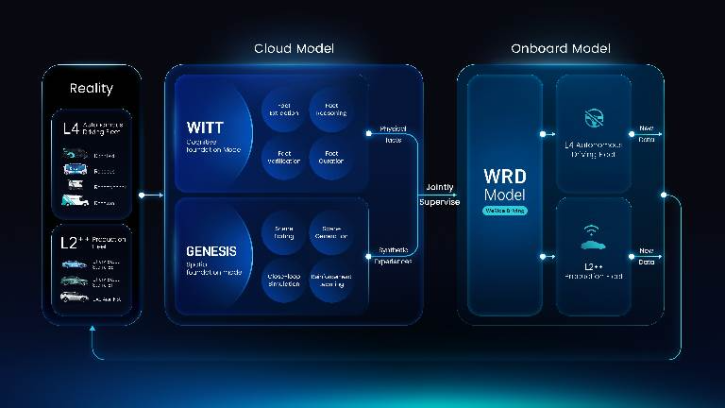
WeRide has unveiled WeRide WITT (World Intelligence Toward Truth), which it describes as a physical AI cognitive foundation model designed to build AI cognition of the physical world through trusted facts extracted from real-world experience.
Leveraging visual-language model (VLM) capabilities, WeRide WITT has introduced a new concept called Atomic Physical Facts (APFs) and established a fact-based cognitive framework for Physical AI, according to the company. By connecting multimodal information across video, images and text, WeRide WITT decomposes continuously evolving real-world environments into verifiable facts that can be identified, reasoned about and validated, establishing a new generation of AI understanding centered on physical facts, WeRide says.
WITT stands for World Intelligence Toward Truth and is inspired by the philosopher Ludwig Wittgenstein, whose proposition that “the world is the totality of facts” closely aligns with the underlying logic of physical AI. To build cognition of the physical world, AI must first identify trusted facts embedded in environments, behaviors, rules, risks and temporal relationships. These facts become the foundation for reasoning, judgment and decision-making.
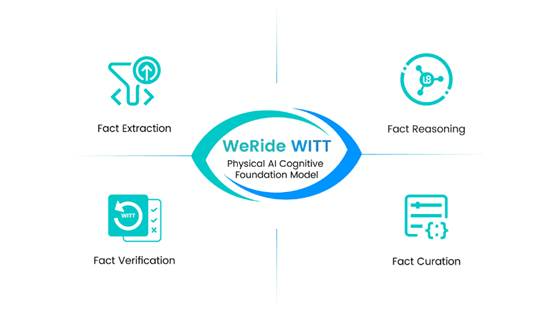
Rooted in WeRide’s large-scale autonomous driving operations, WITT continuously extracts patterns, relationships and trusted facts from vast volumes of operational data. Rather than treating data as raw inputs for model training, WeRide WITT treats trusted facts as the fundamental building blocks of physical AI cognition. This foundation enables the model to transform real-world experience into structured knowledge through four core capabilities: fact extraction, fact reasoning, fact verification and fact curation.
The company says together, these capabilities create a complete pipeline spanning scene understanding, event attribution, data validation and learning curation – enabling every kilometer of real-world driving data to become a trusted signal for model improvement.
Fact extraction
WeRide WITT identifies and extracts three categories of Atomic Physical Facts from real-world driving data: standard driving facts, multi-agent interaction facts and physically ambiguous conditions. Together, these facts capture everyday traffic behaviors, evolving relationships among traffic participants, and uncertainty within complex physical environments.
For example, a driving video can be decomposed into multiple Atomic Physical Facts, including reduced visibility caused by rain, a pedestrian entering a crosswalk, an ego vehicle slowing down, a nearby vehicle traveling in parallel, changing traffic signals and increasing collision risk. Each fact is designed to be highly reliable, traceable and verifiable, enabling richer scene descriptions and providing the foundation for subsequent reasoning, validation and learning.
Fact reasoning
After extracting facts, WeRide WITT analyzes key events, behavioral relationships and evolving risks within a scene, while identifying the underlying causes and potential trajectories of those events.
During the R&D phrase of autonomous driving, engineers often need to search vast video datasets for specific long-tail scenarios, such as pedestrians suddenly crossing in construction zones, lane departures under poor visibility conditions, or complex yielding maneuvers in narrow-road encounters. Powered by an integrated video intelligence engine, WeRide WITT enables users to retrieve target scenarios through keywords or natural-language queries, dramatically improving the efficiency of scenario discovery, data investigation and root-cause analysis.
Fact verification
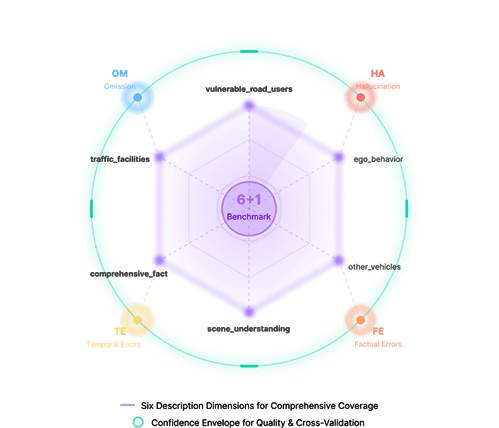
To reduce hallucinations commonly associated with general-purpose AI models, WeRide WITT evaluates outputs across six dimensions: vulnerable road users; ego-vehicle behavior; surrounding vehicle behavior; scene understanding; comprehensive fact; and traffic facilities.
The model introduces factual confidence scoring and validates conclusions against external physical evidence to determine whether interpretations are supported by observable reality.
By tracking factual errors, hallucinations, omissions and temporal inconsistencies, WeRide WITT provides both a quality benchmark for data users and a preference signal for model training, continuously guiding AI systems toward more accurate and physically grounded understanding.
Today, WeRide WITT achieves an average factual error rate approximately one-third that of leading general-purpose AI models in autonomous driving scenario understanding tasks.
Fact curation
In real-world operations, not all data contributes equally to model learning. WeRide WITT automatically identifies high-value facts and routes them into the most effective learning workflows to maximize model improvement.
Rare long-tail scenarios can be returned to WeRide GENESIS, the company’s proprietary general-purpose simulation model, for simulation training and scenario expansion. High-frequency everyday scenarios can support reinforcement learning and workflow optimization. Abnormal or ambiguous data can be directed into review processes to prevent valuable information from being mistakenly discarded as noise. By ensuring that every piece of data follows the most appropriate learning path, WeRide WITT maximizes the value of real-world operational data and continuously converts experience into model intelligence.
Within WeRide’s physical AI architecture, WeRide WITT serves as the critical understanding and evaluation layer. Together with WeRide GENESIS, WeRide WITT forms a physical AI flywheel that continuously converts real-world experience into model improvement.
WeRide WITT extracts, understands, verifies and curates physical facts from real-world data, while GENESIS generates high-fidelity simulation environments and long-tail training scenarios based on those facts. Together, the two systems train and improve vehicle-side models, enabling autonomous driving systems to continuously evolve through both real-world experience and synthetic-world learning.
Compared with general-purpose AI models that often rely on hundreds of billions of parameters, WeRide WITT delivers strong performance with a significantly more efficient architecture. The company says the model reduces token costs by up to 98%, processes up to 10,000 minutes of vehicle-operation video per day on a single GPU and delivers up to 200 times greater data-processing efficiency in comparable workloads.
In labeling workflows, a single request to WeRide WITT can generate more than 100 dynamic tags, enabling massive volumes of real-world driving video to be rapidly retrieved, validated and incorporated into model-development pipelines, where they become continuously accumulating fact assets.
You can read more about the latest world models in an exclusive feature first published in the April 2026 isssue of ADAS & Autonomous Vehicle International magazine. Subscribe here to receive future issues.
Related news, Toyota builds AI-defined mobility platform with Nvidia