


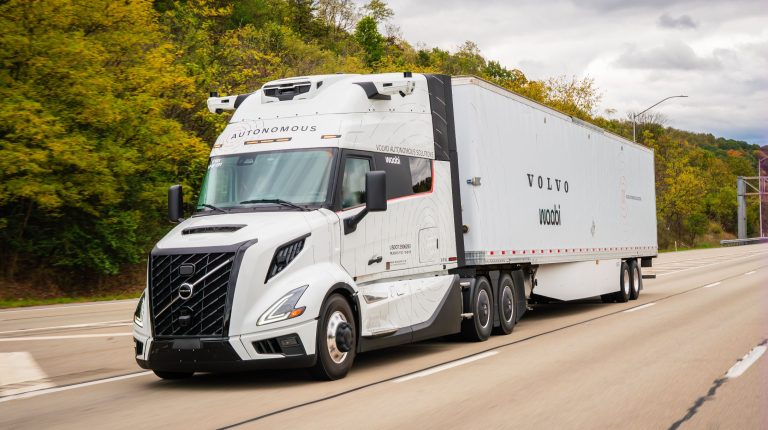
Physical AI systems must be capable of generalizing across new situations and tasks, applying learned knowledge reliably and safely in unfamiliar conditions. Waabi has announced the results of its zero-shot transfer, marking a significant step toward scalable autonomous vehicle deployment.
Generalization in self-driving takes two distinct forms.
The first is the ability to generalize across environments and behaviors, applying knowledge and skills safely across different operational design domains (ODDs), from highways to dense urban streets, varying traffic patterns, road geometries and driving behaviors. Waabi’s Driver system addresses this through an end-to-end AI approach with reasoning capabilities that, in Q1 2025, it expanded beyond highway operation to complex urban surface streets.
The second frontier is generalization across embodiments, the ability to transfer to a new vehicle platform with different sensors, control systems and physical characteristics. Historically, adapting to each new platform has required extensive engineering, data collection, retraining and validation.
To address this, Waabi designed the Driver as a single AI system intended to adapt automatically to different vehicle platforms without requiring retraining for each new embodiment, drawing an analogy to how a human driver can operate an unfamiliar vehicle without relearning the fundamentals of driving.
Volvo VNL Autonomous powered by the Waabi Driver
To test this capability, Waabi worked with Volvo Autonomous Solutions to integrate the Driver system into the Volvo VNL Autonomous, a vehicle platform the Driver had not previously operated on.
The Waabi Driver generalized to the Volvo VNL Autonomous zero-shot, without new real-world data, simulation data or fine-tuning. Waabi says the system performed fully from the first mile, operating autonomously across both highways and complex surface streets.
Waabi says the result demonstrates zero-shot generalization across platforms with different vehicle sizes, sensor suites and control systems, and points to it as evidence of the Driver’s ability to transfer learned knowledge across varied driving environments and vehicle form factors.
The Waabi Driver, trained on a Peterbilt 579, was transferred zero-shot to the Volvo VNL Autonomous, a platform with different sensors, control systems and physical characteristics, without requiring new real-world data, simulation data, fine-tuning or additional engineering.
“Road testing the Volvo VNL Autonomous, integrated with the Waabi Driver, on public roads is an important proof point of our partnership with Waabi. It also demonstrates the scalability of Volvo’s autonomous truck platform, which is designed to integrate different vehicle models and virtual drivers to enable a wide range of use cases and applications. Together with Waabi, we are advancing autonomous transportation solutions toward commercial reality,” explained Nils Jaeger, president, Volvo Autonomous Solutions.
“This is a defining moment for physical AI. For the first time in the industry, we have shown that a virtual driver can generalize across fundamentally different embodiments without requiring a single training example – real or simulated – or fine-tuning. This capability has the potential to transform far more than transportation. It is the foundation for a new generation of intelligent machines that can adapt, scale and operate across the physical world, creating possibilities and opportunities we can scarcely imagine today,” said Raquel Urtasun, founder and CEO, Waabi.
In related news, Automated Driving Alliance develops scalable AI-based software stack for Level 2 ADAS