


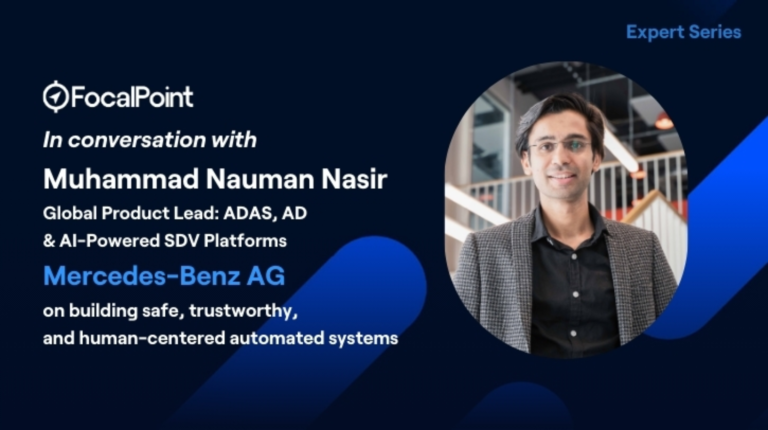
In this interview with Focal Point Positioning, Muhammad Nauman Nasir, ADAS lead at Mercedes-Benz, explains how cutting-edge vehicle autonomy balances innovation, safety and trust – emphasizing that in ADAS, every line of code carries both a moral and a technical responsibility.
ADAS technology sits at the intersection of innovation and safety-critical systems. How do you balance the push for cutting-edge features with the absolute necessity of reliability and safety?
In ADAS, innovation without safety is not ambition, it is irresponsibility. Every single line of code must be written with a human life in mind. That sounds like a constraint. It is actually the most clarifying design principle you can operate with.
The rule I live by is simple: you don’t ship a feature because it’s impressive, you ship it because it’s trustworthy. That is the difference between a demo and a product. Innovation asks, “What’s possible?” Safety asks, “What’s predictable and controllable?” The art of this work is holding both questions in tension, simultaneously, without flinching.
“If I wouldn’t put my own family in this vehicle today, we are not shipping”
The real friction isn’t between safety and innovation, it’s between speed and thoroughness. We resolved it by investing in architecture upfront: ISO 26262 compliance, rigorous SIL/MIL/HIL validation pipelines, AI-driven DevOps. When your foundation is unshakeable, you can innovate faster, not slower. Safety accelerates, it doesn’t brake.
My personal line in the sand: if I wouldn’t put my own family in this vehicle today, we are not shipping. That standard sounds extreme. It keeps people alive. Safety isn’t a constraint, it is the design philosophy itself. Build trust, and innovation scales. Break trust once and it collapses. That is not a technical position. It is a moral one.
You’ve worked across autonomy levels from L2+ to L4. How do the technical and regulatory challenges change as you move up those levels and how do they impact liability/insurance?
Each autonomy level isn’t just a technical upgrade, it is a transfer of responsibility.
At L2, the human remains in the loop: the system assists, the human decides.
At L3, the machine conditionally takes the wheel and that single shift creates a legal earthquake. Who is liable when the car makes a decision and that decision causes harm?
At L4, the system operates independently within defined domains.
Technically, complexity grows exponentially as you move up the stack. Redundancy becomes mandatory. Fail-operational systems are required. Scenario coverage explodes from thousands to millions of edge cases. The architecture must be designed not just to perform but to fail gracefully, predictably and safely.
Regulatory and insurance frameworks must evolve in lockstep. The higher the autonomy, the more responsibility migrates from the driver to the system, shifting from consumer insurance to product liability and B2B risk models. Regulators stop asking, “Does it work?” and start asking, “How does it fail?” That is a fundamentally different conversation and it demands a fundamentally different engineering culture.
What I always say is this: we are no longer just engineering systems, we are engineering ethics at scale. Autonomy is not a product. It is a partnership between humans, machines and policymakers. The higher the level of autonomy, the more that partnership demands trust, and trust is built through transparency, accountability and radical honesty. Not just through technology.
How can OEMs balance cost, safety, and redundancy when designing sensor suites?
This is one of the most practical and underappreciated challenges in the industry. The natural instinct is to add more sensors in the name of safety. But more sensors mean more cost, more power draw, more data to process and, counterintuitively, more potential failure points. The answer isn’t more. It’s smarter.
Redundancy doesn’t mean stacking hardware. It means intelligent architecture. The winning philosophy is minimum necessary redundancy with maximum validated coverage. You don’t design a sensor suite for what might happen in a test lab, you design it for every edge case that can occur at 3am in a rainstorm on an unmarked rural road. That’s a data and software challenge as much as it is a hardware one.
“The answer isn’t more sensors. It’s smarter architecture, minimum redundancy, maximum validated coverage”
The future belongs to platform thinking, software-driven perception fusion, modular sensor architectures that scale from entry-level to flagship and AI models trained on real-world complexity rather than controlled scenarios. We optimize cost not by cutting corners but by designing systems that are reusable, validated once and deployed everywhere.
Cost discipline and safety are not opposites. They never were. Good systems engineering aligns both, and the OEMs that internalize that truth first will have a structural cost advantage that compounds across every future platform generation.
What’s your perspective on where we currently stand in the journey toward fully autonomous vehicles? What are the realistic next milestones versus the hype?
We are between maturity and hype correction. Here is what is genuinely, demonstrably real right now: L3 is commercially deployed and legally certified on public roads. Robotaxis are operating at meaningful scale in multiple cities without safety drivers in the vehicle. L4 is live in geofenced urban environments today. These are not demos. These are products in the hands of real customers. That progress deserves full acknowledgment.
“The industry has shifted from, ‘Can we do this?’ to, ‘Can we deploy it safely and profitably at scale?’ That is maturity”
The realistic milestones over the next three to five years are broader L3 certification expanding across Europe and Asia-Pacific, accelerating L4 robotaxi deployment into additional urban corridors, and the commoditization of L2+ safety features across mass-market vehicles globally. Those milestones are achievable. Those are happening right now.
The industry is shifting from asking, “Can we do this?” to asking, “Can we deploy this safely, sustainably and profitably at scale?” That is not a retreat from ambition. That is the maturity the industry needed. And ubiquitous, reliable L3 and L4 in well-mapped corridors by 2030 will save hundreds of thousands of lives annually. That alone makes every year of this work worth it.
About Muhammad Nauman Nasir
Muhammad Nauman Nasir is a global mobility executive shaping the future of AI-powered, software-defined vehicles by bridging technology, strategy and human-centered design. At Mercedes-Benz, he leads advanced driver assistance and software transformation initiatives and has contributed to launching the MB.OS software platform and delivering the world’s first certified Level 3 autonomous driving system to production. He champions human-centered AI through the Co-Pilot Mindset philosophy, designing systems that amplify human judgment while building trust and safety.
* Muhammad Nauman Nasir was interviewed by GNSS specialist Focal Point Positioning, whose S-GNSS Auto software ensures GNSS reliability in challenging environments such as urban canyons and under foliage. Integrated onto STMicroelectronics Teseo V and Teseo VI devices, this joint solution is offered as a seamless firmware upgrade, empowering OEMs to advance their ADAS and V2X capabilities.
Disclaimer: The views and opinions expressed in this chapter are solely those of the author and do not necessarily reflect the views, policies or strategies of the author’s employer or any affiliated organization. The content is provided for informational and educational purposes only and should not be construed as official guidance or endorsement by the author’s firm or its affiliates.
In related news, Augustin Friedel explains how OEMs can succeed in SDV/AV transformation