


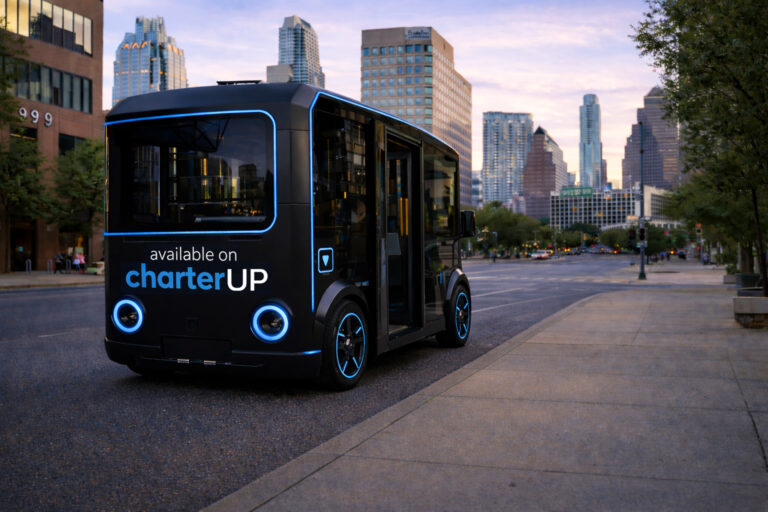
Having recently partnered with Holon to create a scalable pathway for organizations to introduce autonomous services into existing transportation systems, AAVI recently caught up with Armir Harris, CharterUP’s  founder and CEO to find out more about how the partnership combines Holon’s autonomous technology and operational systems with CharterUP’s end-to-end software platform and deployment expertise. CharterUP will deploy Holon’s integrated autonomous mobility solution across its AI-enabled network, including campuses, airports, transit agencies and community environments.
Can you describe CharterUP’s current operation?
CharterUP manages the largest group transportation marketplace in North America, providing access to thousands of vehicles across all 50 states and Canada. CharterUP works with over 700 unique operators and has access to over 8,000 vehicles on its platform. To date, CharterUP has moved over 21 million passengers.
What is the business case for including autonomous vehicles?
CharterUP works across many disciplines. From one-off marketplace bookings to substantial, multi-year shuttle and charter contracts with large corporations, k-12 districts, universities, municipalities, airports, general contractors, emergency management agencies, and more.
Autonomous vehicles are a natural fit for high-frequency shuttle environments where routes are predictable and demand is consistent. Campuses, airports, and private communities are ideal early use cases because they already rely on structured shuttle networks that operate throughout the day.
What are the challenges?
Like any emerging technology, autonomous mobility requires thoughtful deployment and integration into existing transportation systems. Regulatory frameworks are still evolving state-by-state, and building public trust with autonomous vehicles will take time.
How can CharterUP help?
We currently manage – through our AI-enabled Transit Intelligence Platform – multiple, large-scale transportation programs. These cover a variety of environments including university and airport shuttles, construction and workforce transportation, and large event mobility. Integrating AVs into the same system allows partners to introduce autonomy in a phased approach while maintaining the same tools they’re comfortable with today.
What changes would you like to see to current regulations and safety frameworks?
It’s encouraging to see states like California, Arizona, Texas, and Florida taking a leadership role in advancing autonomous vehicle deployment. As the technology continues to mature, clear and consistent regulatory frameworks across additional states will be important to support nationwide scaling and adoption. Collaboration between operators, manufacturers, and regulators will help strengthen safety standards while building the necessary public trust.
What is the ideal controller-to-vehicle ratio to make autonomy work, financially?
This ratio will depend on a number of factors, most importantly the operating environment and maturity of the technology. Early deployments will include more oversight, with that structure evolving over time as systems mature and confidence grows.
How do you decide on the optimum route?
Route designs will always vary based on the current conditions, but ‘primary’ route design will be driven by historical trip data and demand patterns. CharterUP’s platform already analyzes these factors to aid in current shuttle optimization across campuses, airports and other environments.
How will autonomous vehicles redefine mobility?
Autonomous vehicles have the potential to expand transportation access and improve efficiency across busy environments. We see autonomy as an evolution for mobility, and we’re proud to be in the unique position to help shape this evolution for the generations to come.