


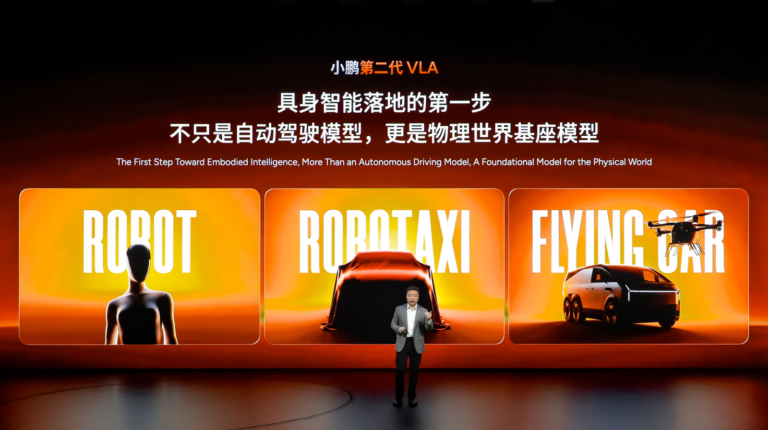
Chinese auto maker XPeng has announced that its second-generation Vision-Language-Action autonomous driving system (VLA 2.0) will begin global delivery in 2027, with Volkswagen designated as the inaugural launch partner in the Chinese market.
In addition, this month will see the company begin rolling out its XOS 5.8.7 over-the-air update to existing vehicle owners in Europe.
At XPeng’s launch event in Amsterdam, Netherlands, on March 2, the company showcased VLA 2.0’s architecture and outlined the global rollout strategy.
The evolution to VLA 2.0 marks a significant advance in AI-controlled driving. Unlike traditional VLA models that rely on a sequential vision‑language‑action pipeline, VLA 2.0 uses an end-to-end vision-to-action architecture that removes intermediate language-based translation layers and directly converts perception into driving decisions. This design reduces dependence on high-definition maps and rigid rules, enabling the system to interpret complex environments and make faster, human-like driving actions.
Early tests in dense urban and mixed-traffic conditions have shown robust performance, with a 23% improvement in driving efficiency. The system can identify erratic vehicles, navigate accident scenes, yield to small animals, start from a standstill and handle diverse real-world conditions, including campus lanes, rural dirt roads, non-navigable routes and potholes.
“XPeng’s VLA 2.0 is the first version designed to achieve full autonomous driving and will iterate at an unprecedented pace,” said He Xiaopeng, chairman and CEO of XPeng. “We believe that full autonomy will arrive within the next one to three years, making autonomous driving a natural part of people’s daily travel.”
The deployment of VLA 2.0 will begin in China, where XPeng’s robotaxis equipped with the system have entered supervised public-road testing, with trial operations scheduled to begin later this year. Volkswagen will be the first customer and commercial partner to adopt the VLA 2.0 intelligent driving system in China.
Beyond passenger vehicles, the AI foundation model powering VLA 2.0 is designed as a platform for multiple embodied AI systems, including robotaxi fleets, humanoid robots and modular flying vehicles.
As part of the global rollout, XPeng will soon begin overseas road validation of VLA 2.0, focusing on international driving conditions. The company has targeted global deployment by 2027. The system’s capabilities will be activated in each market upon regulatory approval, reflecting its design in line with evolving international standards.
Meanwhile, the update to XOS 5.8.7 will include refinements for daily European driving. Optimizations to adaptive cruise control and lane-centering control reduce unnecessary deceleration and eliminate small-amplitude steering wheel oscillations on straight roads. Additional enhancements include improved system stability, stronger CarPlay and Android Auto connectivity, optimized interface language displays and faster OTA update speeds.
In related news, Motive launches edge AI dashcam with enhanced risk-detection capabilities