


ADAS & Autonomous Vehicle International
  • News
    • A-L
      • ADAS
      • AI & Sensor Fusion
      • Business
      • Connectivity
      • Cybersecurity
      • Expo
      • HMI
      • Last-mile delivery
      • Legislation & Standards
      • Localization/GNSS
    • M-Z
      • Mapping
      • Off-Highway
      • Robo-Taxis
      • Sensors
      • Shared Mobility
      • Safety
      • Simulation
      • Testing
      • Trucks
      • V2X
  • Features
  • Online Magazines
    • January 2026
    • September 2025
    • April 2025
    • January 2025
    • September 2024
    • April 2024
    • January 2024
    • Subscribe
  • Opinion
  • Videos
  • Supplier Spotlight
  • Events
LinkedIn Facebook Twitter
  • Automotive Interiors
  • Automotive Testing
  • Automotive Powertrain
  • Professional Motorsport
  • Tire Technology
  • Media Pack
LinkedIn Facebook
Subscribe
ADAS & Autonomous Vehicle International
  • News
      • ADAS
      • AI & Sensor Fusion
      • Business
      • Connectivity
      • Cybersecurity
      • Expo
      • HMI
      • Last-mile delivery
      • Legislation & Standards
      • Localization/GNSS
      • Mapping
      • Off-Highway
      • Robo-Taxis
      • Sensors
      • Shared Mobility
      • Safety
      • Simulation
      • Testing
      • Trucks
      • V2X
  • Features
  • Online Magazines
    1. January 2026
    2. September 2025
    3. April 2025
    4. January 2025
    5. September 2024
    6. April 2024
    7. January 2024
    8. Subscribe
    Featured
    November 27, 2025

    In this Issue – January 2026

    Online Magazines By Hazel King
    Recent

    In this Issue – January 2026

    November 27, 2025

    In this Issue – September 2025

    July 21, 2025

    In this Issue – April 2025

    April 15, 2025
  • Opinion
  • Videos
  • Supplier Spotlight
  • Expo
  • Awards
    • About
    • 2025 winners
    • Judges
  • Webinars
LinkedIn Facebook
Subscribe
ADAS & Autonomous Vehicle International
Features

FEATURE*: Augustin Friedel on how OEMs can succeed in SDV/AV transformation

Zahra AwanBy Zahra AwanFebruary 26, 20265 Mins Read
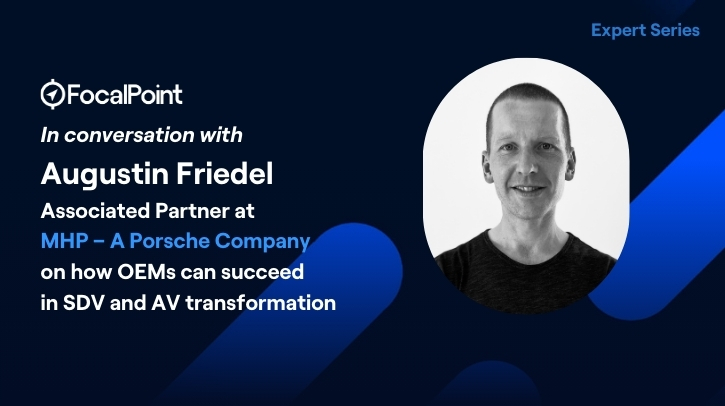
A dark blue image with the title of the article in white text on the left hand side and a headshot of interviewee Augustin Friedel, associated partner at MHP, on the right.
Share
LinkedIn Twitter Facebook Email

Augustin Friedel, a software-defined vehicle expert and associated partner at MHP, shares a candid view of what it takes for incumbent OEMs to make the leap to software-led operating models, how to think about the path to a full software-defined vehicle (SDV), and what it will take to build customer trust as autonomy scales.

You guide OEMs through SDV transformation. What is the biggest organizational barrier you see when large, legacy companies move toward software-led models? 

Willingness and ability to change is the number one barrier, and it shows up in subtle but systematic ways. Even when top decision makers signal a clear intent to move toward software-led practices, other streams in the organization often resist or quietly avoid change. Many legacy firms resemble ‘ice‑cream sandwich’ organizations: enthusiastic vision at the top and strong execution energy on the front line, but a frozen middle that preserves the old structures, incentives and governance. That frozen layer makes it nearly impossible to realign roadmaps, budgets and accountability from component-centered projects to product platforms and services. Breaking through requires a mandate that is both structural and cultural: product-based P&L ownership, multi-disciplinary teams with true end‑to‑end accountability, and operating cadences that reward learning speed over plan conformance.

Cost pressure is rising while safety requirements are increasing. Where can software meaningfully replace hardware complexity without compromising safety? 

The most reliable savings come from consolidating hardware into fewer, more capable compute domains and letting software carry the variation. Instead of proliferating ECUs and wiring for every feature variant, OEMs can adopt a common hardware baseline and enable or refine functions via software, feature flags and calibrated models. Sensor fusion and perception improvements can substitute for some single‑purpose hardware by extracting more information from existing sensors, while rigorous safety concepts – fault containment regions, health monitoring and graceful degradation – ensure we do not trade away safety. Software‑defined HMI can reduce physical switches without reducing usability, and predictive diagnostics can cut warranty spend by identifying issues before they cascade. The rule is simple: remove hardware only where you can prove, through evidence and safety cases, that software plus system design preserves or improves the residual risk profile.

As vehicles move toward Level 3 and beyond, how should OEMs think about confidence in their sensor and positioning stack? What role does redundancy play in building that confidence? 

Location intelligence is now a core element of advanced driver assistance and autonomy. High‑integrity positioning – using highly reliable GNSS and fusing it with inertial sensors, wheel odometry and perception landmarks – raises availability and resilience, especially in urban canyons and adverse weather.

We see different philosophies across ADAS levels: some suppliers bet on AI‑ and compute‑heavy perception to reduce sensor counts, while others maintain a richer, heterogeneous stack to maximize observability. For Level 3 and above, redundancy is a design requirement because the machine is, at times, in charge. Redundancy spans sensing (diverse modalities), compute (fail‑operational paths), power, and actuation. But naive redundancy drives cost and weight, and current brute‑force approaches are not sustainable.

The way forward is evidence‑based optimization: use scenario‑driven safety cases, quantitative performance envelopes and continuous fleet telemetry to determine where diversity is essential and where advances in software, perception and self‑diagnostics deliver equivalent or better confidence at lower cost.

What is one mistake you would advise automotive leaders to avoid? 

Do not wait. The cost of doing nothing is now higher than the cost of imperfect action. Standing still erodes competitiveness on multiple fronts: customer experience, cycle time and the ability to attract and retain software talent. Leaders should not look left and right to see who moves first; they should take the lead for the area they own and demonstrate the behaviors they expect from others. Lead by example: ship improvements in shorter cycles, remove handovers, and make decisions that favor reusable platforms over bespoke one‑offs. When leaders model change, organizations follow.

Customer trust becomes essential as autonomy advances. How can OEMs and ecosystem players build and sustain that trust – and does this differ across regions? 

Trust is earned through clarity, consistency and responsiveness. First, explain the technology in plain language – what the system can do, where it works, and where it does not. Second, set clear guardrails by defining and communicating the operational design domain, driver responsibilities and handover behaviors. Third, follow the rules: adhere to local regulations and standards and be transparent about data use. Fourth, fix fast – operate with an incident response mindset, ship corrective updates quickly, and close the loop with customers. Finally, build a ‘story machine’: a steady flow of real examples, metrics and user stories that show improvements over time.

Regional nuances matter. Europe typically expects stronger privacy protections and rigorous regulatory alignment; the US values clear liability and practical benefits; China emphasizes rapid scaling, tight ecosystem integration and regulatory compliance framed by national priorities. The principles are universal, but the narrative, evidence and engagement model must be localized.

About Augustin Friedel

Augustin Friedel, associated partner at MHP, is one of the leading industry experts, particularly known for his expertise related to SDV strategies, autonomous driving and mobility services. He reaches more than 59,000 followers on LinkedIn and his focus is on guiding OEMs and Tier 1 and Tier 2 suppliers through the transformation toward software-defined and AI-defined vehicles. 

*Augstin Friedel was interviewed by GNSS specialist FocalPoint Positioning, whose S-GNSS Auto software ensures GNSS reliability in challenging environments such as urban canyons and under foliage. Integrated onto STMicroelectronics Teseo V and Teseo VI devices, this joint solution is offered as a seamless firmware upgrade, empowering OEMs to advance their ADAS and V2X capabilities. 


Share. Twitter LinkedIn Facebook Email
Previous ArticleWayve secures US$1.5bn to scale commercial deployment of its embodied AI autonomy platform

Related Posts

Features

INTERVIEW: Motive’s Nyanya Joof on driver monitoring and safety

February 23, 20266 Mins Read
Features

INTERVIEW: Qualcomm Europe’s Enrico Salvatori on the Snapdragon Ride Pilot AD system

January 26, 202611 Mins Read
V2X

INTERVIEW: Viasat’s Damian Lewis on non-terrestrial network (NTN) communications for V2X

January 14, 20265 Mins Read
Latest News

FEATURE*: Augustin Friedel on how OEMs can succeed in SDV/AV transformation

February 26, 2026

Wayve secures US$1.5bn to scale commercial deployment of its embodied AI autonomy platform

February 26, 2026

P3 to develop middleware solution that standardizes mapping data

February 25, 2026
FREE WEEKLY E-NEWSLETTER

Receive breaking stories and features in your inbox each week, for free


Enter your email address:


Our Social Channels
  • Facebook
  • LinkedIn
Getting in Touch
  • Free Weekly E-Newsletters
  • Meet the Editors
  • Contact Us
  • Media Pack
RELATED UKI TOPICS
  • Automotive Interiors
  • Automotive Testing
  • Automotive Powertrain
  • Professional Motorsport
  • Tire Technology
  • Media Pack
© 2025 UKi Media & Events a division of UKIP Media & Events Ltd
  • Terms and Conditions
  • Privacy Policy
  • Cookie Policy
  • Notice & Takedown Policy
  • Site FAQs

Type above and press Enter to search. Press Esc to cancel.

We use cookies on our website to give you the most relevant experience by remembering your preferences and repeat visits. By clicking “Accept”, you consent to the use of ALL the cookies.
Cookie settingsACCEPT
Manage consent

Privacy Overview

This website uses cookies to improve your experience while you navigate through the website. Out of these, the cookies that are categorized as necessary are stored on your browser as they are essential for the working of basic functionalities of the website. We also use third-party cookies that help us analyze and understand how you use this website. These cookies will be stored in your browser only with your consent. You also have the option to opt-out of these cookies. But opting out of some of these cookies may affect your browsing experience.
Necessary
Always Enabled

Necessary cookies are absolutely essential for the website to function properly. These cookies ensure basic functionalities and security features of the website, anonymously.

CookieDurationDescription
cookielawinfo-checbox-analytics11 monthsThis cookie is set by GDPR Cookie Consent plugin. The cookie is used to store the user consent for the cookies in the category "Analytics".
cookielawinfo-checbox-functional11 monthsThe cookie is set by GDPR cookie consent to record the user consent for the cookies in the category "Functional".
cookielawinfo-checbox-others11 monthsThis cookie is set by GDPR Cookie Consent plugin. The cookie is used to store the user consent for the cookies in the category "Other.
cookielawinfo-checkbox-necessary11 monthsThis cookie is set by GDPR Cookie Consent plugin. The cookies is used to store the user consent for the cookies in the category "Necessary".
cookielawinfo-checkbox-performance11 monthsThis cookie is set by GDPR Cookie Consent plugin. The cookie is used to store the user consent for the cookies in the category "Performance".
viewed_cookie_policy11 monthsThe cookie is set by the GDPR Cookie Consent plugin and is used to store whether or not user has consented to the use of cookies. It does not store any personal data.

Functional

Functional cookies help to perform certain functionalities like sharing the content of the website on social media platforms, collect feedbacks, and other third-party features.

Performance

Performance cookies are used to understand and analyze the key performance indexes of the website which helps in delivering a better user experience for the visitors.

Analytics

Analytical cookies are used to understand how visitors interact with the website. These cookies help provide information on metrics the number of visitors, bounce rate, traffic source, etc.

Advertisement

Advertisement cookies are used to provide visitors with relevant ads and marketing campaigns. These cookies track visitors across websites and collect information to provide customized ads.

Others

Other uncategorized cookies are those that are being analyzed and have not been classified into a category as yet.

SAVE & ACCEPT