


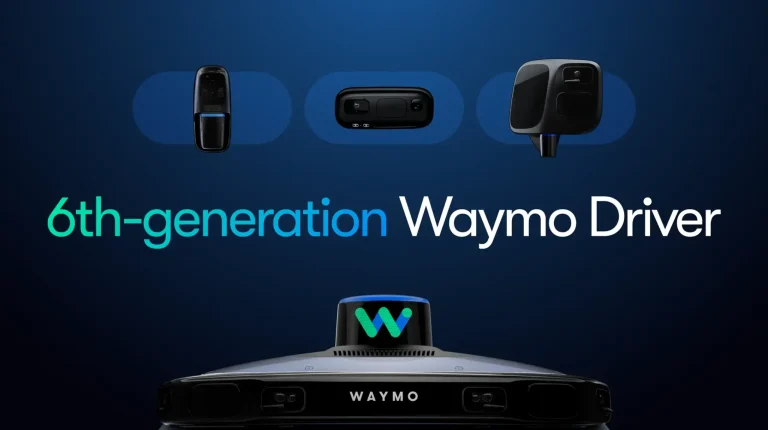
Waymo has announced that it will begin fully autonomous operations with its sixth-generation Driver, bringing its technology to more riders in more cities. The system is designed to reduce costs while maintaining safety standards. It supports long-term growth across multiple vehicle platforms, including operations in diverse environments such as extreme winter conditions.
The sixth-generation Waymo Driver builds on seven years of service, with over 320,000,000 fully autonomous kilometers across dense urban cores and expanding freeway networks. Drawing on this experience, the system uses a custom multimodal sensing suite comprising high-resolution cameras, advanced radar and lidar to handle rare, complex driving scenarios by combining diverse inputs for more reliable decision-making.
Vision system
The Waymo Driver’s vision system captures the same road details – such as traffic lights and signs – that humans do, but with greater awareness. It monitors multiple areas simultaneously and can detect critical details in challenging lighting, including deep shadows and bright glare from headlights or emergency lights.
The Waymo Driver uses a next-generation 17MP imager, providing high-resolution, thermally stable images with fewer cameras than lower-resolution sensors. This enables superior resolution, dynamic range and low-light sensitivity compared with standard automotive cameras. The system also features integrated cleaning to maintain visibility.
When camera views are limited, the Waymo Driver relies on lidar and radar to ensure reliable perception.
Lidar
Unlike cameras that rely on light reflected from the environment, lidar lights up its own way by using laser beams to paint a 3D picture,
Waymo’s sixth-generation lidar uses recent cost reductions in the industry, combined with custom chips and optics designed in California, to provide longer-range, higher-fidelity, more robust sensing at a cost optimized for expansion.
Short-range lidars complement the Waymo Driver’s cameras, providing precise distance measurements crucial for navigating urban situations and protecting vulnerable road users
Radar
Waymo’s imaging radar generates detailed maps that track object distance, speed and size in all lighting and weather conditions. Using increasingly sensitive and affordable radar chipsets, the system balances enhanced capability with cost-efficiency.
Building on the fifth-generation system, Waymo’s sixth-generation radar uses in-house algorithms and machine-learned models to improve performance in rain or snow, enhancing sensor fusion and optimizing data from all sensing components.
External audio receivers
The Waymo Driver uses external audio receivers (EARs) to detect sounds such as sirens and railroad crossings. Strategically placed around the perception dome, the EARs help the system localize sounds while minimizing wind noise, often identifying the direction of approaching emergency vehicles before they are visible.
In related news, FocalPoint Positioning to showcase S-GNSS Auto at Tech.AD Europe 2026