
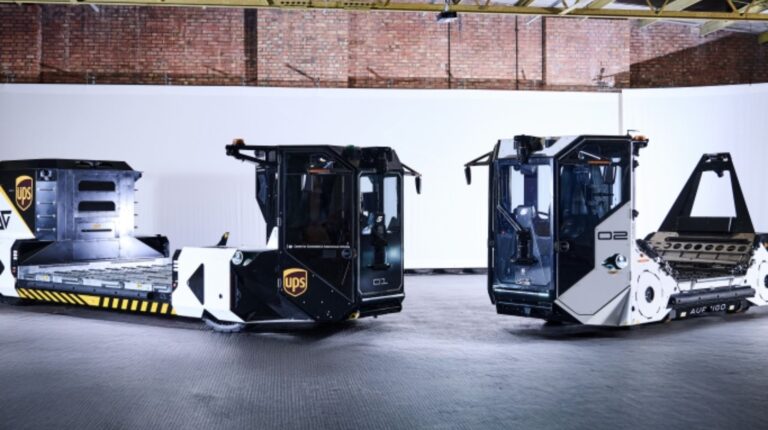
Aston University has joined forces with Aurrigo to develop artificial intelligence (AI) to improve its fleet’s efficiency, responsiveness and sustainability. As the number of autonomous vehicles used for baggage and cargo handling at airports continues to grow, managing these fleets becomes increasingly complex.
Traditionally, task allocation and scheduling have relied on centrally controlled systems overseen by human operators. They must interpret large volumes of real-time information (for example, battery level and location) and respond to frequent changes such as flight delays or gate reassignments. While effective at smaller scales, this approach can create decision bottlenecks and limit the ability of fleets to adapt quickly as operations expand.
Under the Knowledge Transfer Partnership (KTP), Aston University’s research team will develop algorithms that enable individual vehicles to make safe, informed decisions locally using real-time data on vehicle status, surroundings and their place in the wider network of autonomous vehicles (AVs).
As part of the KTP, the team will apply advanced AI techniques, including machine learning, to address challenges such as dynamic task allocation based on vehicle location, workload and battery status. The work will also focus on enabling communication and coordination between vehicles operated by different ground handlers, real-time movement planning to respond to disruptions such as flight delays or gate changes, and scalable task management as airports expand autonomous baggage handling fleets.
Aurrigo believes the KTP is an opportunity to investigate advanced fleet coordination methods that will lead to more efficient vehicle tasking, a reduced number of unnecessary journeys and lower emissions and fuel use. Simon Brewerton, chief technology officer at Aurrigo, said, “Our latest partnership with Aston University builds on the excellent outcomes obtained in previous KTP projects. The academic team brings exceptional technical expertise and a deep understanding of how to apply research to complex operational challenges.”
The Aston Centre for Artificial Intelligence Research and Application’s Dr Farzaneh Farhadi is the lead academic on the project. She added, “We want each vehicle to act more autonomously while still working as part of a fleet. By combining advanced techniques within AI and machine learning, our goal is to give vehicles the intelligence to cooperate and adapt – without waiting for human direction.”
In related news, bitsensing brings ADAS kit to the commercial vehicle sector