


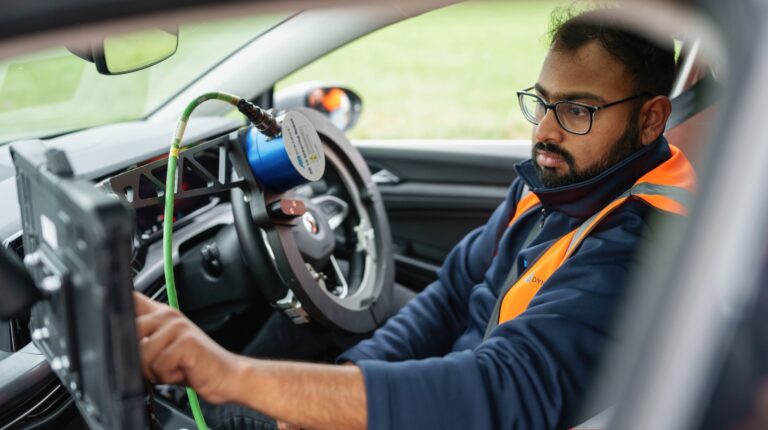
AB Dynamics’ Special Groups library supports the automation of more than 1,200 Euro NCAP tests under the updated 2026 protocols. The comprehensive set of preconfigured scenarios can be used for testing and validating industry-standard active safety and driver assistance systems. Automating the creation, calculation and validation of these tests is expected to save test teams months of development time.
Available as an optional upgrade in the latest version of the company’s Track Applications Suite, the update is the largest expansion of Euro NCAP scenarios in the library to date, and adds greater flexibility to support manufacturers’ growing testing requirements.
“The upcoming Euro NCAP 2026 protocols pose a significant challenge to test teams,” said Liam D’Souza, senior verification and validation engineer at AB Dynamics. “There are now more than 1,200 different test scenarios to contend with, not to mention the other regional NCAP and type approval protocols that test teams must also navigate. Designing, calculating and running these tests manually is incredibly labor-intensive. We have done all the hard work for our customers and are saving teams months in time.”
A key development in the Euro NCAP 2026 protocols is robustness testing. Unlike traditional fixed tests, robustness testing defines a base scenario but allows variations such as speed or offset to replicate the unpredictability of real-world driving. The special groups are fully configurable, enabling customers to extend testing beyond Euro NCAP requirements and perform their own robustness assessments.
The updated Special Groups now include challenging head-on collision scenarios, such as Car-to-Car Front Head-On Straight (CCFhos) and Car-to-Car Front Head-On Lane Change (CCFhol). The highest-speed tests reach a closing speed of 200km/h, making precise execution critical to ensure the validity of the test data.
“The head-on scenarios represent some of the riskiest tests manufacturers face,” added D’Souza. “Euro NCAP considers a 20km/h reduction in collision speed a pass. As a result, even successful tests can involve an aggressive collision and potentially cause damage to the test vehicle and equipment. Automating these tests helps to de-risk this scenario.”
In related news, Mobileye partners with US auto maker on hands-free driving