

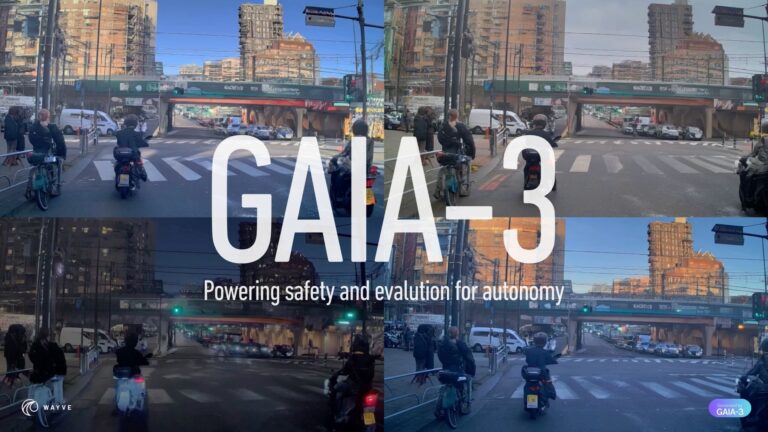
Wayve has launched GAIA-3, a new generation of its generative world model designed to accelerate the evaluation and validation of its autonomous driving AI. Building on the success of GAIA-2, Wayve says this new model is larger, more capable and purpose-built to enable meaningful evaluation of modern end-to-end driving systems.
Real-world safety hazards are rare and unsafe to reproduce, and current testing relies heavily on controlled test-track experiments that cannot capture the complexity of real-world environments. Generative world models address this challenge by simulating dynamic driving scenarios that allow AI models to learn, plan and make decisions safely and efficiently.
At 15 billion parameters, GAIA-3 is double the size of GAIA-2, with a video tokenizer that is also twice as large, enabling a more faithful representation of real-world physics and causality. It is pre-trained on 10 times more data, spanning multiple continents, vehicle types, environments and driving conditions. The model produces higher-fidelity video generations, with sharper visuals, more consistent lighting and richer texture detail, particularly in road signage.
GAIA-3 also introduces new evaluation modes, including safety-critical scenario generation to test what-if edge cases safely offline; embodiment transfer for consistent evaluation across different vehicle rigs; and controlled visual diversity for robustness testing under changing conditions.
According to the company, GAIA-3 also advances world modeling from visual synthesis to autonomy evaluation. It can generate structured, realistic scenes that support quantitative assessment of AI-driving behavior under many conditions. Early studies show that GAIA-3 simulated testing closely mirrors real-world driving results and has reduced synthetic-test rejection rates fivefold.
“With GAIA-3, Wayve is taking a bold step forward, advancing world modeling from visual synthesis to true autonomy evaluation and validation,” said Jamie Shotton, chief scientist at Wayve. “The model learns to recreate the dynamics of real-world environments – from everyday traffic to rare, safety-critical events. It will enable developers to measure, compare and accelerate progress toward safe and scalable autonomous driving.”
Wayve is also working in partnership with Warwick Manufacturing Group at the University of Warwick on DriveSafeSim, a UK government-funded project to validate the use of generative world models such as GAIA-3 in safety evaluation.
In related news, latest radar testing solution by dSPACE supports accurate ADAS validation