


Close Menu
ADAS & Autonomous Vehicle International
  • News
    • A-L
      • ADAS
      • AI & Sensor Fusion
      • Business
      • Connectivity
      • Cybersecurity
      • Expo
      • HMI
      • Last-mile delivery
      • Legislation & Standards
      • Localization/GNSS
    • M-Z
      • Mapping
      • Off-Highway
      • Robo-Taxis
      • Sensors
      • Shared Mobility
      • Safety
      • Simulation
      • Testing
      • Trucks
      • V2X
  • Features
  • Online Magazines
    • April 2026
    • January 2026
    • September 2025
    • April 2025
    • January 2025
    • September 2024
    • April 2024
    • January 2024
    • Subscribe
  • Opinion
  • Videos
  • Supplier Spotlight
  • Events
LinkedIn Facebook X (Twitter)
  • Automotive Interiors
  • Automotive Testing
  • Automotive Powertrain
  • Professional Motorsport
  • Tire Technology
  • Media Pack
LinkedIn Facebook
Subscribe
ADAS & Autonomous Vehicle International
  • News
      • ADAS
      • AI & Sensor Fusion
      • Business
      • Connectivity
      • Cybersecurity
      • Expo
      • HMI
      • Last-mile delivery
      • Legislation & Standards
      • Localization/GNSS
      • Mapping
      • Off-Highway
      • Robo-Taxis
      • Sensors
      • Shared Mobility
      • Safety
      • Simulation
      • Testing
      • Trucks
      • V2X
  • Features
  • Online Magazines
    1. April 2026
    2. January 2026
    3. September 2025
    4. April 2025
    5. January 2025
    6. September 2024
    7. April 2024
    8. January 2024
    9. Subscribe
    Featured
    April 28, 2026

    In this Issue – April 2026

    Online Magazines By Web Team
    Recent

    In this Issue – April 2026

    April 28, 2026

    In this Issue – January 2026

    November 27, 2025

    In this Issue – September 2025

    July 21, 2025
  • Opinion
  • Videos
  • Supplier Spotlight
  • Expo
  • Awards
    • About
    • 2025 winners
    • Judges
  • Webinars
LinkedIn Facebook
Subscribe
ADAS & Autonomous Vehicle International
Connectivity

Mobileye reveals road-ready AV for ride-hailing service

Lawrence ButcherBy Lawrence ButcherSeptember 9, 20214 Mins Read
Share
LinkedIn Twitter Facebook Email

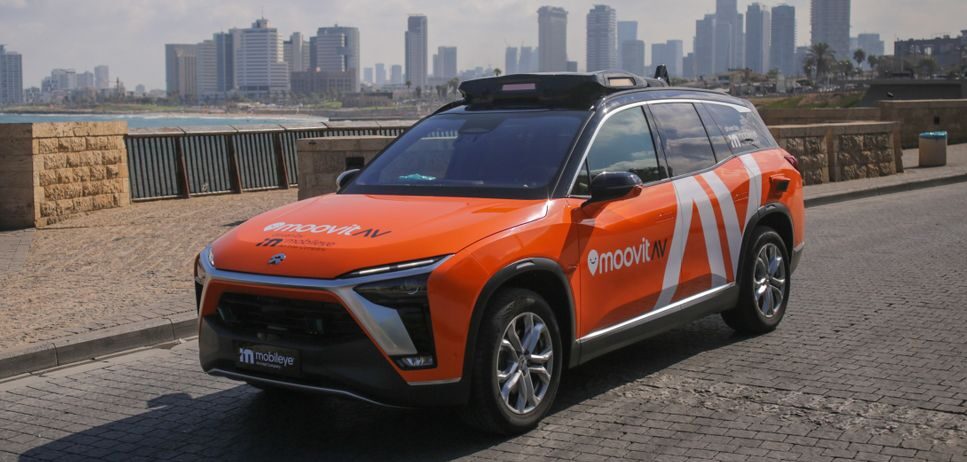
Intel’s Mobileye operation has unveiled a six-passenger, road-ready electric autonomous vehicle (AV) that will be used for commercial driverless ride-hailing services in Tel Aviv and Munich, starting in 2022, operating under the Moovit (which Intel acquired in 2020) and Sixt brands.

Mobileye says the AV was designed from the ground up to scale both economically and geographically while addressing the essential attributes of efficiency, accessibility and safety. It is the first AV to employ all features of the Mobileye trinity, including the True Redundancy sensing solution with cameras, radar and lidar sensors, Mobileye’s crowd-sourced Roadbook AV map, and Responsibility-Sensitive Safety (RSS) driving policy.

Currently, Mobileye is collaborating with supplier Veoneer on the platform’s Lidar sensors, but is targeting production of its own SoC (System on Chip) frequency modulation continuous-wave (FMCW) Lidar by 2025, which would provide additional velocity information not currently available with time-of-flight based systems. The company’s approach is to use a two-layer sensor setup, with vision based systems operating independently of Lidar and radar sensors, hence the True Redundancy moniker. According to the company, the vehicle shown here utilizes eleven cameras and an array of both Lidar and radar sensors, with data fed back to the in-house developed AVKIT58 compute system, which incorporates eight of its EyeQ 5 SoCs, for processing.

The company notes that the system can be used in a variety of vehicle types for the movement of goods and people, making it perhaps the most versatile self-driving solution available today. These multiple application options are also highlighted by Mobileye’s plans to collaborate with Schaeffler on a self-driving chassis that can be used in building autonomous shuttles.

In addition to using its in-house MaaS provider Moovit, Mobileye has also formed a partnership with Sixt on the long term integration of robotaxis into the latter’s ‘One’ platform, which combines products for ride hailing as well as car rental, car sharing and car subscriptions into a single app. Following recent German law changes to allow early rider tests of Mobileye vehicles, the first pilot robotaxi service is due to operate in Munich, ahead of a hoped for nationwide expansion.

“Germany has shown global leadership toward a future of autonomous mobility by expediting crucial AV legislation,” said Intel CEO Pat Gelsinger. “Our ability to begin robotaxi operations in Munich next year would not be possible without this new law.

Speaking at IAA (Munich) Mobility,Gelsinger also predicted that, thanks in part to the rise of AVs, semiconductors will account for more than 20% of the total premium vehicle bill of materials (BOM) by 2030. This represents a five-fold increase on 2019’s 4% figure and comes amid increasing demand for semiconductors generally.

In his first in-person keynote since taking the helm of the company in February, Gelsinger predicted the total addressable market (TAM) for automotive semiconductors will nearly double by the end of the decade to US$115bn, accounting for more than 11% of the entire silicon TAM. This trend is being driven by what Gelsinger called “the digitization of everything” and four superpowers – ubiquitous compute, pervasive connectivity, cloud-to-edge infrastructure and AI – that are permeating the automotive and mobility industries, and are set to only grow further with a move toward greater adoption of autonomous driving and ADAS.

Intel fellow and Mobileye VP of Automotive Standards Jack Weast also welcomed the recently completed draft of IEEE 2846. Expected to be an approved standard by the end of the year, IEEE 2846 will be the first AV safety standard to address the question, ‘How safe is safe enough?’ Weast explained that IEEE 2846 formalizes the reasonably foreseeable assumptions humans make every day and that AVs need to make in order to balance risk and usefulness. “IEEE 2846 will give regulators the essential tool they need to welcome AVs to roads everywhere,” said Weast.

Share. Twitter LinkedIn Facebook Email
Previous ArticleMobileye and Schaeffler partner on AD shuttle system
Next Article Honda announces Cruise AV testing program in Japan

Related Posts

AI & Sensor Fusion

Neusoft and AISpeech partner on AI-powered in-vehicle mobility companion using LLM technology

April 29, 20262 Mins Read
Robo-Taxis

Autonomous mobility partnership to deploy ID. Buzz fleet in US public transit to start in Orlando

April 24, 20263 Mins Read
ADAS

WRD 3.0 secures fourth consecutive win in China’s Urban Intelligent Driving Competition

April 21, 20262 Mins Read
Latest News

EDITOR’S PICKS: Presentation highlights ahead of this year’s Autonomous Vehicle Tech Expo

April 29, 2026

Neusoft and AISpeech partner on AI-powered in-vehicle mobility companion using LLM technology

April 29, 2026

Super Cruise use hits one billion miles across GM vehicles

April 29, 2026
FREE WEEKLY E-NEWSLETTER

Receive breaking stories and features in your inbox each week, for free


Enter your email address:


Our Social Channels
  • Facebook
  • LinkedIn
Getting in Touch
  • Free Weekly E-Newsletters
  • Meet the Editors
  • Contact Us
  • Media Pack
RELATED UKI TOPICS
  • Automotive Interiors
  • Automotive Testing
  • Automotive Powertrain
  • Professional Motorsport
  • Tire Technology
  • Media Pack
© 2026 UKi Media & Events a division of UKIP Media & Events Ltd
  • Terms and Conditions
  • Privacy Policy
  • Cookie Policy
  • Notice & Takedown Policy
  • Site FAQs

Type above and press Enter to search. Press Esc to cancel.

We use cookies on our website to give you the most relevant experience by remembering your preferences and repeat visits. By clicking “Accept”, you consent to the use of ALL the cookies.
Cookie settingsACCEPT
Manage consent

Privacy Overview

This website uses cookies to improve your experience while you navigate through the website. Out of these, the cookies that are categorized as necessary are stored on your browser as they are essential for the working of basic functionalities of the website. We also use third-party cookies that help us analyze and understand how you use this website. These cookies will be stored in your browser only with your consent. You also have the option to opt-out of these cookies. But opting out of some of these cookies may affect your browsing experience.
Necessary
Always Enabled
Necessary cookies are absolutely essential for the website to function properly. These cookies ensure basic functionalities and security features of the website, anonymously.
CookieDurationDescription
cookielawinfo-checbox-analytics11 monthsThis cookie is set by GDPR Cookie Consent plugin. The cookie is used to store the user consent for the cookies in the category "Analytics".
cookielawinfo-checbox-functional11 monthsThe cookie is set by GDPR cookie consent to record the user consent for the cookies in the category "Functional".
cookielawinfo-checbox-others11 monthsThis cookie is set by GDPR Cookie Consent plugin. The cookie is used to store the user consent for the cookies in the category "Other.
cookielawinfo-checkbox-necessary11 monthsThis cookie is set by GDPR Cookie Consent plugin. The cookies is used to store the user consent for the cookies in the category "Necessary".
cookielawinfo-checkbox-performance11 monthsThis cookie is set by GDPR Cookie Consent plugin. The cookie is used to store the user consent for the cookies in the category "Performance".
viewed_cookie_policy11 monthsThe cookie is set by the GDPR Cookie Consent plugin and is used to store whether or not user has consented to the use of cookies. It does not store any personal data.
SAVE & ACCEPT