


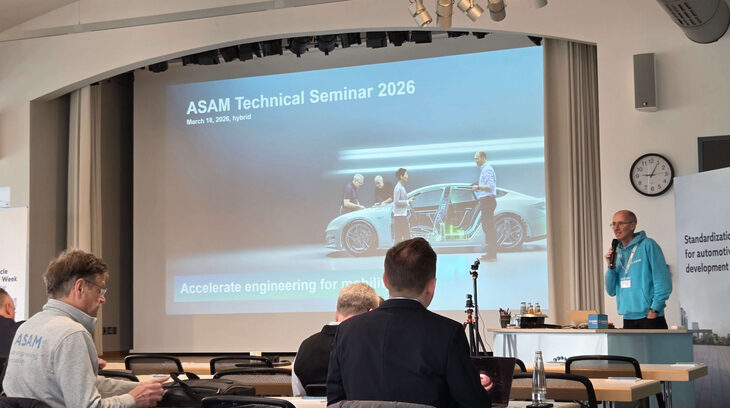
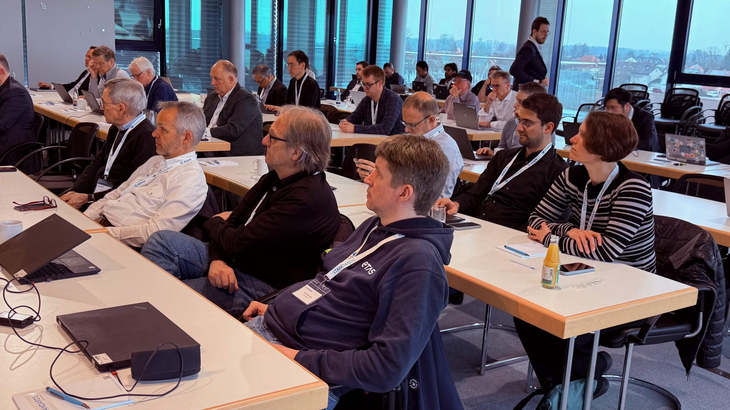
ASAM’s 2026 Technical Seminar took place on March 18 in Munich, Germany, and offered insight into automotive standardization amid rapid technological change.
The agenda covered simulation, data management, diagnostics and test automation, with discussions underscoring interoperability, simulation credibility and data‑centric development. These themes emerged across sessions on ASAM standards OpenDrive, OpenScenario, OSI, ODS, SOVD, XIL, OTX, CMP, and digital‑twin integration through the Asset Administration Shell (AAS).
Cross-standard harmonization and the need to align toolchains across domains, suppliers and development stages remain priorities, with speakers citing inconsistent interpretations of ASAM specifications as a cause of fragmentation. Updates included co‑simulation workflows, higher‑fidelity OpenX modeling, interoperable data management, modular measurement architectures, digital‑twin concepts, ODD taxonomies and simulation‑quality assessment.
Regional updates and roadmap
Updates from ASAM’s ambassadors in China, Korea, Japan and the USA were shared by CATARC technical director Bolin Zhou, IVH CEO Daeoh Kang and ASAM Japan representative Yoshiaki Shoi. Priorities included co-simulation and merging standards in China; sensor simulation and ASAM SOVD in Japan; and study groups in South Korea supporting global application of standards, such as ASAM OpenDrive.
BMW IT specialist Michael Schwarzbach outlined the 2026 Technical Steering Committee roadmap, highlighting ODD-based testing, collaboration improvements, harmonized standards and a common ontology.
 OpenX updates
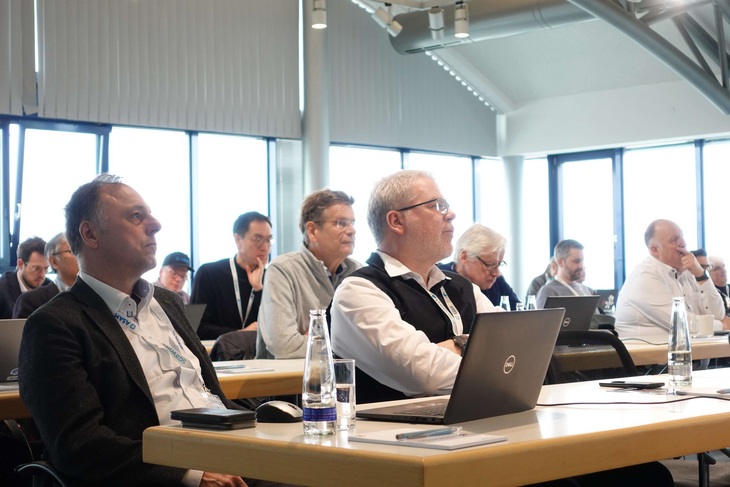
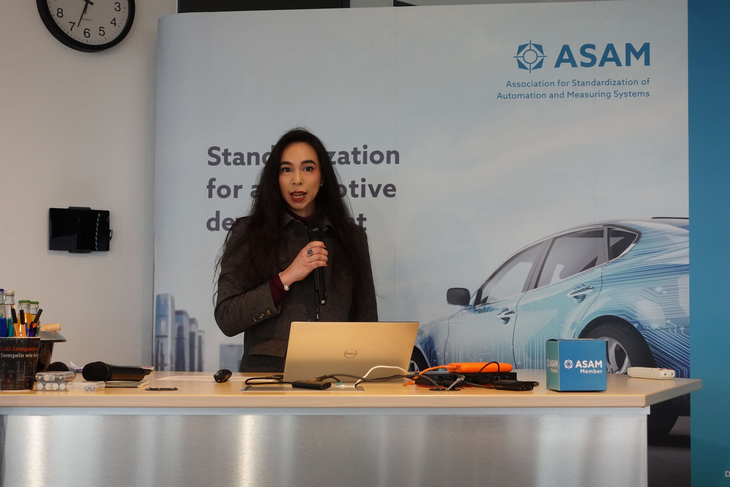
ASAM technology managers Ahmed Sadek and Yash Shah (below) presented ASAM OpenX updates. Previous OpenX models defined traffic participants independently, creating toolchain inconsistencies. New concepts for ASAM’s simulation standards include combining ASAM OpenDrive with the Quantifying Simulation Quality (QSQ) initiative, and ASAM OSI adding high-fidelity sensor simulation support, such as spectral irradiance and radar waveforms. “No standard is developed in a silo,” Shah said. “We think feature-based, then collect standards experts for harmonization.”
Simulation integration
Clemens Linnhoff, founder and CTO at Persival, demonstrated co-simulation between Scenario Player and Sensor Model, with all assets linked in ASAM OpenScenario as a single source of truth.
ASAM ODS, MDF, CMP and digital twins
Technica Engineering technical fellow and head of media relations Lars Völker outlined Capture Module Protocol (ASAM CMP) improvements. “Before 2022, in‑vehicle DAQ was vendor‑specific and non‑modular. CMP 1.0 introduced modular DAQ and support for heterogeneous technologies. New use cases support raw Ethernet and define message transport across the vehicle system. Scaling HIL and test setups enables an elastic measurement infrastructure.”
Using slides from the Industrial Digital Twin Association (IDTA), Stefan Romainczyk, senior product manager at Peak Solution, said, “Today’s digital twins are proprietary and one lifecycle element, whereas future twins have a complete lifecycle with efficient scaling. With ASAM ODS, AAS can create a comprehensive data profile for digital twins – standardized interoperability improves predictive maintenance, time and cost.”
SDV diagnostics updates
Following the launch of ASAM SOVD 1.2 in February with 29 global OEMs and suppliers, Vector Informatik manager Tobias Weidmann presented at the seminar the latest activities in the development of the standard. ISO 17978-4 Remote Access covers how to access vehicle information via authorization and defining the access path; possibilities include functional communication, new access methods to log information via a streaming interface, and large file handling via third-party service providers.
ODD taxonomy and AV deployment
Andreas Richter (below), engineering program manager – Operational Design Domains, Volkswagen Commercial Vehicles, outlined ASAM OpenODD implementation within MOIA America, VW’s autonomous‑mobility affiliate, formerly known as ADMT. VW Commercial Vehicles is the first group brand to introduce SAE Level 4 autonomous driving using the ID Buzz platform with integrated third‑party automated‑driving systems. Testing is underway in Hamburg and Munich in Germany, Oslo in Norway, and in Austin, Texas.
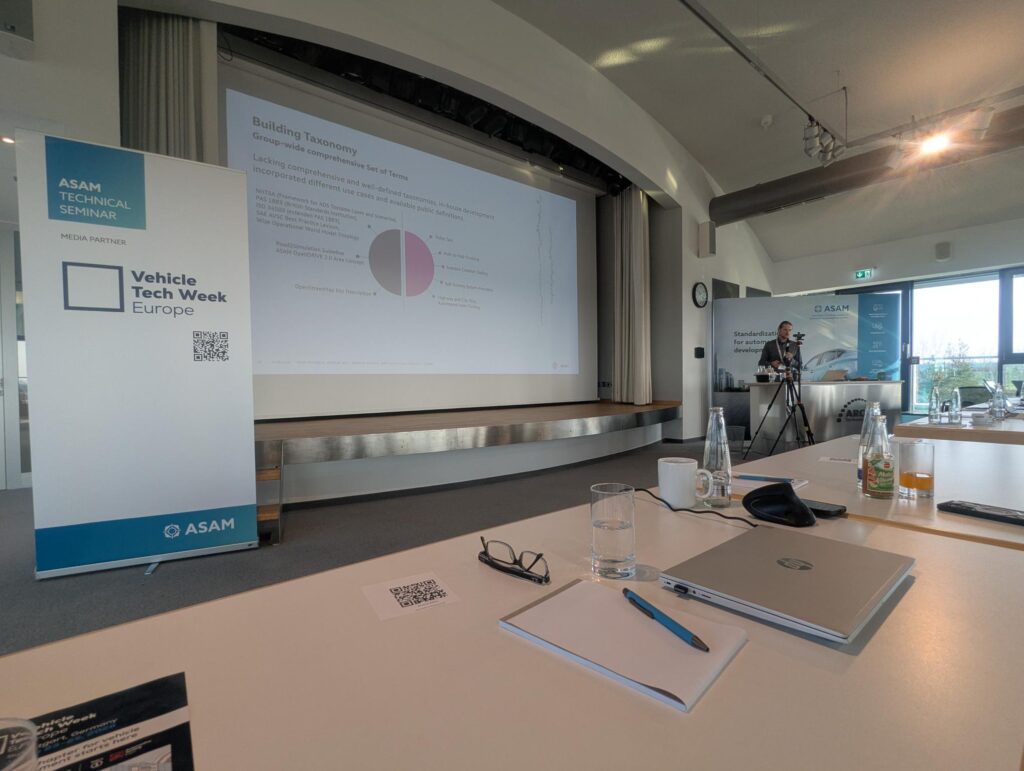 Richter noted that the industry is not always clear on ‘ODD’, ‘taxonomy’, ‘service area’ and ‘scenarios’. “To bring autonomous driving to life, we have to agree on the same terms,” he said, calling for ODD definitions that are unambiguously readable by humans and machines, supported by geodata analysis and enterprise‑ready tools for ODD and scenario management.
“ASAM OpenODD offers a taxonomy-agnostic, modular model to represent ODDs in different technical formats, [and] support development, storage and processing in a machine and human-readable way,” he explained. “Originally intended for scenario-based testing, ODD definition is now required in more process steps for developing, testing, approving and operating ADS. The ODD as a single point of knowledge ensures OEMs and authorities share definitions.”
VW’s internal elaborated ODD taxonomy demonstrates how modular definitions support understanding across organizations and regulators. The ODD management toolchain validates taxonomies and module definitions, supports multilingual concepts and connects to scenario‑creation and requirements‑management workflows. Using STIEF (scenario-accompanied, text-base, iterative evaluation of automated driving functions), engineers can preload scenario definitions via natural‑language inputs, while geodata analysis identifies new operational areas and generates challenging test routes.
 Simulation credibility
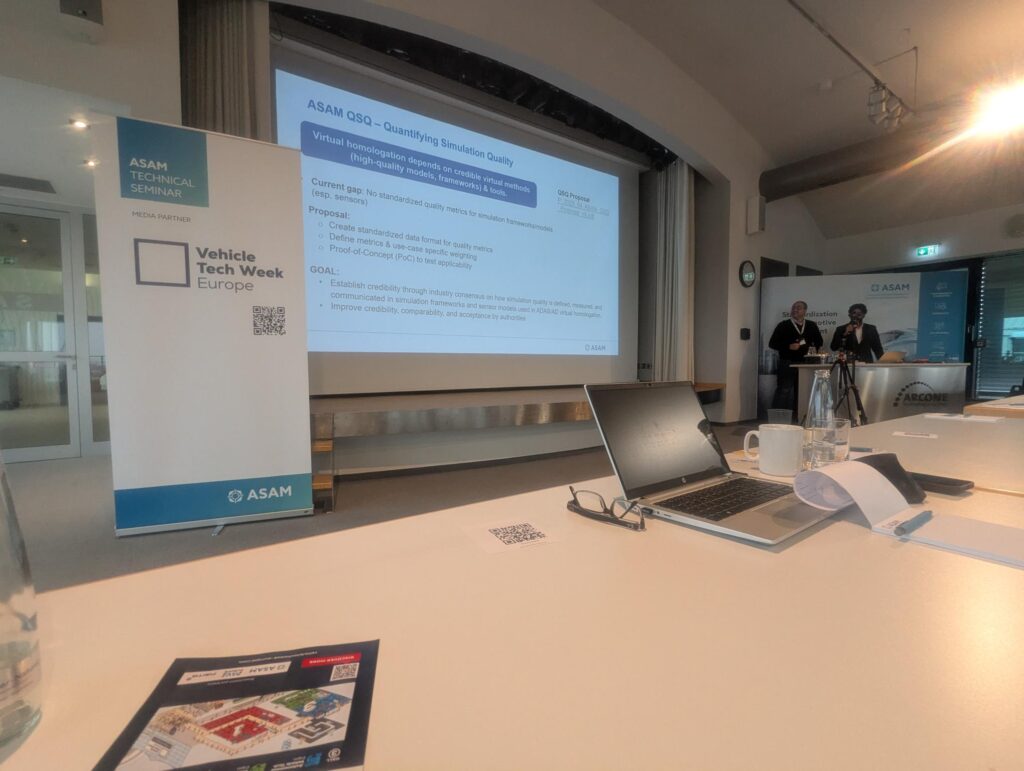
In an ASAM QSQ update, Automotive Artificial Intelligence’s general manager Basit Khan highlighted the challenge of trusting simulation for virtual homologation.
“No standardized quality metrics exist for simulation frameworks, especially ADAS/AD sensors,” he said. “Many contributors – OEMs, suppliers, research and tool vendors – have different priorities and vocabulary. Through working groups spanning use cases, camera, lidar, radar and vehicle dynamics, our goal is to drive cross-sector innovation by building a unified standard upon proven, existing components. By harmonizing established concepts, we can create a practical framework that ensures simulation reliability without reinventing the wheel.”
Research and collaborations
Fraunhofer IOSB’s research group leader Jens Ziehn reported on how ASAM helps scale R&D results, for example where ASAM’s OpenDrive, OpenLabel and OpenScenario are used to deliver interoperability and reusable data across diverse acquisition sources in the AVEAS Brave10K project to scale automated driving in public transportation.
SAE’s Ed Straub outlined ASAM’s collaboration with SAE J3259 (ODD taxonomy), while ASCS’s Alexander Walsh emphasized the complementary role of ASCS and ASAM in simulation, AI and HPC.
Industry collaboration continues at Vehicle Tech Week Europe
Vehicle Tech Week Europe, represented by ADAS & Autonomous Vehicle International, Automotive Testing Technology International and Automotive Interiors World, served as ASAM’s media partner.
Launching this June in Stuttgart, Germany, the three-day ‘festival of engineering’ will unite the full vehicle‑technology ecosystem – from EV and battery testing to autonomous‑vehicle development, UX/HMI, materials engineering and in‑cabin innovation – creating cross‑disciplinary value at a time when the industry faces intense technological and regulatory pressure.
ASAM is an association partner of Vehicle Tech Week Europe, and Yash Shah and Andreas Richter will continue their discussions about ASAM OpenX evolution and ODDs at the event.
Learn about Vehicle Tech Week’s partnerships here.
Find out more about ASAM’s International Conference, which will take place on November 4 and 5, 2026.
Related news, First speakers announced for this year’s Autonomous Vehicle Tech Expo Conference