


Close Menu
ADAS & Autonomous Vehicle International
  • News
    • A-L
      • ADAS
      • AI & Sensor Fusion
      • Business
      • Connectivity
      • Cybersecurity
      • Expo
      • HMI
      • Last-mile delivery
      • Legislation & Standards
      • Localization/GNSS
    • M-Z
      • Mapping
      • Off-Highway
      • Robo-Taxis
      • Sensors
      • Shared Mobility
      • Safety
      • Simulation
      • Testing
      • Trucks
      • V2X
  • Features
  • Online Magazines
    • April 2026
    • January 2026
    • September 2025
    • April 2025
    • January 2025
    • September 2024
    • April 2024
    • January 2024
    • Subscribe
  • Opinion
  • Videos
  • Supplier Spotlight
  • Events
LinkedIn Facebook X (Twitter)
  • Automotive Interiors
  • Automotive Testing
  • Automotive Powertrain
  • Professional Motorsport
  • Tire Technology
  • Media Pack
LinkedIn Facebook
Subscribe
ADAS & Autonomous Vehicle International
  • News
      • ADAS
      • AI & Sensor Fusion
      • Business
      • Connectivity
      • Cybersecurity
      • Expo
      • HMI
      • Last-mile delivery
      • Legislation & Standards
      • Localization/GNSS
      • Mapping
      • Off-Highway
      • Robo-Taxis
      • Sensors
      • Shared Mobility
      • Safety
      • Simulation
      • Testing
      • Trucks
      • V2X
  • Features
  • Online Magazines
    1. April 2026
    2. January 2026
    3. September 2025
    4. April 2025
    5. January 2025
    6. September 2024
    7. April 2024
    8. January 2024
    9. Subscribe
    Featured
    April 28, 2026

    In this Issue – April 2026

    Online Magazines By Web Team
    Recent

    In this Issue – April 2026

    April 28, 2026

    In this Issue – January 2026

    November 27, 2025

    In this Issue – September 2025

    July 21, 2025
  • Opinion
  • Videos
  • Supplier Spotlight
  • Expo
  • Awards
    • About
    • 2025 winners
    • Judges
  • Webinars
LinkedIn Facebook
Subscribe
ADAS & Autonomous Vehicle International
AI & Sensor Fusion

Nvidia Research achieves first place in autonomous driving challenge

Callum Brook-JonesBy Callum Brook-JonesJune 22, 20232 Mins Read
Share
LinkedIn Twitter Facebook Email

Nvidia has won the 3D Occupancy Prediction Challenge for autonomous driving development set out by the Computer Vision and Pattern Recognition Conference (CVPR), in Vancouver, Canada.

The 3D Occupancy Prediction Challenge required teams to develop algorithms which used only camera input for inference. Teams could use open-source data sets and models to facilitate the exploration of data-driven algorithms and large-scale models. Additionally, CVPR provided a baseline sandbox for the latest state-of-the-art 3D occupancy prediction algorithms in real-world scenarios. The competition saw more than 400 submissions from nearly 150 international teams.

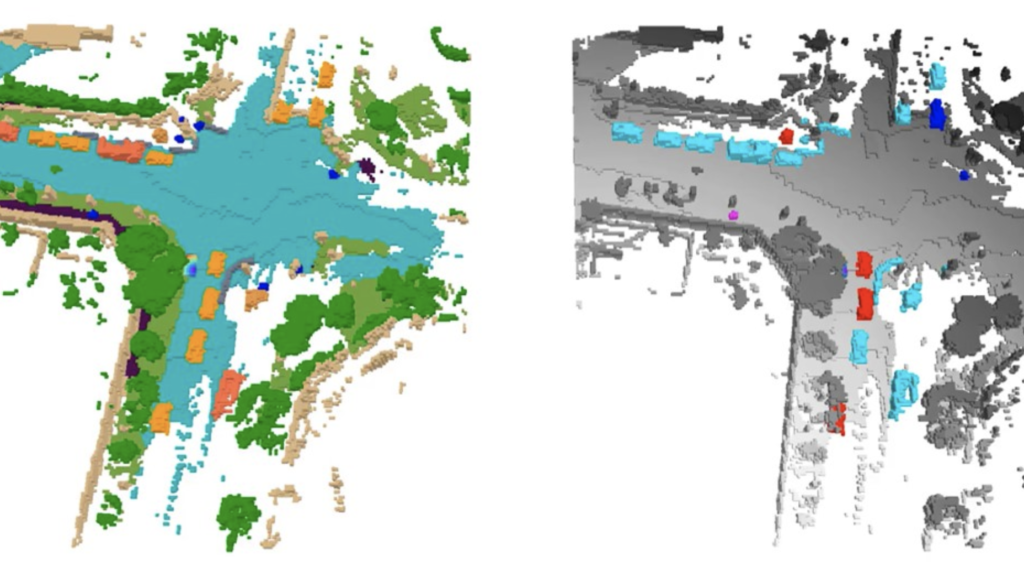
3D occupancy prediction is described as the process of forecasting the status of each voxel in a scene or each datapoint on a 3D bird’s-eye-view grid. Voxels are identified as free, occupied or unknown. 3D occupancy grid prediction is vital when working on the development of safe and reliable self-driving systems as it provides an array of information to AV planning and control stacks which utilize neural networks and transformer models, enabled by the Nvidia Drive platform.

“Nvidia’s winning solution features two important AV advancements,” said Zhiding Yu, senior research scientist for learning and perception at Nvidia. “It demonstrates a state-of-the-art model design that yields excellent bird’s-eye-view perception. It also shows the effectiveness of visual foundation models with up to 1 billion parameters and large-scale pre-training in 3D occupancy prediction.”

While conventional 3D object detection is a core task in AV perception, it has its limitations, such as lack of expressiveness. This means the bounding boxes may not represent sufficient real-world information. Furthermore, this also requires defining taxonomies and ground truths for all possible objects – including rare real-world occurrences, such as objects which may have fallen off a vehicle. 3D occupancy prediction, however, delivers rich information about the surrounding world and environment to a self-driving vehicle’s planning stack – a necessity for end-to-end autonomous driving.

For more Nvidia news, click here.

Share. Twitter LinkedIn Facebook Email
Previous ArticlePoliMOVE wins Indy Autonomous Challenge at Autodromo Nazionale di Monza
Next Article Kodiak Robotics to equip Loadsmith trucks with autonomous driving solution

Related Posts

AI & Sensor Fusion

Univrses AI technology integrated into Pirelli Cyber Tyre platform

May 8, 20263 Mins Read
AI & Sensor Fusion

Neusoft and AISpeech partner on AI-powered in-vehicle mobility companion using LLM technology

April 29, 20262 Mins Read
AI & Sensor Fusion

Pony.ai debuts new autonomous driving compute platform

April 27, 20263 Mins Read
Latest News

California approves Nuro for autonomous robotaxi pilot testing

May 12, 2026

Cloud-based Bosch system advances predictive road hazard detection across global fleets

May 11, 2026

DMV updates AV rules to improve accountability, first responder coordination and public safety

May 11, 2026
FREE WEEKLY E-NEWSLETTER

Receive breaking stories and features in your inbox each week, for free


Enter your email address:


Our Social Channels
  • Facebook
  • LinkedIn
Getting in Touch
  • Free Weekly E-Newsletters
  • Meet the Editors
  • Contact Us
  • Media Pack
RELATED UKI TOPICS
  • Automotive Interiors
  • Automotive Testing
  • Automotive Powertrain
  • Professional Motorsport
  • Tire Technology
  • Media Pack
© 2026 UKi Media & Events a division of UKIP Media & Events Ltd
  • Terms and Conditions
  • Privacy Policy
  • Cookie Policy
  • Notice & Takedown Policy
  • Site FAQs

Type above and press Enter to search. Press Esc to cancel.

We use cookies on our website to give you the most relevant experience by remembering your preferences and repeat visits. By clicking “Accept”, you consent to the use of ALL the cookies.
Cookie settingsACCEPT
Manage consent

Privacy Overview

This website uses cookies to improve your experience while you navigate through the website. Out of these, the cookies that are categorized as necessary are stored on your browser as they are essential for the working of basic functionalities of the website. We also use third-party cookies that help us analyze and understand how you use this website. These cookies will be stored in your browser only with your consent. You also have the option to opt-out of these cookies. But opting out of some of these cookies may affect your browsing experience.
Necessary
Always Enabled
Necessary cookies are absolutely essential for the website to function properly. These cookies ensure basic functionalities and security features of the website, anonymously.
CookieDurationDescription
cookielawinfo-checbox-analytics11 monthsThis cookie is set by GDPR Cookie Consent plugin. The cookie is used to store the user consent for the cookies in the category "Analytics".
cookielawinfo-checbox-functional11 monthsThe cookie is set by GDPR cookie consent to record the user consent for the cookies in the category "Functional".
cookielawinfo-checbox-others11 monthsThis cookie is set by GDPR Cookie Consent plugin. The cookie is used to store the user consent for the cookies in the category "Other.
cookielawinfo-checkbox-necessary11 monthsThis cookie is set by GDPR Cookie Consent plugin. The cookies is used to store the user consent for the cookies in the category "Necessary".
cookielawinfo-checkbox-performance11 monthsThis cookie is set by GDPR Cookie Consent plugin. The cookie is used to store the user consent for the cookies in the category "Performance".
viewed_cookie_policy11 monthsThe cookie is set by the GDPR Cookie Consent plugin and is used to store whether or not user has consented to the use of cookies. It does not store any personal data.
SAVE & ACCEPT