


ADAS & Autonomous Vehicle International
  • News
    • A-L
      • ADAS
      • AI & Sensor Fusion
      • Business
      • Connectivity
      • Cybersecurity
      • Expo
      • HMI
      • Last-mile delivery
      • Legislation & Standards
      • Localization/GNSS
    • M-Z
      • Mapping
      • Off-Highway
      • Robo-Taxis
      • Sensors
      • Shared Mobility
      • Safety
      • Simulation
      • Testing
      • Trucks
      • V2X
  • Features
  • Online Magazines
    • January 2026
    • September 2025
    • April 2025
    • January 2025
    • September 2024
    • April 2024
    • January 2024
    • Subscribe
  • Opinion
  • Videos
  • Supplier Spotlight
  • Events
LinkedIn Facebook Twitter
  • Automotive Interiors
  • Automotive Testing
  • Automotive Powertrain
  • Professional Motorsport
  • Tire Technology
  • Media Pack
LinkedIn Facebook
Subscribe
ADAS & Autonomous Vehicle International
  • News
      • ADAS
      • AI & Sensor Fusion
      • Business
      • Connectivity
      • Cybersecurity
      • Expo
      • HMI
      • Last-mile delivery
      • Legislation & Standards
      • Localization/GNSS
      • Mapping
      • Off-Highway
      • Robo-Taxis
      • Sensors
      • Shared Mobility
      • Safety
      • Simulation
      • Testing
      • Trucks
      • V2X
  • Features
  • Online Magazines
    1. January 2026
    2. September 2025
    3. April 2025
    4. January 2025
    5. September 2024
    6. April 2024
    7. January 2024
    8. Subscribe
    Featured
    November 27, 2025

    In this Issue – January 2026

    Online Magazines By Hazel King
    Recent

    In this Issue – January 2026

    November 27, 2025

    In this Issue – September 2025

    July 21, 2025

    In this Issue – April 2025

    April 15, 2025
  • Opinion
  • Videos
  • Supplier Spotlight
  • Expo
  • Awards
    • About
    • 2025 winners
    • Judges
  • Webinars
LinkedIn Facebook
Subscribe
ADAS & Autonomous Vehicle International
AI & Sensor Fusion

Nvidia launches Alpmayo family to accelerate safe, reasoning-based autonomous vehicle development

Anthony JamesBy Anthony JamesJanuary 8, 20265 Mins Read
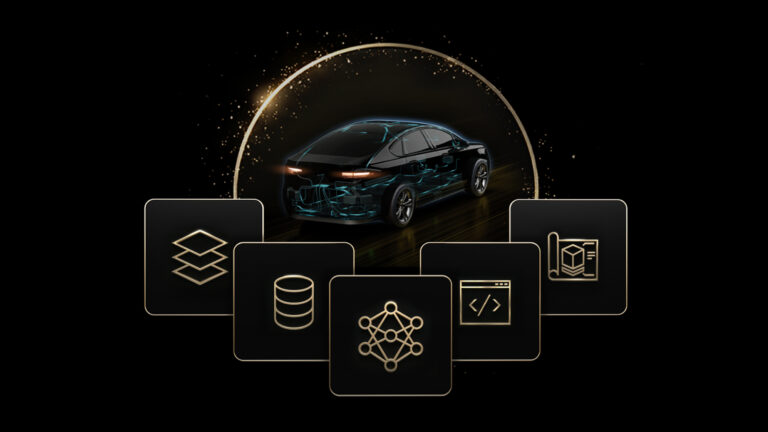
Graphic with a range of shapes and symbols illustrating the Nvidia Alpamayo family of open-source AI models and tools, with a black vehicle at the top of the image
Share
LinkedIn Twitter Facebook Email

A new suite of open AI models, simulation tools and datasets designed to better tackle the rare, complex ‘long tail’ scenarios that can be encountered during autonomous driving has been launched by Nvidia at CES 2026. Its new Alpamayo family introduces chain-of-thought, reasoning-based vision language action (VLA) models that bring humanlike thinking to AV decision-making. These systems can think through novel or rare scenarios step by step, improving driving capability and explainability – which is critical to scaling trust and safety in intelligent vehicles – and are underpinned by the Nvidia Halos safety system.

The company says traditional AV architectures that separate perception and planning can limit scalability when new or unusual situations arise. Recent advances in end-to-end learning have made significant progress, but overcoming these long-tail edge cases requires models that can safely reason about cause and effect, especially when situations fall outside a model’s training experience.

“The ChatGPT moment for physical AI is here – when machines begin to understand, reason and act in the real world,” said Jensen Huang, founder and CEO of Nvidia. “Robotaxis are among the first to benefit. Alpamayo brings reasoning to autonomous vehicles, allowing them to think through rare scenarios, drive safely in complex environments and explain their driving decisions – it’s the foundation for safe, scalable autonomy.”

Reasoning‑based autonomy

Alpamayo integrates three foundational pillars – open models, simulation frameworks and datasets – into a cohesive, open ecosystem that any automotive developer or research team can build upon. Rather than running directly in-vehicle, Alpamayo models serve as large-scale teacher models that developers can fine-tune and distill into the backbones of their complete AV stacks.

At CES, Nvidia is releasing:

  • Alpamayo 1: The industry’s first chain-of-thought reasoning VLA model designed for the AV research community, now on Hugging Face. With a 10-billion-parameter architecture, Alpamayo 1 uses video input to generate trajectories alongside reasoning traces, showing the logic behind each decision. Developers can adapt Alpamayo 1 into smaller runtime models for vehicle development, or use it as a foundation for AV development tools such as reasoning-based evaluators and auto-labeling systems. Alpamayo 1 provides open model weights and open-source inferencing scripts. Future models in the family will feature larger parameter counts, more detailed reasoning capabilities, more input and output flexibility, and options for commercial usage.
  • AlpaSim: A fully open‑source, end-to-end simulation framework for high‑fidelity AV development, available on GitHub. It provides realistic sensor modeling, configurable traffic dynamics and scalable closed‑loop testing environments, enabling rapid validation and policy refinement.
  • Physical AI open datasets: Nvidia offers the most diverse large-scale, open dataset for AV that contains 1,700+ hours of driving data collected across the widest range of geographies and conditions, covering rare and complex real-world edge cases essential for advancing reasoning architectures. These datasets are available on Hugging Face.

Together, these tools enable a self-reinforcing development loop for reasoning-based AV stacks.

Industry response

Mobility leaders and industry experts, including Lucid, JLR, Uber and Berkeley DeepDrive, are showing interest in Alpamayo to develop reasoning-based AV stacks that will enable Level 4 autonomy.

“The shift toward physical AI highlights the growing need for AI systems that can reason about real-world behavior, not just process data,” said Kay Stepper, VP of ADAS and autonomous driving at Lucid Motors. “Advanced simulation environments, rich datasets and reasoning models are important elements of the evolution.”

“Open, transparent AI development is essential to advancing autonomous mobility responsibly,” said Thomas Müller, executive director of product engineering at JLR. “By open-sourcing models like Alpamayo, Nvidia is helping to accelerate innovation across the autonomous driving ecosystem, giving developers and researchers new tools to tackle complex real-world scenarios safely.”

“Handling long-tail and unpredictable driving scenarios is one of the defining challenges of autonomy,” said Sarfraz Maredia, global head of autonomous mobility and delivery at Uber. “Alpamayo creates exciting new opportunities for the industry to accelerate physical AI, improve transparency and increase safe Level 4 deployments.”

“Alpamayo 1 enables vehicles to interpret complex environments, anticipate novel situations and make safe decisions, even in scenarios not previously encountered,” said Owen Chen, senior principal analyst of S&P Global. “The model’s open-source nature accelerates industry-wide innovation, allowing partners to adapt and refine the technology for their unique needs.”

“The launch of the Alpamayo portfolio represents a major leap forward for the research community,” said Wei Zhan, co-director of Berkeley DeepDrive. “Nvidia’s decision to make this openly available is transformative as its access and capabilities will enable us to train at unprecedented scale – giving us the flexibility and resources needed to push autonomous driving into the mainstream.”

Beyond Alpamayo, developers can tap into Nvidia’s rich library of tools and models, including from the Nvidia Cosmos and Nvidia Omniverse platforms. Developers can fine-tune model releases on proprietary fleet data, integrate them into the Nvidia Drive Hyperion architecture built with Nvidia Drive AGX Thor accelerated compute, and validate performance in simulation before commercial deployment.

In related news, Ambarella unveils DevZone for rapid edge AI development

Share. Twitter LinkedIn Facebook Email
Previous ArticleAmbarella unveils DevZone for rapid edge AI development
Next Article Innoviz and Vueron create AI-powered toolset for automated lidar data annotation and training

Related Posts

ADAS

Innoviz and Vueron create AI-powered toolset for automated lidar data annotation and training

January 8, 20262 Mins Read
ADAS

Seeing Machines creates Future Mobility Group to support global autonomous driving programs

January 5, 20262 Mins Read
AI & Sensor Fusion

Nvidia Jetson-powered AI compute platform to launch at CES 2026

December 18, 20252 Mins Read
Latest News

Innoviz and Vueron create AI-powered toolset for automated lidar data annotation and training

January 8, 2026

Nvidia launches Alpmayo family to accelerate safe, reasoning-based autonomous vehicle development

January 8, 2026

Ambarella unveils DevZone for rapid edge AI development

January 6, 2026
FREE WEEKLY E-NEWSLETTER

Receive breaking stories and features in your inbox each week, for free


Enter your email address:


Our Social Channels
  • Facebook
  • LinkedIn
Getting in Touch
  • Free Weekly E-Newsletters
  • Meet the Editors
  • Contact Us
  • Media Pack
RELATED UKI TOPICS
  • Automotive Interiors
  • Automotive Testing
  • Automotive Powertrain
  • Professional Motorsport
  • Tire Technology
  • Media Pack
© 2025 UKi Media & Events a division of UKIP Media & Events Ltd
  • Terms and Conditions
  • Privacy Policy
  • Cookie Policy
  • Notice & Takedown Policy
  • Site FAQs

Type above and press Enter to search. Press Esc to cancel.

We use cookies on our website to give you the most relevant experience by remembering your preferences and repeat visits. By clicking “Accept”, you consent to the use of ALL the cookies.
Cookie settingsACCEPT
Manage consent

Privacy Overview

This website uses cookies to improve your experience while you navigate through the website. Out of these, the cookies that are categorized as necessary are stored on your browser as they are essential for the working of basic functionalities of the website. We also use third-party cookies that help us analyze and understand how you use this website. These cookies will be stored in your browser only with your consent. You also have the option to opt-out of these cookies. But opting out of some of these cookies may affect your browsing experience.
Necessary
Always Enabled

Necessary cookies are absolutely essential for the website to function properly. These cookies ensure basic functionalities and security features of the website, anonymously.

CookieDurationDescription
cookielawinfo-checbox-analytics11 monthsThis cookie is set by GDPR Cookie Consent plugin. The cookie is used to store the user consent for the cookies in the category "Analytics".
cookielawinfo-checbox-functional11 monthsThe cookie is set by GDPR cookie consent to record the user consent for the cookies in the category "Functional".
cookielawinfo-checbox-others11 monthsThis cookie is set by GDPR Cookie Consent plugin. The cookie is used to store the user consent for the cookies in the category "Other.
cookielawinfo-checkbox-necessary11 monthsThis cookie is set by GDPR Cookie Consent plugin. The cookies is used to store the user consent for the cookies in the category "Necessary".
cookielawinfo-checkbox-performance11 monthsThis cookie is set by GDPR Cookie Consent plugin. The cookie is used to store the user consent for the cookies in the category "Performance".
viewed_cookie_policy11 monthsThe cookie is set by the GDPR Cookie Consent plugin and is used to store whether or not user has consented to the use of cookies. It does not store any personal data.

Functional

Functional cookies help to perform certain functionalities like sharing the content of the website on social media platforms, collect feedbacks, and other third-party features.

Performance

Performance cookies are used to understand and analyze the key performance indexes of the website which helps in delivering a better user experience for the visitors.

Analytics

Analytical cookies are used to understand how visitors interact with the website. These cookies help provide information on metrics the number of visitors, bounce rate, traffic source, etc.

Advertisement

Advertisement cookies are used to provide visitors with relevant ads and marketing campaigns. These cookies track visitors across websites and collect information to provide customized ads.

Others

Other uncategorized cookies are those that are being analyzed and have not been classified into a category as yet.

SAVE & ACCEPT