


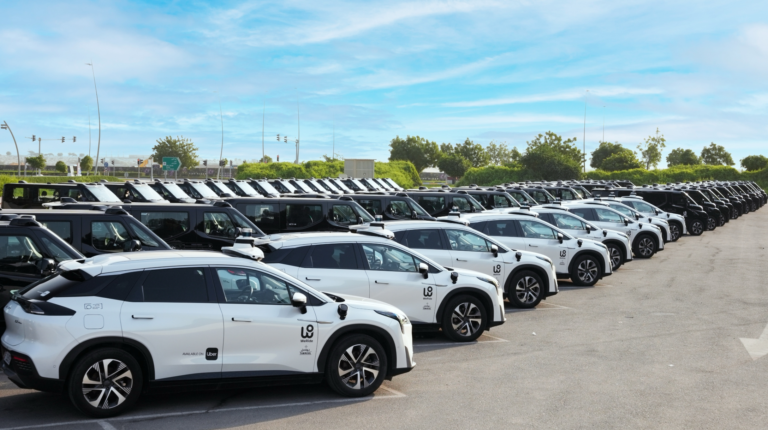
In October 2025, Uber and WeRide launched their first publicly accessible autonomous robotaxi service in Saudi Arabia, debuting in Riyadh with routes connecting Roshn Front and Princess Noura University. Ryan Zhan, WeRide’s regional general manager for the Middle East and Africa, outlines the company’s strategic approach, the evolving regulatory landscape and the major challenges of deploying autonomous driving technology at scale on public roads.
How has WeRide worked with the Transport General Authority (TGA) and other local partners to bring autonomous vehicles to public roads, and what lessons can be drawn from this collaboration (and applied to models in different cities/countries)?
WeRide and Uber began offering Robotaxi passenger rides on the Uber platform in Riyadh, supported by the Transport General Authority (TGA). Before launching passenger services in July 2025, WeRide’s Robotaxi became the first in Saudi Arabia to secure an autonomous driving permit. As the first AV technology company to complete the Transport General Authority’s Regulatory Sandbox for Autonomous Vehicle Piloting, WeRide underwent a rigorous approval process involving extensive testing, assessments and technology validation conducted alongside multiple government agencies to ensure the highest standards of safety and performance. That same month, Saleh bin Nasser Al-Jasser, minister of transport and logistics services and chairman of the TGA, inaugurated the Initial Operational Phase of Autonomous Vehicles in Riyadh.
At WeRide, we have learned that each market has its own unique requirements and considerations when deploying autonomous vehicles.
The company has found that the most effective global approach is early collaboration between governments and industry, combining shared infrastructure with clear deployment standards. It works with local governments and partners to deploy its products to fit local demands. WeRide welcomes clear government regulation and frameworks for the safe deployment of autonomous vehicles and is open to collaborating with governments to provide insights from an AV provider’s perspective.
Meanwhile, industry players need to avoid malicious competition and work together to upgrade the technology to ensure maximum safety and advance the deployment.
What were the key technical challenges in adapting WeRide’s autonomous systems to Riyadh’s unique road layouts, weather and traffic behaviors, and how was local data used to fine-tune performance?
WeRide’s technologies are proven globally, with testing and operations in over 30 cities across 11 countries. We are the first and only technology company whose products have received autonomous driving permits in eight markets: China, Saudi Arabia, the UAE, Singapore, France, Belgium, Switzerland and the US.
The company uses WeRide One, the first universal autonomous driving technology platform designed to operate 24/7 in urban environments and all weather conditions. All of our products are powered by WeRide One, enabling deployment across mobility, logistics and sanitation use cases on the open road.
In July 2025, WeRide announced the launch of its latest HPC 3.0 platform, developed with Lenovo Car Computing and powered by two of the latest Nvidia DGX Thor X chips. HPC 3.0 is the most powerful computing platform available for supporting L4 autonomy, delivering up to 2,000 TOPS of AI compute. It is certified to meet global automotive safety standards as well as VOCs environmental standards, making it suitable for deployment in international markets, including Saudi Arabia. The platform is currently deployed in WeRide’s Robotaxi GXR model.
Currently, each Robotaxi includes a vehicle operator. What is the roadmap toward fully driverless operations, and how soon could this transition occur in Saudi Arabia? What technical milestones must be achieved before WeRide can deploy fully driverless Robotaxis in the kingdom?
WeRide has proven fully driverless technologies. The company has been operating fully driverless Robotaxi commercial services in Guangzhou and Beijing. In Abu Dhabi, we have been testing fully driverless Robotaxis without a safety driver since Q2 2025. On November 14, 2025, we were granted a permit to conduct fully driverless Robotaxi commercial operations in Abu Dhabi, the UAE, marking it as one of the first companies to receive a city-level commercial permit for Level 4 autonomous driving issued outside the US.
Commercial driverless rides in Saudi Arabia will be introduced progressively, subject to regulatory approval.
What are the biggest regulatory hurdles WeRide faces when deploying autonomous vehicles internationally, and how does the company work with authorities to accelerate safe adoption?
Each market has different requirements for the deployment of autonomous vehicles, so WeRide works closely with local governments and partners to deploy its products to fit local demands.
As the first and only technology company whose products have received autonomous driving permits in eight markets globally, WeRide has built a strong track record with regulators and government agencies, and these permits showcase their trust in our technology.
A key example is in Saudi Arabia, where our Robotaxi obtained Saudi Arabia’s first Robotaxi autonomous driving permit and became the first AV technology company whose Robotaxi completed the TGA’s Regulatory Sandbox for AV Piloting. The approval process was conducted in coordination with multiple government agencies to ensure the highest standards of safety and performance.
Meanwhile, we’re open to partnerships with industry leaders to accelerate the commercialization of autonomous vehicles and technology development. Our partnership with Uber has witnessed significant progress in deploying WeRide Robotaxis on Uber platforms in Abu Dhabi, Dubai and Riyadh, showcasing how joint innovation and regulatory engagement can bring autonomous mobility to the public quickly and safely.
Does WeRide see the need for a global framework or standardized regulations for autonomous vehicles, and how would such a framework influence technology development and international expansion?
We are closely following industry developments in global markets. We understand that some regions have different permit systems with multi-jurisdictional regulatory frameworks.
We welcome clear government regulation and frameworks for the safe deployment of autonomous vehicles. We are open to collaborating with global governments to provide insights from an AV provider’s perspective, including guidance on regulatory frameworks, to help support the responsible growth of AVs.
Explore: Hanbyul Seo, LG Electronics discusses Non-Terrestrial Network (NTN) communications for V2X