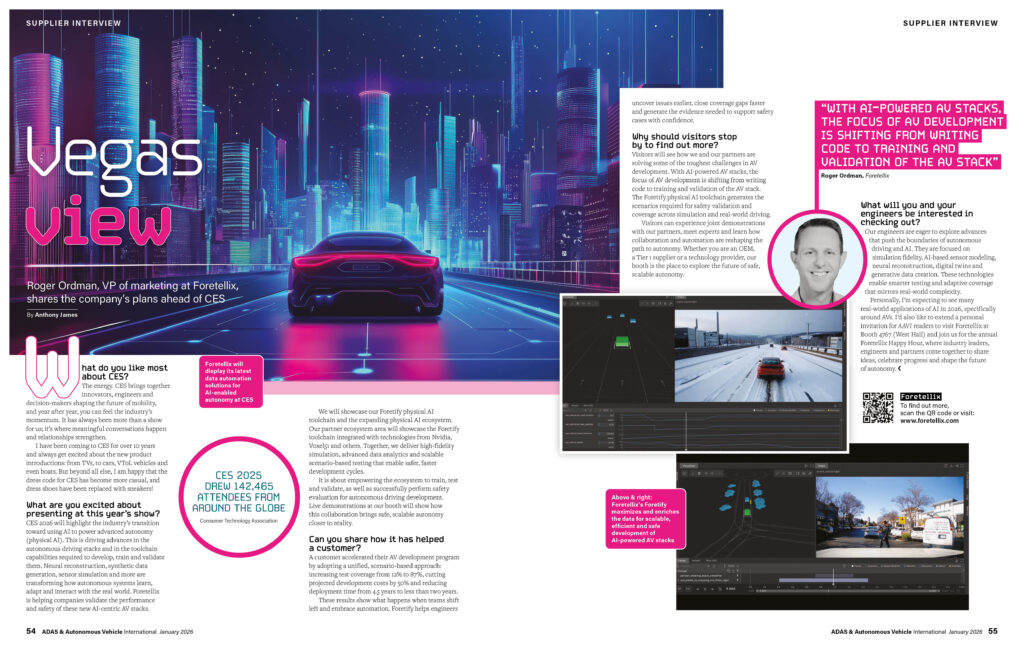



 Roger Ordman, VP of marketing at Foretellix, which provides data automation for AI-powered autonomy, shares the company’s plans ahead of this year’s CES (January 6-9, 2026), in an exclusive interview first published in the January 2026 issue of ADAS & Autonomous Vehicle International magazine.
What do you like most about CES?
The energy. CES brings together innovators, engineers and decision-makers shaping the future of mobility, and year after year, you can feel the industry’s momentum. It has always been more than a show for us; it’s where meaningful conversations happen and relationships strengthen.
I have been coming to CES for over 10 years and always get excited about the new product introductions: from TVs, to cars, VToL vehicles and even boats. But beyond all else, I am happy that the dress code for CES has become more casual, and dress shoes have been replaced with sneakers!
What are you excited about presenting at this year’s show?
CES 2026 will highlight the industry’s transition toward using AI to power advanced autonomy (physical AI). This is driving advances in the autonomous driving stacks and in the toolchain capabilities required to develop, train and validate them. Neural reconstruction, synthetic data generation, sensor simulation and more are transforming how autonomous systems learn, adapt and interact with the real world. Foretellix is helping companies validate the performance and safety of these new AI-centric AV stacks.
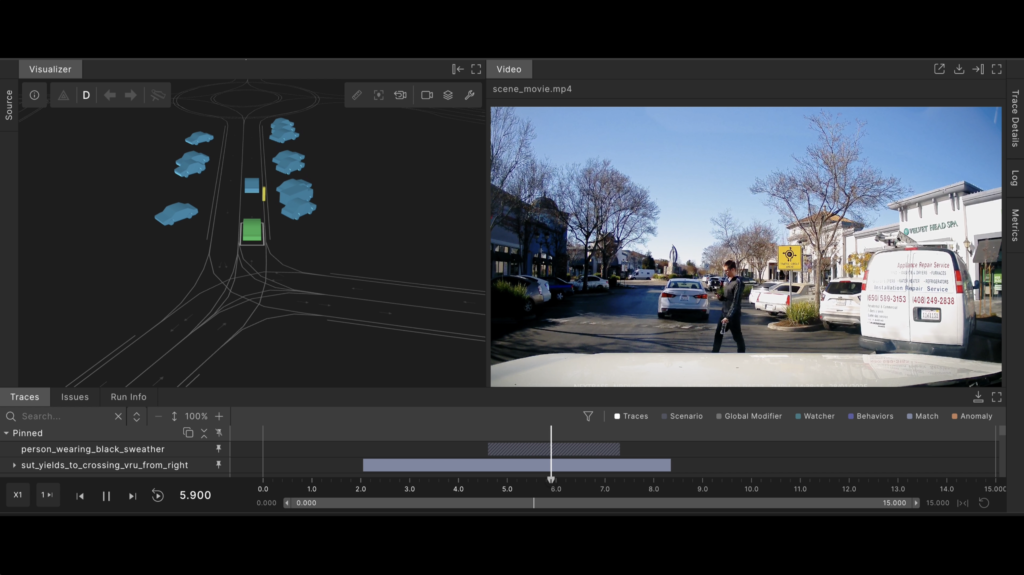
We will showcase our Foretify physical AI toolchain and the expanding physical AI ecosystem. Our partner ecosystem area will showcase the Foretify toolchain integrated with technologies from Nvidia, Voxel51 and others. Together, we deliver high-fidelity simulation, advanced data analytics and scalable scenario-based testing that enable safer, faster development cycles.
It is about empowering the ecosystem to train, test and validate, as well as successfully perform safety evaluation for autonomous driving development. Live demonstrations at our booth will show how this collaboration brings safe, scalable autonomy closer to reality.
Can you share how it has helped a customer?
A customer accelerated their AV development program by adopting a unified, scenario-based approach: increasing test coverage from 12% to 87%, cutting projected development costs by 50% and reducing deployment time from 4.5 years to less than two years.
These results show what happens when teams shift left and embrace automation. Foretify helps engineers uncover issues earlier, close coverage gaps faster and generate the evidence needed to support safety cases with confidence.
Why should visitors stop by to find out more?
Visitors will see how we and our partners are solving some of the toughest challenges in AV development. With AI-powered AV stacks, the focus of AV development is shifting from writing code to training and validation of the AV stack.
The Foretify physical AI toolchain generates the scenarios required for safety validation and coverage across simulation and real-world driving.
Visitors can experience joint demonstrations with our partners, meet experts and learn how collaboration and automation are reshaping the path to autonomy. Whether you are an OEM, a Tier 1 supplier or a technology provider, our booth is the place to explore the future of safe, scalable autonomy.
What will you and your engineers be interested in checking out?
Our engineers are eager to explore advances that push the boundaries of autonomous driving and AI. They are focused on simulation fidelity, AI-based sensor modeling, neural reconstruction, digital twins and generative data creation. These technologies enable smarter testing and adaptive coverage that mirrors real-world complexity.
Personally, I’m expecting to see many real-world applications of AI in 2026, specifically around AVs. I’d also like to extend a personal invitation for AAVI readers to visit Foretellix at Booth 4767 (West Hall) and join us for the annual Foretellix Happy Hour, where industry leaders, engineers and partners come together to share ideas, celebrate progress and shape the future of autonomy.